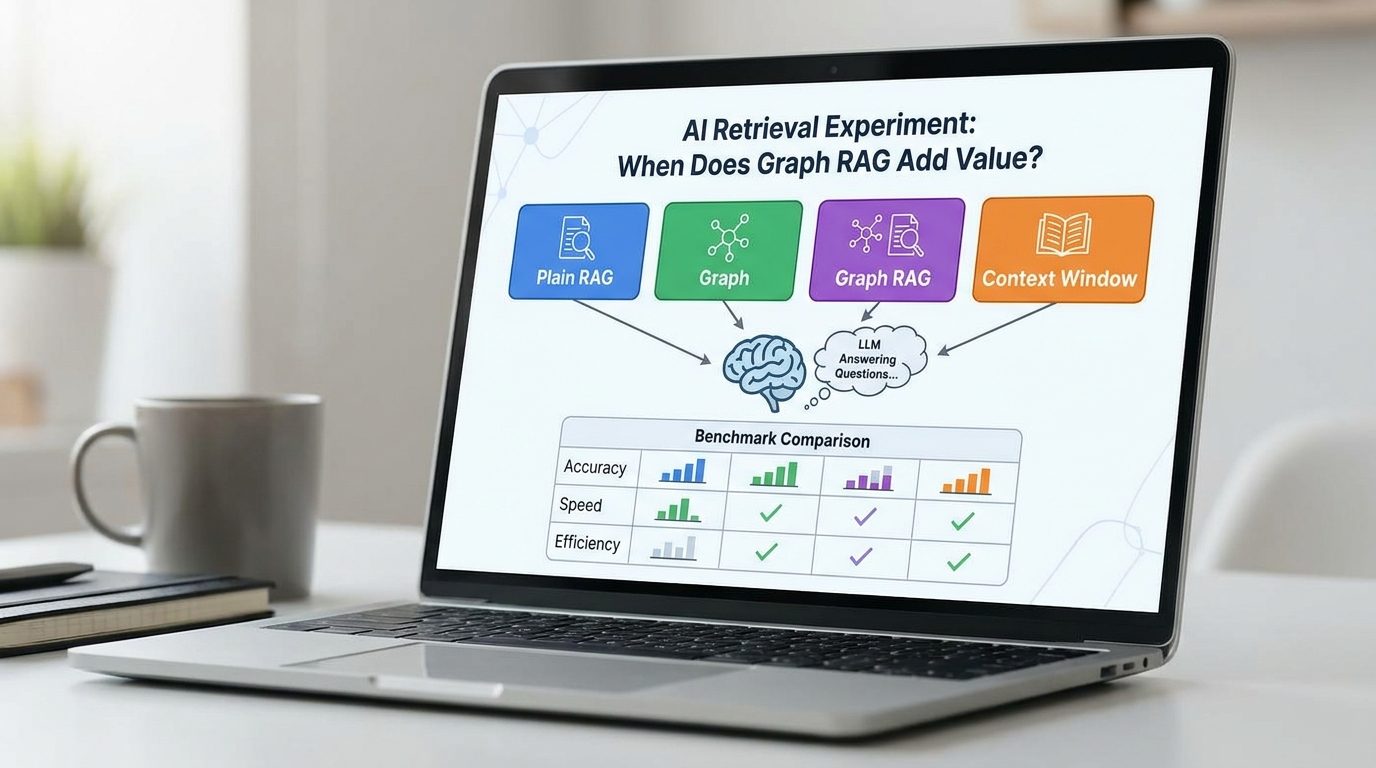
The hands-on experiment that pitted plain RAG against graph RAG and a full-context approach on a laptop is exactly the kind of grounded testing we need more of. Too often, the conversation around retrieval architectures drifts into abstract praise for complexity, with graph databases positioned as the obvious upgrade. Building four systems, benchmarking them against identical documents and questions, and reporting the trade-offs without cheerleading is refreshing. It also resonates with a theme we have been tracking: the real barrier to adoption is rarely capability, but rather knowing which tool fits the actual job. This is the same spirit behind our piece on verifying an AI's understanding during tax season, where the focus was on practical checks rather than assumed competence.
What makes this experiment so valuable is that it cuts through the noise around graph RAG's supposed superiority. The results suggest that for many everyday queries, plain RAG or even a frontier model's context window can deliver comparable answers with far less infrastructure overhead. That is not an argument against graph RAG, it is an argument for intentionality. If you are dealing with highly interconnected data, where relationships matter as much as the content itself, graph structures likely earn their keep. But if your questions are mostly fact-based or require synthesis across a few documents, the added complexity may slow you down without improving accuracy. This mirrors what we have observed in the shifting expectations for AI and ML roles, where the industry is slowly realizing that broader software engineering skills often matter more than niche algorithmic expertise.
The practical takeaway here is not to abandon graph RAG, but to stop treating it as a default. Start with your actual questions and your data's shape. If you cannot articulate why a graph structure would change the answer, it probably will not. The experiment is a reminder that the best architecture is the one that solves the problem with the least moving parts, not the one that sounds most impressive on paper. This aligns with the exploration of how LLMs navigate token space, where the structure of input is just one variable among many. We would tell any reader asking about graph RAG: run your own small benchmark first. The laptop is powerful enough, and the results will be far more useful than any vendor's white paper. Watch for the moment when your queries start requiring multi-hop reasoning across distinct entities; that is the signal that graph structures might actually pay off.