bottlenecks
Beyond Market Intelligence keeps bottlenecks in one place: 7 stories so far. The section currently leads with “Replace Python bottlenecks with Rust through incremental, low-risk refactoring.”, “Simulation-Driven Testing Turns AI Agents from Demo to Production Reality”, and “Stream S3 data to GPU at 60 Gbps with zero reprocessing needed”. Rewriting a working system from scratch is a gamble most teams don't need to take. Most AI agents never leave the demo room. Acme AI is the next-generation, AI-powered spreadsheet platform built to replace Excel and redefine how analysts, data scientists, and enterprise teams work… The list below is every bottlenecks story on Beyond Market Intelligence, newest first.

Replace Python bottlenecks with Rust through incremental, low-risk refactoring.
Rewriting a working system from scratch is a gamble most teams don't need to take. Lily Mara's approach is more pragmatic: swap out Python bottlenecks for Rust piece by piece, using PyO3 to bridge the gap. The result is function-level speedups that compound, without the operational weight of microservices. It's a measured path to performance that respects what already works. For more on how databases handle similar pressure, our piece on Perplexity's CobbleDB migration offers a useful parallel.

Simulation-Driven Testing Turns AI Agents from Demo to Production Reality
Most AI agents never leave the demo room. Zhou Yu sees that bottleneck clearly, and she's addressing it head-on with simulation-driven testing that tackles compliance and reliability before deployment. Her work with Columbia and Arklex AI uses synthetic user personas and trajectory entropy to stress-test multi-turn agents, catching edge cases that typically slip through. It's practical, human-centered engineering. For a deeper look at how AI moves beyond the lab, explore our related piece on unlocking enterprise potential.

Stream S3 data to GPU at 60 Gbps with zero reprocessing needed
Onur Satici's work with Vortex tackles a bottleneck that quietly throttles machine learning teams: the long, slow road from object storage to GPU. Instead of asking users to reprocess or reformat their data upfront, Vortex applies cascading lightweight encodings and layout-based segment pruning. The result is a direct pipeline that moves S3 data to GPUs at up to 60 Gbps, with zero-copy memory handling. It's a practical, open-source approach to a problem that has too long been accepted as inevitable.

Explore how Triton simplifies custom GPU kernels for faster ML workflows.
Triton shines when the bottleneck is memory-bound rather than compute-bound. Operations like element-wise fusions, reductions, or attention that stall on data movement are prime candidates for custom kernels. Harshwardhan Fartale's early-access book gets this right: it focuses on practical acceleration, not theory. If you're stuck waiting on a stubborn layer, that's the signal to explore. For those new to kernel work, pairing this with broader distributed training context, like the guide on LLM training algorithms, helps frame when optimization matters most.

From Fab to Token: Navigating AI's Infrastructure Bottlenecks
The gap between chip fabrication and the models that actually process data is where the real pressure builds. Jordan Nanos unpacks this friction in his presentation, connecting semiconductor constraints and data center buildout to the tokenomics that shape AI software today. What stands out is the focus on real-world GPU scaling and benchmark performance, grounding the conversation in practical reality. It is a useful perspective for anyone navigating this market, and it pairs well with our guide on distributed training algorithms.
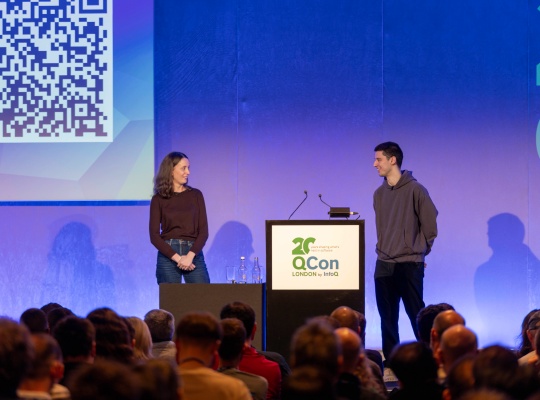
How Spotify's AI Agent Standardizes Thousands of Code Repositories
When Spotify set out to rewrite its entire codebase, it didn't just throw more engineers at the problem. Jo Kelly-Fenton and Aleksandar Mitic built Honk, an AI coding agent designed to handle fleet-wide migrations that would otherwise stall for months. Their approach decouples CI verification from the agent itself, a smart move that prevents bottlenecks before they start. It's a practical, forward-thinking look at how to standardize thousands of repositories without losing momentum.

Move Beyond Token Metrics to True AI-Driven Delivery
Engineering leaders are pouring money into AI, yet software delivery often stalls. That's the puzzle Lizzie Matusov, CEO of Quotient, tackles head-on. She argues that soaring spend misses the mark when teams chase vanity metrics like token usage. Instead, she introduces a research-backed maturity framework to help leaders identify where adoption gets stuck, align their organizations, and focus on real bottlenecks across the development lifecycle. It's a grounded, practical call to move from activity to measurable outcomes.