cloud
cloud at Beyond Market Intelligence is a file of 41 stories. The newest of them: “Perplexity brings its AI agent home, running locally on Nvidia hardware you own”, “Grok Bot brings persistent AI agents to work across your digital tools”, and “Agentic traffic demands a smarter approach to autoscaling.”. Perplexity is taking its agentic platform off the cloud and onto your desk, and the move feels less like a stunt and more like a quiet turning point. SpaceXAI's Grok Bot is a bold step toward making autonomous agents a practical reality. Acme AI is the next-generation, AI-powered spreadsheet platform built to replace Excel and redefine how analysts, data scientists, and enterprise teams work… The list below is every cloud story on Beyond Market Intelligence, newest first.

Perplexity brings its AI agent home, running locally on Nvidia hardware you own
Perplexity is taking its agentic platform off the cloud and onto your desk, and the move feels less like a stunt and more like a quiet turning point. Portable Computer, built with Nvidia, runs entirely on hardware you already own, starting with the DGX Spark and RTX-equipped Linux machines. The pitch is refreshingly direct: your files, your models, and your work stay local, and the credit counter stays parked at zero.

Grok Bot brings persistent AI agents to work across your digital tools
SpaceXAI's Grok Bot is a bold step toward making autonomous agents a practical reality. By running persistent AI systems on dedicated cloud computers, it lets these bots handle websites, apps, and inboxes without constant hand-holding. That's the kind of shift that turns busywork into background noise. We're encouraged by how this pushes beyond static tools into active problem-solving. If you're curious about how such agents move from retrieving information to taking action, our guide, "Bridging Retrieval and Action," pairs nicely with this launch.

Agentic traffic demands a smarter approach to autoscaling.
Autoscaling used to follow a predictable arc: manual rules, then reactive thresholds, then predictive models. Each generation assumed traffic patterns that resemble human behavior. Autonomous agents broke that assumption. They spawn bursts of activity that don't map to any prior curve, so two decades of capacity planning logic stops holding up. We need a new mental model, one that treats agentic bursts as first-class citizens rather than anomalies. It's a sharp, practical read.
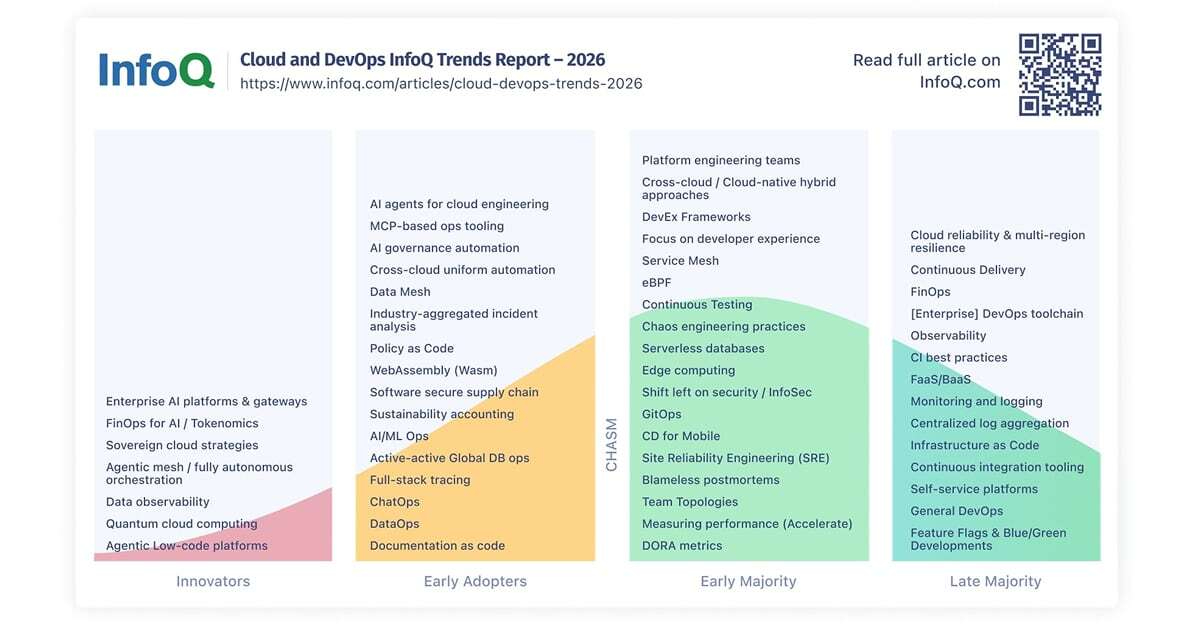
Explore the 2026 cloud and DevOps trends shaping your data future
The cloud and DevOps landscape is shifting under our feet, and the InfoQ editorial team is here to map it out. In this podcast, Daniel Bryant, Matt Saunders, Shweta Vohra, Steef-Jan Wiggers, and Mark Silvester sit down to dissect the annual Trends Report for 2026. They get raw and honest about AI, resilience, platforms, FinOps, and sovereignty. If you're feeling constrained by traditional infrastructure thinking, this conversation empowers you to explore what is actually next.

Enterprises invest in AI speed but lack visibility into infrastructure costs.
Enterprises are running AI in production, 66% have live workloads, and 29% operate at scale, yet fewer than half can rigorously track what that compute costs. Performance and GPU availability now outrank total cost of ownership, and reliability outranks price. That trade makes sense under pressure, but it leaves the weakest satisfaction score on value for money, a judgment made without full instrumentation. The next dollar targets specialized clouds and new silicon, even as current GPU utilization stalls near half.

CosmosEscape exposed a shared responsibility gap that demands closer attention.
Wiz Research uncovered CosmosEscape, a chain that slipped past Azure Cosmos DB's Gremlin sandbox and reached a platform-wide key with read and write access to every database on the service. Microsoft closed the entry point in two days, yet the key lingered until July 2026. That timeline raises real questions about shared responsibility and what removing it actually cost. Practitioners are right to debate whether the rearchitecture delivered enough value, or if faster key rotation should have been table stakes.

Your Network Was Built for Yesterday. AI Demands More.
Traditional networks were built for predictable traffic. AI shatters that assumption. Continuous inference, agent-to-agent communication, and real-time data pipelines generate unpredictable, always-on demand that legacy architectures simply cannot handle. As AI moves from pilot to operational backbone, the network becomes the critical control layer determining performance, reliability, and cost. The gap between ambition and reality is stark: most enterprises still operate on transitional infrastructure. Treating the network as passive plumbing turns AI investments into a gamble. It must evolve into an intelligent, programmable platform.

Anthropic invests $10 billion in Volta to reshape AI infrastructure
Anthropic is placing another massive bet on infrastructure, reportedly signing a $10 billion deal with AI cloud startup Volta. This move extends a partnership spree that signals something important: the company is serious about scaling its models without relying on a single provider. It's a pragmatic play, not a flashy one. For users, it means more resilience and capacity behind the tools they depend on.

Superblocks embeds into AWS private clouds, decoupling apps from models
AWS's decision to let Superblocks embed its vibe-coding platform directly into customer private clouds is a meaningful step toward loosening the grip of locked-in models. It's not just about convenience; it's about giving teams more control over where and how their applications run. That's the kind of flexibility that turns experimentation into real workflow. If you're exploring how AI tools are reshaping infrastructure, our piece on Nscale's recent funding offers another angle on where this momentum is heading.
Okta strengthens identity security for the age of AI agents
Okta's acquisition of Permiso, reportedly around $200 million, signals a clear response to a growing reality: not every identity in your cloud is human. As AI agents multiply, so do the access points that demand scrutiny. This move gives Okta serious threat detection for non-human identities, which is precisely where enterprise security gets tricky. It's a practical step, not a flashy one. For teams wrestling with agent sprawl, this feels timely.
Mastering the Technical Interview for Live Streaming Deployments
Preparing for a live streaming deployment interview means more than rehearsing answers. You need to show how CI/CD pipelines, Kafka, and Kubernetes work together under real-time pressure. For an MLE role, focus on fault tolerance, scaling, and data consistency. Your friend should map out scenarios around message replay, pod autoscaling, and rolling updates. It's practical, not theoretical. For deeper grounding, our guide "Unlock LLM Training: A Practical Guide to Distributed Algorithms" offers a solid base on system coordination.
Choose Your Path: Cloud AI Agents or Self-Hosted Control
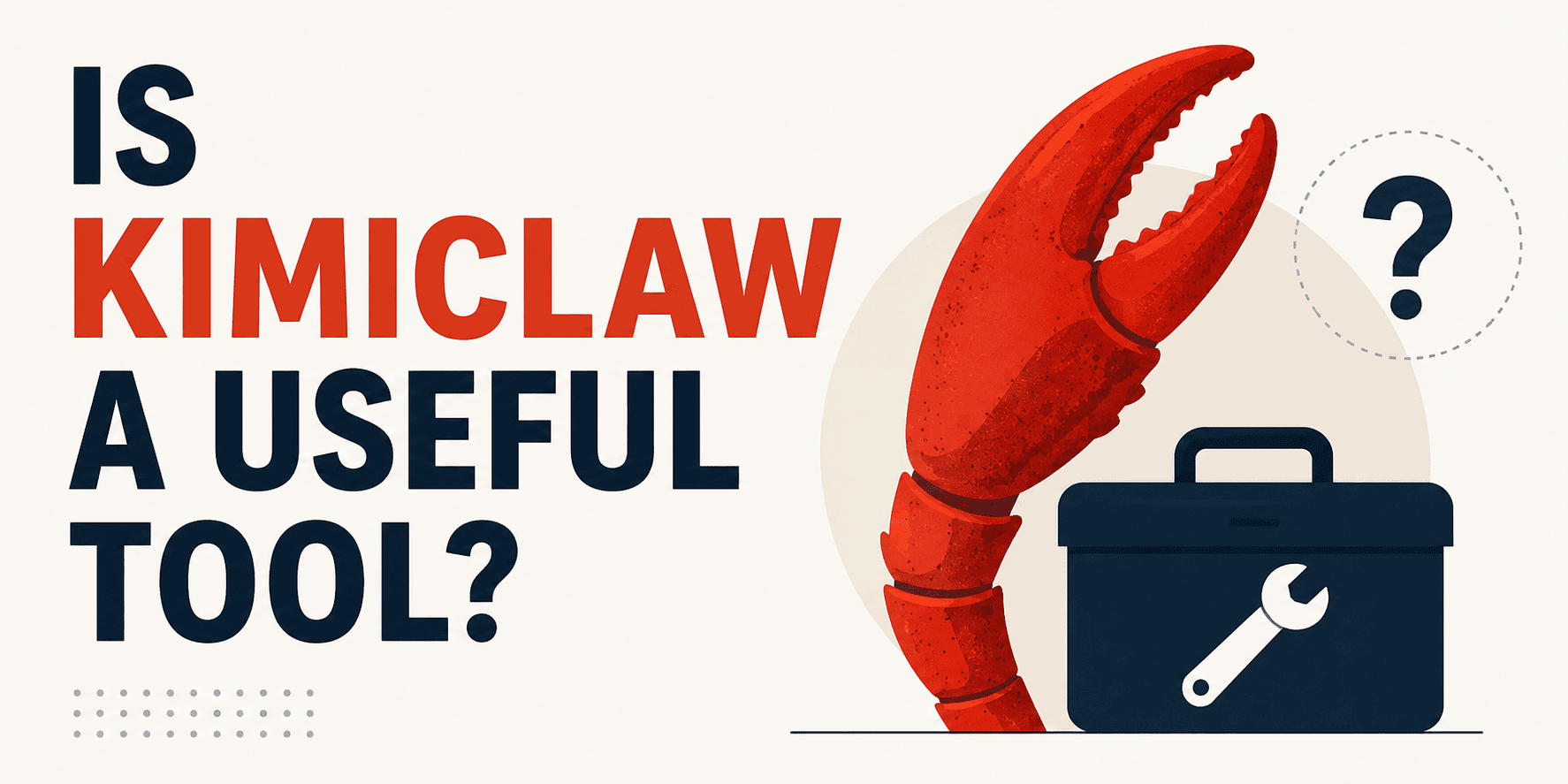
Choosing between KimiClaw and self-hosted OpenClaw comes down to a single question: how much control do you want over your AI agent? KimiClaw's cloud-hosted platform promises instant setup and hands-off automation, while OpenClaw gives you full ownership at the cost of technical heavy lifting. For most teams, the tradeoff is privacy versus convenience. We think KimiClaw wins on speed, but OpenClaw suits those who need data sovereignty.

Automate PII extraction from emails with intelligent cloud processing
Email inboxes are messy, and the sensitive data they hold makes manual classification both tedious and risky. This walkthrough shows you how to build an intelligent document processing system on AWS that automates the extraction of personally identifiable information. It is a practical, cloud-native approach to reclaiming control over your data workflows. The focus stays on actionable steps, not abstract theory. For those ready to push further into modern AI infrastructure, our guide to distributed training algorithms offers a natural next step.

ServiceNow invests $40 million to bring AI-native banking software worldwide
ServiceNow's $40 million investment in Indian banking software specialist BusinessNext signals a deliberate move to deepen its financial services expertise. The partnership positions BusinessNext to scale its AI-powered banking tools globally, with ServiceNow providing the strategic weight to make that expansion credible. It's a smart bet: banking runs on legacy systems, and AI-native tools are the clearest path forward. For readers tracking how AI reshapes established industries, this mirrors themes from our piece on Cloudflare's EmDash migration, where purpose-built technology quietly displaces older infrastructure.

Google Cloud's AI surge drives record profits and future growth
Google's cloud business is booming, and that growth is doing more than padding its bottom line. It's the clearest justification yet for the company's massive AI spending. Companies aren't just buying compute power; they're adopting AI infrastructure to solve real problems, and that demand is translating into record profits. This isn't about hype. It's a practical return on investment. If you're questioning the value of AI tools, this momentum shows why they're becoming essential.

Cloud native foundations unlock the future of agentic AI systems
The Cloud Native Computing Foundation makes a compelling case that agentic AI's foundation is already here. Rather than chasing entirely new systems, this analysis points to the mature cloud-native ecosystem as the backbone for trustworthy AI agents. It is a grounded perspective that prioritizes reliability over novelty. For those questioning how AI fits into existing workflows, the discussion echoes themes from our related piece, "Verify Your AI's Understanding: A Simple Check for Tax Season." We find this a practical, forward-looking take on a complex shift.

Explore a direct link between VS Code and Google Cloud notebooks
The Google Cloud Workbench Notebooks extension does something quietly significant: it lets developers run managed Jupyter environments straight from VS Code, without uprooting their local workflow. That matters. It removes friction while keeping the power of Google Cloud's infrastructure. We like when tools meet developers where they already work, and this feels like a step toward more fluid, AI-assisted data work. If you're exploring how AI fits into your daily toolkit, our piece on bridging retrieval and action offers a useful parallel.