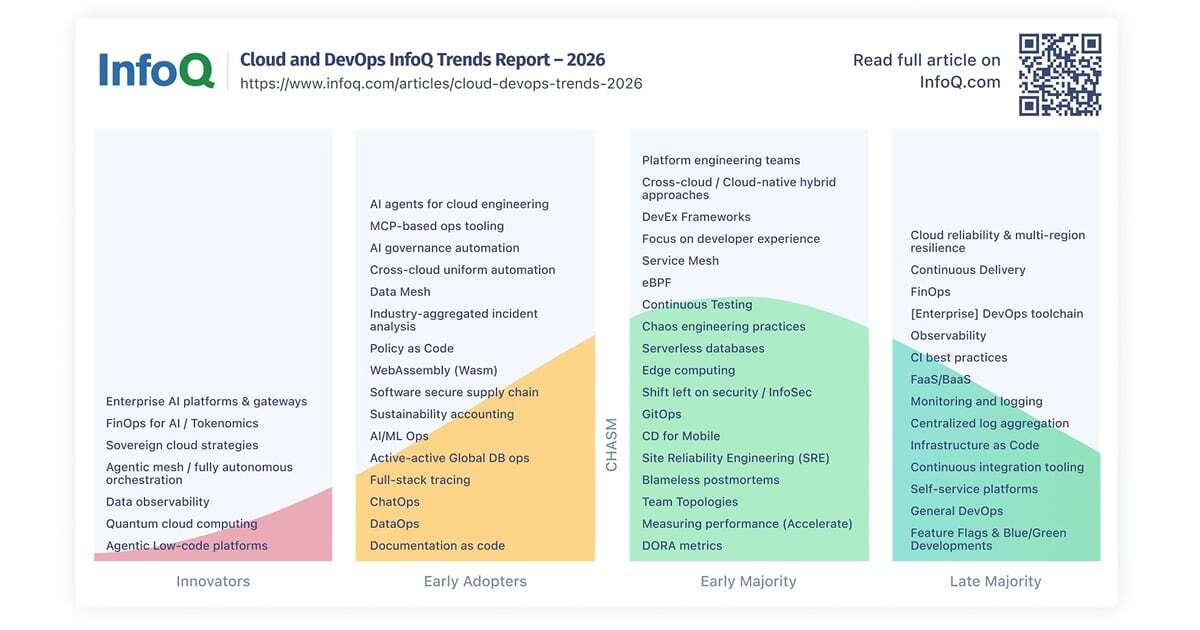
The annual InfoQ Cloud and DevOps Trends Report has become a reliable compass for practitioners navigating an increasingly noisy technical landscape. This year's podcast episode, featuring Daniel Bryant, Matt Saunders, Shweta Vohra, Steef-Jan Wiggers, and Mark Silvester, doesn't just list topics; it captures the raw, unpolished conversations that shape how we think about infrastructure and delivery. The report's emphasis on AI, resilience, platforms, FinOps, and sovereignty reflects a maturity that was absent just a few years ago. We are no longer asking whether these trends matter, but rather how they will reshape the daily realities of engineering teams.
The conversation around AI in this context feels particularly relevant when we consider the broader trajectory of the industry. We have seen the talking to my AI clone article explore the uncomfortable feelings that arise when we interact with machine-generated personas, and the cloud and DevOps trends echo that same tension. AI is not just a tool for automation; it is now a participant in our workflows, from code generation to incident response. The InfoQ editors are right to flag this as a trend to watch, but our take is that we need to move beyond the novelty. The practical question is not whether AI can handle a task, but how we verify its understanding when it inevitably gets things wrong, a concern that mirrors the simple check for AI's understanding discussed elsewhere.
When we look at the shift toward platform engineering and FinOps, we see a clear signal that the industry is moving from building infrastructure to managing the economics and experience of it. This is where the report's value becomes tangible for our readers. It is easy to get lost in the hype of new tools, but the underlying message here is about accountability. The report pushes back against the idea that resilience is just a technical metric; it is a business decision. Similarly, the focus on sovereignty is a direct response to the growing unease about where data lives and who controls it. These are not abstract concerns. They affect the choices you make about your cloud provider, your deployment strategy, and your team's skill set.
Our honest take is that the shifting expectations in AI/ML job requirements are a direct consequence of the trends highlighted in this report. You cannot separate the demand for engineers who understand both software development and machine learning from the platform-centric, cost-aware world that InfoQ describes. The editors are not just listing buzzwords; they are describing a convergence of responsibilities. For a reader who asks, "What should I do with this?" our answer is simple: use this report to audit your own roadmap. Are you investing in AI capabilities without a plan to verify their outputs? Are you treating FinOps as a finance problem rather than an engineering one? The report gives you the vocabulary to have those conversations, but the work is yours to do. The specific detail we are watching is how the resilience trend evolves from a reactive practice to a proactive design principle, because that will determine whether we are building systems that merely survive or ones that genuinely adapt.