computation graph
4 stories filed under computation graph on Beyond Market Intelligence. The newest of them: “Simplify complex gradients by shifting randomness outside the computation graph”, “Porting Doom's renderer into a transformer with zero training”, and “Teaching a transformer exact arithmetic by hand, not training”. Noisy gradients are the price of sampling inside the computation graph. A 21-billion-parameter transformer just rendered Doom's iconic first frame, and it never saw a single training example. Acme AI is the next-generation, AI-powered spreadsheet platform built to replace Excel and redefine how analysts, data scientists, and enterprise teams work… The list below is every computation graph story on Beyond Market Intelligence, newest first.
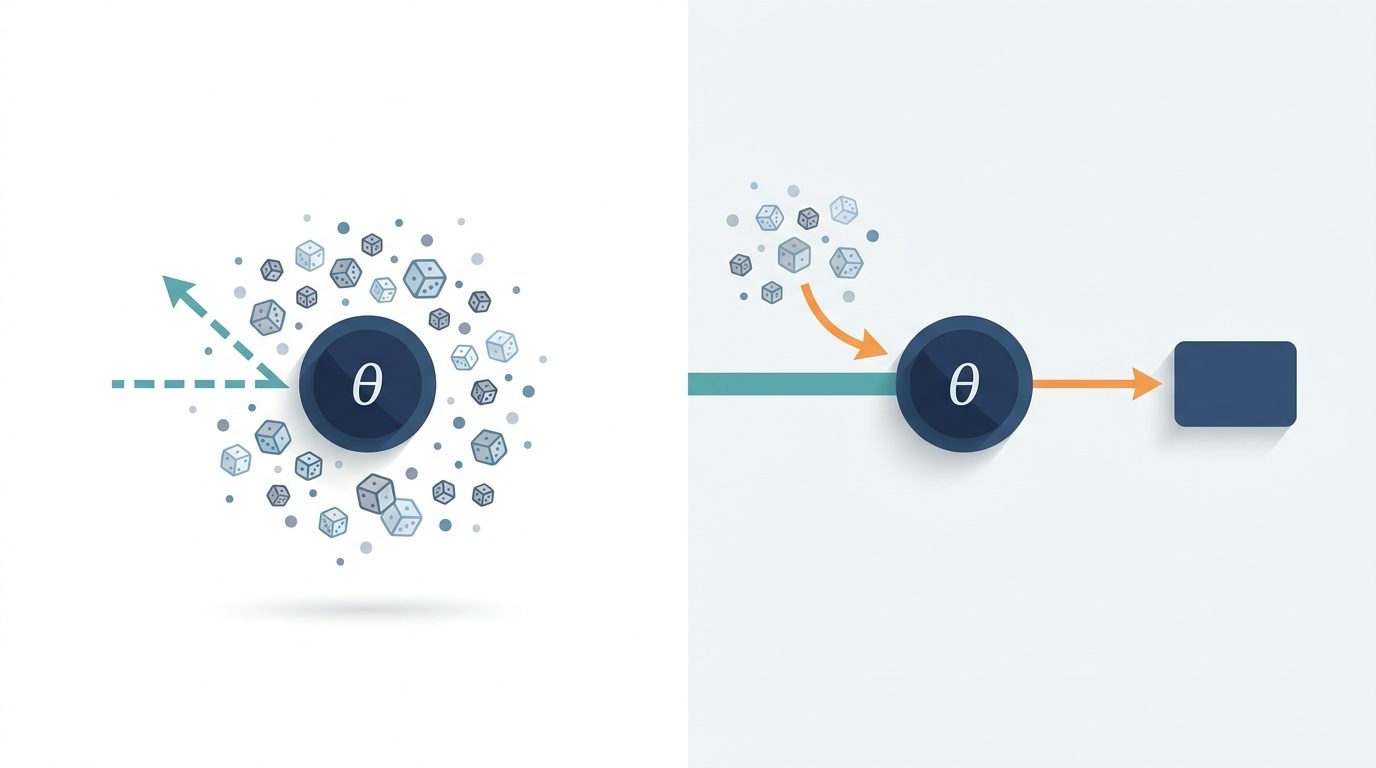
Simplify complex gradients by shifting randomness outside the computation graph
Noisy gradients are the price of sampling inside the computation graph. Moving randomness outside the computation graph changes everything. By reparameterizing, you keep the model differentiable while trimming variance that slows training. It is a practical, accessible breakdown of a technique that feels abstract until you see it applied. If you are exploring how to make your own models more stable, this is worth your time. For another angle on practical ML, our piece on real-world computer vision deployments pairs well here.
Porting Doom's renderer into a transformer with zero training
A 21-billion-parameter transformer just rendered Doom's iconic first frame, and it never saw a single training example. The trick: a custom compiler that bakes a computation graph directly into weights, then runs the classic renderer inside that fixed structure. The result is a standard Hugging Face checkpoint, no special code needed. One frame takes 3,614 prompt tokens plus 53,747 generated ones, about 40 minutes on a B200. That is 35 frames per day, a fitting pace for a project this gloriously impractical.
Teaching a transformer exact arithmetic by hand, not training
A single transformer model, its weights hand-set with no training, just averted the arithmetic meltdown that defines its peers. One version nails all three million possible three-digit products, and the same approach scales to twelve-digit multiplication. What stands out is the compiler work: turning the grade-school algorithm into a standard Phi-3 checkpoint through Torchwright. Frontier models crumble at seven digits, five scoring zero out of five hundred, while this one holds steady.
From Python to weights: a compiler proves what transformers can express
Most people assume a transformer's capabilities come from training. Rob's compiler challenges that assumption directly. He built a tool that takes a computation graph written in ordinary Python and outputs the weights for a standard Phi-3 model, loadable in vanilla Hugging Face with zero training involved. It's a clever way to isolate what these architectures can express, separate from what they can learn. For a deeper look at how he constructs these proofs, the write-up is worth your time.