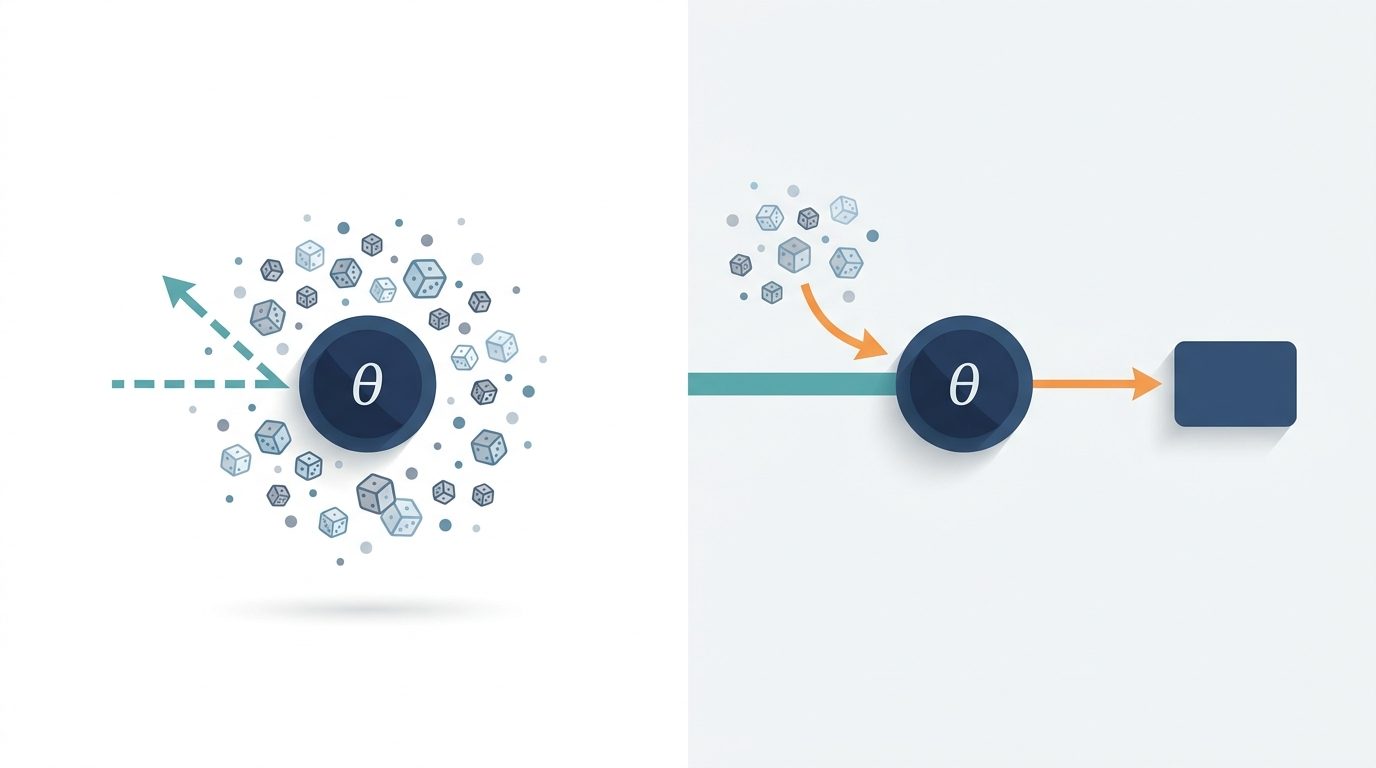
The reparameterization trick is one of those ideas that seems almost too elegant to be practical. On the surface, it is a mathematical sleight of hand: move the randomness out of the computation graph so that gradients can flow where they once got stuck. But variance reduction by smarter gradients gets at something deeper. It is not just a neat trick for optimization; it is a philosophy about how we handle uncertainty in machine learning. When you sample from a distribution, the gradient of that sample is often noisy, sometimes so noisy that learning grinds to a halt. By reparameterizing, you keep the stochasticity but make it differentiable, trading a bit of conceptual complexity for a massive reduction in variance. That trade is the real story here.
For anyone who has wrestled with training variational models or reinforcement learning agents, this is not an academic curiosity. It is the difference between a model that stumbles around in the dark and one that walks purposefully toward a solution. Moving randomness outside the computation graph turns those noisy gradient estimators into low-variance, differentiable ones. What we appreciate is that this is not about avoiding randomness altogether; it is about placing it where it does the least harm. The randomness still exists, but it no longer poisons the gradient signal. That is a practical insight you can carry into any project, whether you are building a recommender system or a generative model. It also connects to a broader theme we have been tracking: how technical fluency in machine learning often comes down to understanding these small, structural choices. As we noted in Expanding Your Tech Fluency: Key Insights Beyond Artificial Intelligence, the tools that matter are rarely the flashiest ones, but the ones that quietly reshape what is possible.
Our take is that the reparameterization trick deserves more credit than it usually gets as a conceptual breakthrough, not just a computational one. It forces us to ask a better question about our models: instead of "how do we reduce noise?", we ask "where does the noise belong?" That shift in perspective is what separates a well-designed system from one that merely works by accident. For readers who are exploring real-world deployments, like the ones discussed in Exploring Real-World Computer Vision: Deployments, Edge Models, and Current Challenges, this is not a distant concern. When you are optimizing models for edge devices, every bit of gradient variance you remove translates directly into faster training and more stable convergence. Similarly, those who enjoy the mathematical side of things, as covered in Explore the Forrester Function: Beyond Mathematics, a Tool for Machine Learning, will recognize that the reparameterization trick is another example of how a simple mathematical insight can have outsized practical impact.
The one thing we would tell a reader who asks about this is to stop treating reparameterization as a footnote in a textbook and start treating it as a design principle. It is not just for variational autoencoders or stochastic computation graphs; it is for anyone who has ever felt like their model is learning too slowly for no clear reason. The concrete takeaway is this: if your gradients are noisy, do not crank up the learning rate or hope for the best. Look at where your randomness lives and consider whether it can be moved. That single habit will save you hours of debugging and might just be the difference between a model that converges and one that never quite gets there. The reparameterization trick is not about removing randomness; it is about being smart about where you let it touch your gradients. That is a lesson worth carrying forward.