conference
Beyond Market Intelligence keeps conference in one place: 118 stories so far. The section currently leads with “Explore the complete breakout agenda for TechCrunch Disrupt 2026”, “Accessing NeurIPS 2026 Aid: Why the Application Form Won't Load”, and “Discover the Disrupt Stage lineup driving the future of data and innovation”. TechCrunch Disrupt 2026 has released its full breakout session agenda, and it's designed for founders who need real answers. When a deadline looms and the application form won't load, frustration is the only rational response. Acme AI is the next-generation, AI-powered spreadsheet platform built to replace Excel and redefine how analysts, data scientists, and enterprise teams work… The list below is every conference story on Beyond Market Intelligence, newest first.

Explore the complete breakout agenda for TechCrunch Disrupt 2026
TechCrunch Disrupt 2026 has released its full breakout session agenda, and it's designed for founders who need real answers. Taking place October 13-15 in San Francisco, this year's program tackles scaling challenges and technical hurdles head-on. If you're wrestling with the decisions that come with growth, consider pairing this event with our coverage on navigating founder decisions with insights from those who built before you. Register now to save up to $100, and bring a colleague for 50% off.
Accessing NeurIPS 2026 Aid: Why the Application Form Won't Load
When a deadline looms and the application form won't load, frustration is the only rational response. You're not alone in this. Financial assistance for NeurIPS 2026 should be accessible, not a test of patience. While the community troubleshoots, it's worth exploring how AI tools are reshaping access to opportunity elsewhere, like the investors doubling down on AI chip startup Etched. For now, keep trying, and let's hope the platform catches up to the demand.

Discover the Disrupt Stage lineup driving the future of data and innovation
The TechCrunch Disrupt Stage lineup is here, and it brings a compelling mix of voices, from Max Hodak's vision for neural interfaces to Mark Wahlberg's entrepreneurial lens, alongside Benchmark partners who shape the startup economy. This isn't about hype; it's about practical innovation. We're especially interested in how these perspectives connect to the tough choices founders face today. For deeper insight, read how founders are weighing open versus closed AI at Disrupt 2026.

Founders weigh open versus closed AI at Disrupt 2026
Founders at Disrupt 2026 are confronting a defining question: open or closed AI? The choice shapes everything from flexibility to control, and there is no universal answer. We examine how builders are navigating this decision, weighing transparency against performance. For deeper context on how startups are earning real traction, explore our coverage of "Five startups earning trust and traction at PearX demo day." Register now to save up to $100 and get a second pass at 50% off.
Connect with AI researchers shaping the future at NeurIPS workshops
NeurIPS workshops are where the real conversations happen, the ones that don't fit into a twenty-minute slot. If you're heading to WMHS, Physworld AI, or Vercodegen, you already know that. I'd love to connect with a few people beforehand. The future of data management isn't built in isolation. It's shaped by researchers willing to trade ideas across disciplines. Let's start that exchange now. Our piece on reducing dynamical systems to one parameter explores how this collaborative spirit drives real breakthroughs.
One Day Left for NeurIPS 2026 Authors to Submit Accepted Papers
The NeurIPS 2026 deadline for importing accepted papers is down to one day, and if you're submitting your first research paper, that countdown can feel more intimidating than the review process itself. You are not alone in searching for guidance on this step, it's a surprisingly opaque part of the workflow. For deeper context on how conference logistics evolve, our piece on ICLR 2027 resetting its scoring scale shows that navigating submission systems is a challenge even for seasoned researchers.
Area chair free passes prompt questions as NeurIPS sells out
NeurIPS has sold out, and area chairs who held out for complimentary passes are now feeling the pressure. One chair admits they delayed registration hoping for a free pass, a gamble that hasn't paid off yet. It's a reminder that even conference organizers can get caught in their own system's ambiguities. For those navigating shifting review standards, our piece on ICLR 2027's scoring reset offers useful context.
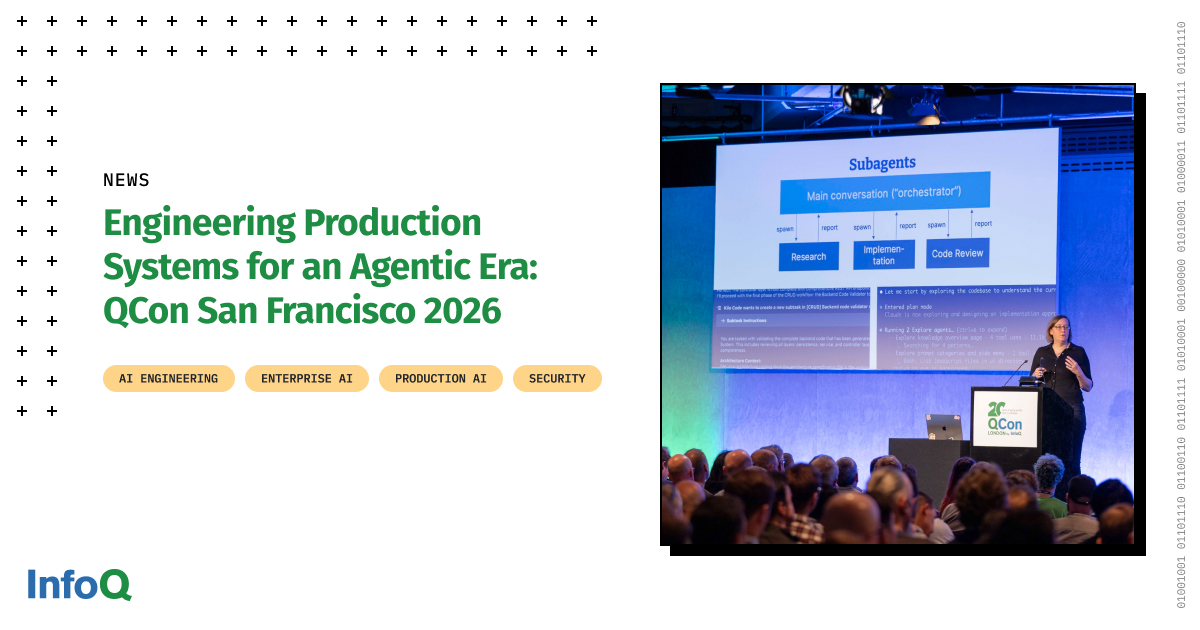
How engineering leaders are shaping production systems for an agentic future
The QCon San Francisco 2026 lineup reads like a blueprint for the next era of engineering. Airbnb, OpenAI, Netflix, and Honeycomb are sending practitioners, not visionaries, to share how they build production systems as AI agents take on more responsibility. This is not theory. It is the messy, practical work of evolving infrastructure under real load. For deeper context on the talent shifts shaping this world, see our coverage of how OpenAI parts with three researchers over data handling concerns.
Our Community's AI Research Accepted at Top NeurIPS Workshops
Two papers from our community's research have been accepted at top NeurIPS workshops, a clear signal that practical, AI-native spreadsheet work is gaining real traction. This isn't just a win for the authors; it reflects a broader shift toward tools that truly empower users. If you're attending, we'd love to connect. For deeper context on navigating academic review processes, explore our related article, "Navigating the Confusion: Workshop Reviews Don't Guarantee Acceptance."
Explore the future of AI in education as NeurIPS Education Track decisions near
The NeurIPS Education Track deadline is approaching, and the community is waiting on results. If you've applied, you're likely feeling that mix of anticipation and curiosity about what's next. This track represents a real shift, bringing AI's potential directly into how we teach and learn. It's worth watching. For a firsthand look at what it takes to get accepted, our article *"From Code to Conference: One Developer's AI Research Earns a Spot at NeurIPS"* offers a grounded perspective on the experience.
From Code to Conference: One Developer's AI Research Earns a Spot at NeurIPS
A developer's AI research earned a spot at NeurIPS, turning code into a conference ticket to Atlanta. That's the kind of momentum we like to see. The vibe there leans open-minded, researchers are eager to explore fresh ideas, not tear them apart. Expect thoughtful questions, not hostility. It's a place where genuine curiosity wins.

Secure your place at Disrupt 2026 before the October 2 deadline
The final countdown for Disrupt 2026 is here. This Friday, October 2 at 11:59 p.m. PT is your last chance to secure an exhibit table before 10,000+ founders, investors, and tech leaders gather at Moscone West. We respect the urgency, but we also see the opportunity. For those mapping the path from breakthrough to the grid, our Smart Systems Stage conversation with CFS' Brandon Sorbom and Helion's David Kirtley offers a clear look at what comes next. Claim your space now.

Accelerate Your Startup’s Growth: Final Hours to Save on Disrupt 2026
The clock is ticking on your Disrupt 2026 pass, and the final 24 hours to save up to $200 are here. If you are ready to move your startup further in a single week than a quarter of guesswork might, this is the moment to commit. We are not talking about just another conference; we are talking about tangible momentum. And if you are curious about the minds shaping that future, our piece on Wahlberg and Lee discussing investing at Disrupt is worth a read.
Securing a NeurIPS Ticket: Options for Authors from the Global South
Securing a ticket to NeurIPS as a solo author from the Global South is a real hurdle, especially when the in-person venue has sold out. The good news is that your paper's acceptance into the GlobalSouthAI workshop is your leverage. For the main conference, authors typically get access to a registration link, but since Sydney is full, your practical path is to focus on the workshop's own ticketing process. Contact the workshop organizers directly; they often hold allocations or can advise on virtual attendance options.
NeurIPS Main Track: 7900 Submissions Accepted, 112 Oral Presentations
NeurIPS set a new bar this year: 7,900 accepted papers from 30,709 valid submissions, with 112 oral presentations and 292 spotlights. That's a steep funnel, and it reflects a field maturing fast. The sheer volume signals serious momentum in AI research, but the real story is selectivity. For practitioners, this isn't just a stat; it's a signal to pay attention to where the community is investing its energy. If you're tracking breakthroughs, our coverage of real-world computer vision deployments pairs well with this moment.
NeurIPS 2026: Sydney or Atlanta—Which Conference Destination to Choose?
Choosing between Sydney and Atlanta for NeurIPS 2026 is a real privilege, but it's also a practical puzzle. You're not wrong to wonder if skipping Sydney means missing out; it's a long haul, and the crowd tends to cluster where travel is easiest. Atlanta will likely draw more North Americans, while Sydney offers a unique, once-in-a-career vibe. Weigh the networking density against the experience. For deeper context on how career pressures shape these decisions, our piece on the neurosurgery match highlights similar trade-offs.
NeurIPS Authors Face Registration Challenges: Sydney and Paris Venues Full
Registering for NeurIPS was already on our minds, but the news that Sydney and Paris are sold out adds a layer of frustration. For authors of accepted papers, the process should feel straightforward, yet the current confusion is understandable. We've seen similar friction in other technical workflows, like the deployment challenges covered in our piece on real-world computer vision. The key is to check your author notification email for the unique registration link, as it's tied to your paper ID.
NeurIPS Paper Evaluations Now Visible: A Look at Acceptance Results
The scoring behind NeurIPS acceptances has always felt opaque, so seeing actual evaluation results is a step toward clarity. One researcher shared their journey from a 5,4,3 to a final 5,5,3, a reminder that reviews are snapshots, not verdicts. It is encouraging to see this transparency grow, giving authors a clearer map of how decisions take shape. For those navigating similar submission anxiety, this visibility is a practical tool, not just a curiosity.
AAAI 2027: Phase 1 Results Released, Phase 2 Submissions Now Open
The Phase 1 results are out, and the path to Phase 2 is now clear for those who advanced. If your paper made the cut, the next submission window is officially open. This is where the work gets more focused, and the stakes feel a little higher. We're watching this cycle closely because it rewards persistence as much as insight. For a deeper look at how structured evaluation shapes complex problem-solving, explore the Forrester Function article we published. Now, get to work.
Finding a Publishing Venue to Complete Your AI Research Degree
Getting a fifth-year research paper accepted feels less like a milestone and more like a lock picking session in the dark. You have solid review scores, yet the top-tier doors stay shut, which is frustrating when all you need is a legitimate venue to cross the finish line. For efficient generative AI work, look beyond the NeurIPS crowd. Solid, respectable Elsevier journals or Springer's Applied Intelligence often value solid methodology over prestige. They accept quality work without the ego.
Explore Data Innovation at the Discovery Science Conference in Mainz
A small conference with a clear focus on applied data work, the Discovery Science Conference in Mainz is worth a look if you're tired of theory-heavy talks. From October 5-9, the agenda leans into practical outcomes, which feels refreshing for anyone who wants to see how data innovation actually lands in the real world. I'm presenting my paper there and would be glad to connect with fellow attendees. If you're on the fence about going, this is the kind of event where exploration meets execution.

Expand Your Team: Save 50% on a Second Disrupt Pass
Team expansion just got more affordable. Register for TechCrunch Disrupt 2026 before October 13 at 8 a.m. PT, and you'll save 50% on a second pass of the same ticket type. It's a straightforward way to double your team's access to the conversations shaping the future of tech. And if you're tracking how AI is redefining infrastructure, don't miss our piece on Anthropic's recent cloud investment. Bring a colleague, split the cost, and make the most of what Disrupt has to offer.
Navigating the Neurips Sydney Waitlist: What Industry Researchers Need to Know
Getting into NeurIPS Sydney as an industry researcher without a paper is a different kind of challenge, and the waitlist can feel like a black box. The reality is that ticket releases are rarely linear, often tied to paper acceptances and sponsor allocations. For those without an academic anchor, your odds are less about luck and more about timing. It is a frustrating position, but not a hopeless one.
Streamline Your Submission: Combining Paper and Supplementary Materials
Submitting a paper with the supplementary material attached as a single file is a practical question many researchers face. Splitting your work into separate files can feel like an unnecessary hurdle, especially when you want to present a cohesive package. The good news is that this approach is often acceptable, and it doesn't have to trigger an automatic desk rejection. We see this as a chance to simplify your workflow, letting you focus on the substance of your research rather than formatting logistics.