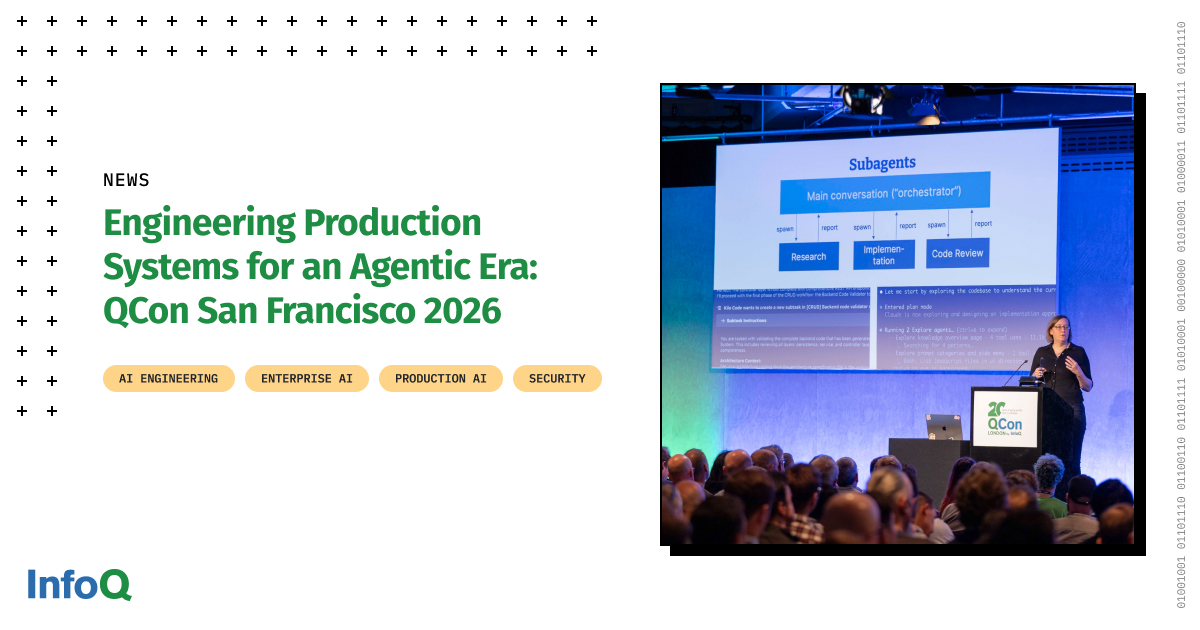
Engineering leaders are asking the wrong question. They keep wondering how to bolt AI agents onto existing production systems, when the real challenge is redesigning those systems from the ground up for a world where agents are first-class participants, not afterthoughts. QCon San Francisco 2026, which will bring together practitioners from Airbnb, OpenAI, Netflix, and Honeycomb, signals that the conversation is finally shifting from experimentation to operation. For anyone building software today, this isn't a distant trend, it's the problem you'll face next quarter.
The lineup tells us something important. These are not research labs talking about theoretical possibilities; they are engineering organizations that run software at massive scale, and they are publicly sharing how they handle agents that make decisions, trigger workflows, and interact with production data in real time. This is a practical acknowledgment that traditional monitoring, observability, and incident response practices break down when a system's behavior is partly determined by autonomous models. If you are still treating AI as a feature your product consumes rather than a core component of your infrastructure, you are already behind. The OpenAI parts with three researchers over data handling concerns story reminds us that the stakes around data governance and agent behavior are not theoretical, they are immediate, and they have real consequences for teams that move too fast without the right guardrails.
What does this mean in practice? It means your deployment pipeline needs to account for agents that can change their own behavior based on new data. It means your on-call rotations need engineers who understand not just system latency but model drift. It means the tools you use to trace a request across microservices must now trace reasoning paths through a large language model. The engineering leaders speaking at QCon are grappling with these exact problems, and the fact that they are willing to share their approaches suggests that the playbook is still being written. For readers who want to understand how to Build for the AI era, the key insight is that agentic systems demand a new category of infrastructure thinking, one that treats uncertainty as a design constraint rather than a bug.
The specific consequence to watch is how these organizations handle observability for agent decision-making. When an agent chooses a path that causes a production incident, you cannot simply replay the logs and see a deterministic sequence of events. You need to understand why the model made that choice, what context it had, and whether its training data introduced a bias that only manifests at scale. Honeycomb's participation is a strong signal that high-cardinality, event-driven observability is becoming central to this work. If your team has not yet discussed how to instrument agent behavior with the same rigor you apply to API calls, start there. That question, how do you know what your agent was thinking when it caused that outage, is the one that will separate teams that survive the agentic shift from those that get burned by it.