confidence
confidence at Beyond Market Intelligence is a file of 8 stories. The newest of them: “Why Small Decision Models Beat LLMs for AI Answer Evaluation”, “Jev vs LLMs: Evaluating AI for Practical Decision-Making”, and “Reviewer feedback remains pending as rebuttal process continues”. Jev takes a different path in the AI evaluation debate. Spreadsheets have long forced a choice between speed and judgment. Acme AI is the next-generation, AI-powered spreadsheet platform built to replace Excel and redefine how analysts, data scientists, and enterprise teams work… The list below is every confidence story on Beyond Market Intelligence, newest first.
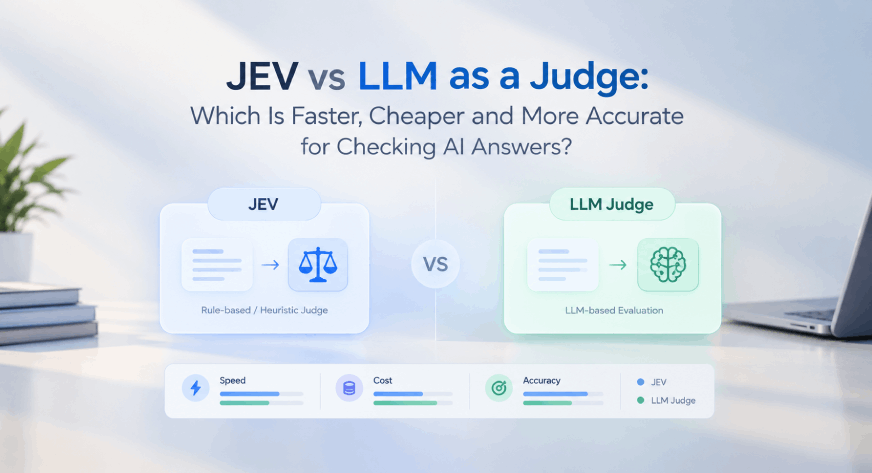
Why Small Decision Models Beat LLMs for AI Answer Evaluation
Jev takes a different path in the AI evaluation debate. Where LLM-as-a-Judge generates full responses for every check, Jev returns a short choice with a confidence score. That is a leaner, faster route to the same destination. Teams feeling the cost and delay of large-model judging should explore this approach. It keeps the evaluation simple without sacrificing reliability. For more on how small decision models fit into the broader routing conversation, our piece on model routing as a design choice pairs well with this discussion.

Jev vs LLMs: Evaluating AI for Practical Decision-Making
Spreadsheets have long forced a choice between speed and judgment. In a new test, TypeSafe AI's Jev tackled 3,080 classification tasks, and the results are worth your attention. The comparison focuses on accuracy, latency, calibration, and confidence, asking whether a dedicated tool can serve as a practical decision layer where LLMs might falter. It is a grounded, useful evaluation. For those exploring how AI systems handle reasoning under pressure, this pairs well with our guide to distributed training algorithms.
Reviewer feedback remains pending as rebuttal process continues
Waiting on reviewer feedback is a specific kind of limbo, and it sounds like you are handling it with a clear head. Your rebuttal is still in motion, and the silence from your reviewers is not a rejection; it is simply part of the process. You have a valid point about the "2" being a limitation you already disclosed, especially when the conference rules discourage that as a weakness.

When a RAG System Says No, It Should Show Four Proof Points
A confident wrong answer is a bug, but a bare "no answer" with no justification is barely better. This piece breaks down why a RAG system that says "not in this document" must show four distinct kinds of evidence to earn trust. It's a practical push for accountability in AI output. For readers wrestling with how LLMs structure their reasoning, "Exploring Paragraph Structure" offers a useful companion on the mechanics behind the curtain.
Theory paper scores after rebuttal reveal familiar patterns worth exploring
The rebuttal period has ended, and the score distribution for theory papers is now the question on everyone's mind. One researcher reports a 4 / 4 / 4 with moderate confidence, noting that theory work often trails behind and that this year's scores feel lower across the board. That observation matches the quiet tension many authors feel. We are watching where the empirical cutoff lands, and for deeper context on how structured reasoning shapes these evaluations, our guide on paragraph structure offers a useful parallel.
When Reviewers Say Concerns Are Resolved but Don't Update Scores
A reviewer saying concerns are resolved without updating the score is a familiar frustration. The 2/4 rating finally moved after a nudge, jumping to 4/2. That aligns with what many observe: score updates often lag behind verbal agreement, but they do happen. The other silent reviewers remain a wildcard. For those waiting, persistence pays off, as this update shows. It is a practical reminder that discussion-phase engagement is uneven, yet a single response can shift the outcome.
Theory Paper Scores Reveal a Shifting Review Landscape This Cycle
Initial scores for theory papers often sit at a conservative 4/3/3, and this cycle feels no different. That pattern isn't a flaw; it reflects how carefully reviewers weigh formal contributions. If you're tracking broader trends, the conversation reminds me of our piece on "Unlock LLM Training," where similar caution shaped expectations. Sharing your numbers helps map whether this is systemic or anecdotal. For now, the data suggests patience matters more than panic. Keep the thread constructive, and let the reviews guide your next move.

Why Falling AI Confidence Signals Smarter Strategy Ahead
A 17-point drop in AI confidence sounds like bad news. It's actually the healthiest number in the report. When 40% of IT leaders claimed maturity six months ago, that was aspiration. The 23% who now admit production is harder than pilots are the ones doing the real work. They aren't retreating; they're recalibrating. That honesty builds the foundation for lasting adoption.