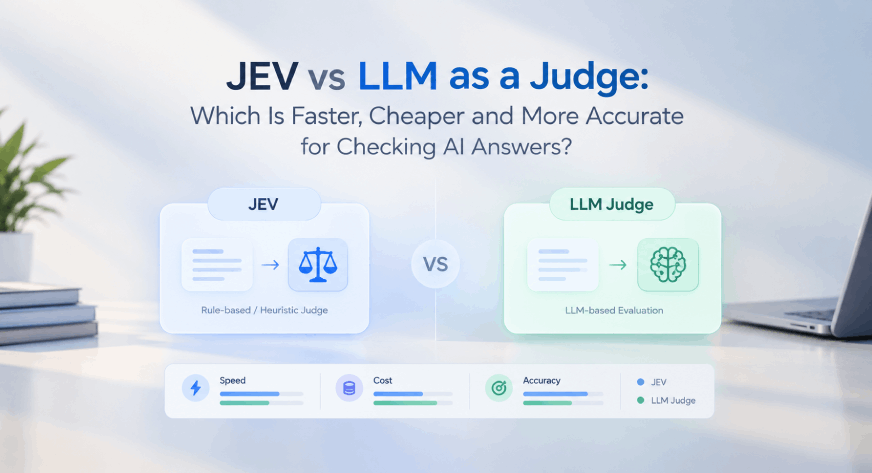
The pressure to evaluate AI outputs at scale has created a quiet crisis: teams default to using large language models as judges, assuming that the most powerful tool available must be the right one for the job. But every call to an LLM-as-a-Judge introduces latency, cost, and a subtle layer of inconsistency that compounds with each query. Jev, a small decision model from TypeSafe AI, offers a sharper alternative by returning a concise choice with a confidence score rather than generating lengthy, free-form justifications. This isn't a minor efficiency tweak; it's a fundamental rethinking of what evaluation should be. For teams wrestling with long-form or open-ended responses where exact-match tests fall short, the question isn't whether to adopt AI evaluation but which architecture genuinely serves your workflow.
The appeal of Jev lies in its restraint. Instead of asking a model to reason through every possible nuance of an answer, it focuses on the decision itself: is this response good, bad, or somewhere in between? That clarity has immediate practical consequences. You cut down on token usage, reduce the time between a user's query and your system's next action, and minimize the risk of a judge model being swayed by its own verbose output. This approach echoes a broader shift we've seen in the space, such as how model routing becomes a design choice with this cost-effective Jev approach, where the emphasis moves from brute-force computation to intentional system design. Similarly, when we look at how language models learn to copy context with hash tables, the lesson is the same: efficiency often comes from narrowing the problem, not adding more layers of complexity.
That said, small decision models aren't a universal remedy. They work best when your evaluation criteria are well-defined and your tolerance for ambiguity is low. If you need rich, qualitative feedback on why an answer failed, a lean model will leave you wanting. But for most production scenarios, where the goal is to route, rank, or reject responses at scale, the trade-off is worth making. The real insight here is that evaluation isn't a single event; it's a pipeline, and you can mix tools depending on the stage. This aligns with what we've observed in how AI transforms enterprise support from complaints to resolutions, where the focus is on outcomes rather than the sophistication of the underlying model.
Here's the concrete takeaway: before you default to an LLM-as-a-Judge, audit your evaluation pipeline. Ask yourself whether you need a paragraph of reasoning or just a reliable signal. If it's the latter, a model like Jev isn't a compromise; it's a correction. The teams that win this race won't be the ones with the largest models or the most complex prompts. They'll be the ones who treat evaluation as a cost center, not a luxury. Watch for the moment when your latency budget starts dictating your architecture, because that's when a small decision model stops being an option and becomes the obvious choice.