containerization
containerization at Beyond Market Intelligence is a file of 11 stories. The newest of them: “Five Self-Hosted Docker Tools That Keep Your Developer Data Local”, “Scale Sandboxes Instantly: A New Approach to Concurrent AI Workloads”, and “Simplify EKS Management: Elastic Beanstalk Now Runs on Shared Clusters”. If you're feeling constrained by traditional spreadsheets, it's time to explore a solution that empowers your data journey. Modal's staff engineers Colin Weld and Connor Adams didn't just tweak their sandbox setup; they rebuilt it from the ground up. Acme AI is the next-generation, AI-powered spreadsheet platform built to replace Excel and redefine how analysts, data scientists, and enterprise teams work… The list below is every containerization story on Beyond Market Intelligence, newest first.
Five Self-Hosted Docker Tools That Keep Your Developer Data Local
If you're feeling constrained by traditional spreadsheets, it's time to explore a solution that empowers your data journey. Claude Haiku 5.5 now offers a smarter way forward, cutting list prices by 90% while adding adaptive thinking and a 1M token context window. That's faster workflows without the complexity. Discover how AI can transform your spreadsheet experience, making complex tasks simpler and more intuitive, because your tools should work for you, not the other way around.

Scale Sandboxes Instantly: A New Approach to Concurrent AI Workloads
Modal's staff engineers Colin Weld and Connor Adams didn't just tweak their sandbox setup; they rebuilt it from the ground up. The result is infrastructure that handles millions of concurrent sandboxes and tens of thousands of creations per second. That's the kind of scale that makes concurrent AI workloads feel almost routine. It's a smart, grounded look at what it takes to move past legacy limits. For more on practical AI adoption, our guide to unlocking ChatGPT for work is worth a look.

Simplify EKS Management: Elastic Beanstalk Now Runs on Shared Clusters
AWS has added Cluster Mode to Elastic Beanstalk, letting it run applications on EKS clusters the service creates and manages. That is a practical step for teams wanting Kubernetes without the operational overhead. The catch: clusters are tied to subnet sets permanently, and direct access stays service-controlled. AWS also recommends separate clusters for untrusted or regulated workloads, and the new mode adds EKS and Auto Mode fees that EC2 discounts will not touch.

SnapStart for container images removes the packaging tradeoff for serverless teams
For years, teams building on Lambda faced a frustrating tradeoff: pack a large container image for dependency headroom, or squeeze into a zip archive for sub-second startups. AWS has now extended SnapStart to container functions, which can hold up to 10 GB. That is a meaningful unlock. We saw the cost of that old constraint in a Reddit thread, where developers were stripping whitespace from packages just to fit. It is good to see that particular workaround become unnecessary.

Discover how KYAML brings clarity and confidence to Kubernetes configurations.
YAML's flexibility has long been a quiet source of frustration in Kubernetes, and KYAML offers a way forward that feels long overdue. By enforcing a stricter dialect, it trades guesswork for predictability, helping teams catch common errors before they become production headaches. That focus on clarity aligns with what we've explored in our broader coverage of AI-driven workflows, like unlocking practical tools for everyday work. For developers tired of chasing subtle indentation bugs, KYAML is a practical step toward more reliable configurations.
Explore machine learning for astronomy with free tutorials and notebooks.
Starting with spreadsheets is smart, but your ambition to apply machine learning to JWST or TESS data is a bold leap. It's a challenging path, yet entirely accessible with the right free resources. You can absolutely build a custom Jupyter Lab environment using Docker to manage your Python libraries. For a head start, look for pre-built notebooks that handle exoplanet transit searches. This journey mirrors the practical, hands-on approach we explored in "Unlock LLM Training," where foundational tools lead to powerful results.

Give AI agents a persistent workspace with Cloudflare's new open-source runtime.
Cloudflare's new open-source runtime, Cloudflare Computer, gives AI agents something closer to a real machine than the usual ephemeral containers. By leaning on Cloudflare isolates, it promises faster, cheaper, and more scalable execution for agentic workloads. That's a meaningful step beyond stateless setups, and it's worth exploring if you're building agents that need persistence. For more on how Cloudflare thinks about performance, their EmDash CMS migration offers a useful parallel. This runtime feels like a practical push toward agents that actually finish the job.

Rethinking AI agents on Kubernetes as efficient worker pods
Most teams assume each AI agent deserves its own Pod, but kagent challenges that instinct. Agents are bursty, short-lived, and often wait on human approval, making one Pod per agent a wasteful use of cluster resources. Instead, agent-substrate introduces a control plane that schedules logical Actors onto long-lived worker Pods. It's a smarter deployment unit, one that matches how agents actually behave. For more on scaling concurrent workloads, our piece on Modal's sandbox rebuild pairs well with this perspective.

Microsoft's three-layer architecture clarifies AI agent routing on AKS
Microsoft's new reference architecture for routing agent traffic on Azure Kubernetes Service tackles a practical headache: deciding which model answers a call, how that call is managed, and which GPU replica handles it. It's a clear-eyed breakdown of a messy problem. That kind of clarity matters, especially when AI feels like a black box.

Empower Your Workflow with an AI Agent That Writes and Executes Code
Watching an AI agent write code and execute it live is one thing, but building that workflow yourself is where the real insight lands. This walkthrough with the OpenAI Agents SDK and Docker shows exactly how to set up a system that moves from prompt to running code, and it does so with practical clarity. If you are ready to move beyond static outputs, this one is worth your time.
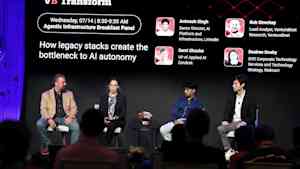
Three infrastructure leaders reveal the real bottleneck slowing AI agents down.
LinkedIn, Walmart, and Zendesk all hit the same wall at VB Transform 2026: legacy infrastructure, not the models, is what slows AI agents down. Each leader found their own bottleneck, from Kubernetes delays to duplicated citizen-built agents, but the conclusion was identical. Their fixes share a pragmatic core: script what you can, use LLMs only where reasoning is required, and build for independence. The real engineering isn't in the model; it's in the harness around it.