convergence
convergence at Beyond Market Intelligence is a file of 9 stories. The newest of them: “A 1D physics solver wins, but neural networks take the lead in 5D”, “Training chaotic systems in parallel: a faster path to neural network convergence”, and “Streamlining softmax by reducing inputs without sacrificing accuracy”. A 1D physics solver wins; in 5D, neural networks take the lead. Training nonlinear RNNs on chaotic time series usually means choosing between slow sequential computation or unstable parallel methods. Acme AI is the next-generation, AI-powered spreadsheet platform built to replace Excel and redefine how analysts, data scientists, and enterprise teams work… The list below is every convergence story on Beyond Market Intelligence, newest first.
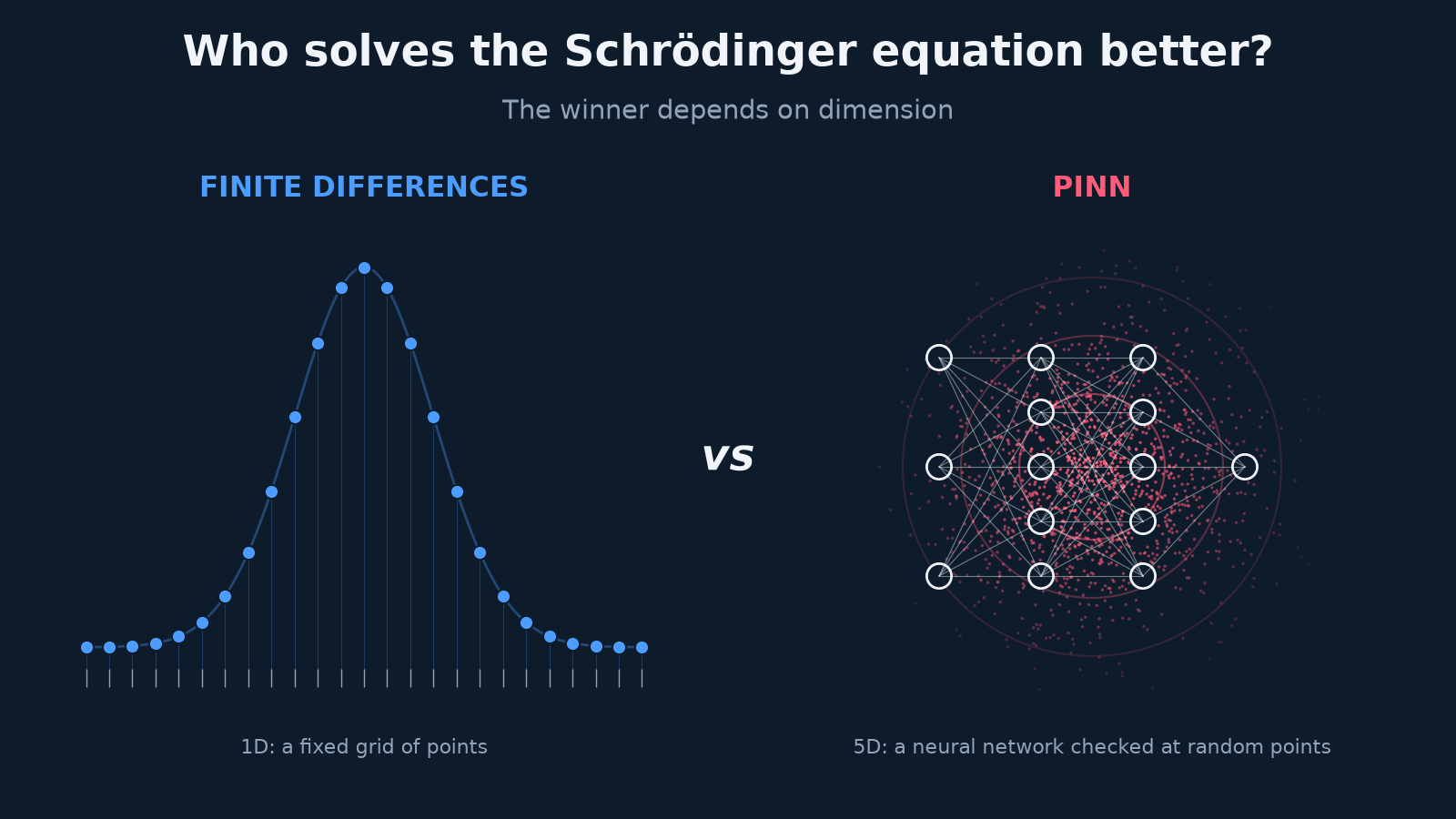
A 1D physics solver wins, but neural networks take the lead in 5D
A 1D physics solver wins; in 5D, neural networks take the lead. We put a physics-informed neural network against a plain finite-difference solver twice, and the winner changed. That shift tells us something important about when AI-powered methods actually outperform classical numerical approaches. It's not a blanket victory, it's conditional, and understanding those conditions matters. For more on how AI adapts to complex environments, see our piece on two AI copies keeping drones in sync with 94% less data.

Training chaotic systems in parallel: a faster path to neural network convergence
Training nonlinear RNNs on chaotic time series usually means choosing between slow sequential computation or unstable parallel methods. Our NeurIPS 2026 spotlight shows you don't have to compromise. By combining DEER's Newton-type iterations with generalized teacher forcing, we stabilized parallel-in-time training on sequences longer than one million time steps, achieving over 100x speedup. This outperforms Mamba and other state space models for dynamical system reconstruction. For deeper coverage of related efficiency advances, see our article on tiered optimizers cutting MoE training memory demands.
Streamlining softmax by reducing inputs without sacrificing accuracy
Reducing softmax's inputs from N to N-1 is a neat theoretical insight, those redundant parameters are doing nothing. If the logits sum to zero, the last one is already determined. The idea could trim the final layer and maybe nudge convergence. But the benefit feels negligible in practice, as the author suspects. Why not do it anyway? Because elegance doesn't always translate to speed. For a deeper look at streamlining neural architectures, our article on "Functional Gradient Descent with Adaptive Representations" explores similar efficiency gains.

Solving functional gradient descent with adaptive representations
Functional gradient descent often beats neural networks in practice, yet it rarely gets implemented accurately. The core issue is that functional gradients are infinite-dimensional, and naive approximations converge to the wrong solution. This new work, accepted at NeurIPS, formalizes a class of adaptive representations that provably guarantee convergence to the global minimizer. The resulting algorithms outperform neural nets by an order of magnitude across multiple settings. It's early days, but this line of research carries genuine potential.

Visualize Neural Network Training: A Step-by-Step Interactive Tool
Watching weights adjust in real time is the difference between memorizing backprop and actually feeling it. OpenTrainDNN strips away setup friction, letting anyone tweak learning rates or network depth and see convergence or collapse happen live. That's the kind of hands-on clarity theoretical guides often miss. For a tool built to demystify training mechanics, it hits a practical sweet spot. If you're curious about broader model deployment challenges, our related piece on real-world computer vision offers a useful follow-up.
Finding the Right Settings for Multi-Agent PPO Training
Hyperparameter tuning for multi-agent reinforcement learning is rarely a one-size-fits-all affair. When you're comparing PPO variants across VMAS tasks, the fact that optimal settings drift between architectures and scenarios is expected, not a flaw. Methodologically, unifying hyperparameters is the only way to isolate architectural value, but note two: forced uniformity can break convergence. That tension is real. Since your goal is testing robustness under frozen-model adversarial attacks, you are effectively evaluating resilience, not raw performance.

Reimagining attention with a simpler, faster Gaussian approach
Scaled dot-product attention carries a heavy O(N²·d) burden because it scores every token against every other token. SSOG takes a different route: it learns a few Gaussian atoms per head and steers them geometrically from the query token. Because those atoms factor into a separable sum, complexity drops to O(N·√N·d). The results are telling. SSOG outperforms SDPA on CIFAR-100 and matches it on ImageNet while converging faster and using less memory. That is a practical step toward scaling attention without sacrificing quality.

Understand Adam's Optimization Dynamics Before Your Model Fails
Vibe coding an import feels efficient until the model quietly misreads your data. That's the trap Adam sets. Treating it as a default fix ignores how its optimization dynamics actually behave, and when they misfire, the failure is anything but subtle. Understanding why it breaks matters more than assuming it works. If you're chasing cleaner inputs, our piece on catching AI slop before it skews your model pairs well with this cautionary read.

Tiered optimizer cuts MoE training memory demands by 97 percent
SkewAdam tackles the biggest pain point in MoE training head-on: optimizer state memory. By tiering precision across backbone, experts, and router, it cuts state from 50.6 GB to 1.29 GB, a 97.4% drop that lets a 6.78B MoE fit on a single 40GB GPU. That's not just incremental progress; it's a practical unlock for researchers stuck on smaller hardware. For deeper context on why memory efficiency matters, our coverage of Microsoft's TauGrid shows similar pressure points in AI workload management.