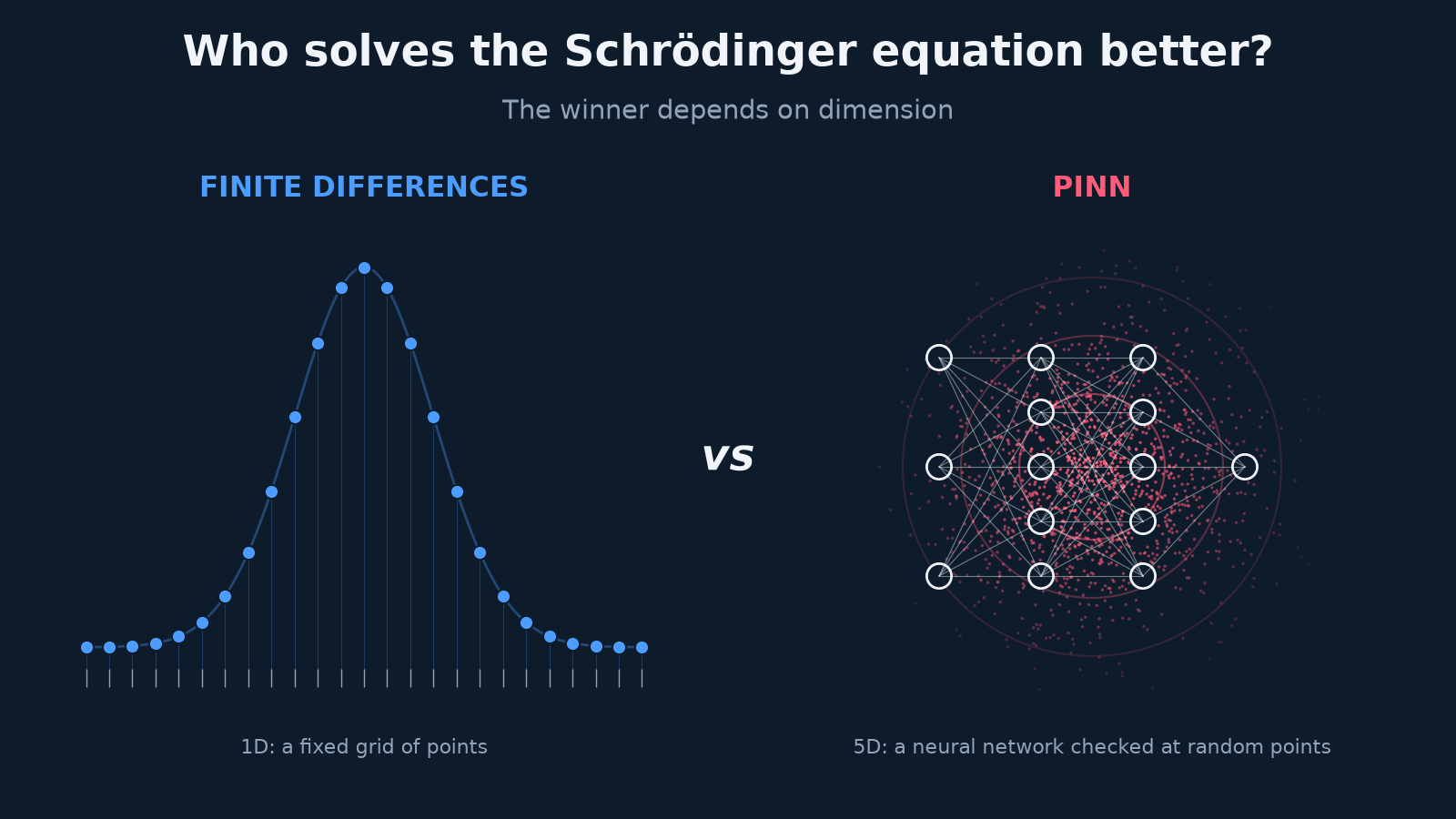
Classical numerical methods have a well-earned reputation for reliability, but this 1D versus 5D experiment reveals something worth paying attention to: the right tool depends entirely on the problem's dimensions. A plain finite-difference solver won the 1D contest handily, yet the physics-informed neural network took the lead when the problem expanded to five dimensions. That outcome is not a verdict against classical methods, it is a practical map of where AI-native approaches actually deliver value today.
For anyone who has felt the ceiling of traditional spreadsheets or conventional solvers, the lesson is direct. Low-dimensional problems are already well-served by established tools. But as complexity scales, the manual effort required to set up and tune classical solvers grows faster than most workflows can absorb. The neural network's ability to handle higher-dimensional spaces without a proportional explosion in setup cost is precisely the kind of capability that transforms how we approach data-heavy tasks. This echoes what we saw when Two AI copies keep drones and cloud in sync with 94% less data: efficiency gains come not from brute force but from smarter architectures that reduce overhead. The same principle applies here, the PINN wins not because it computes faster, but because it sidesteps the dimensionality curse that makes classical methods unwieldy.
We should be clear about what this does not mean. No one is suggesting that finite-difference solvers are obsolete. They remain precise, interpretable, and battle-tested. What this experiment does is give practitioners a concrete threshold: when your problem lives in low dimensions, stick with what works. When it climbs into five or more dimensions, it is time to explore alternatives. That is a practical decision rule, not a marketing slogan. It also aligns with the kind of nuanced thinking required when Real concurrency bugs, real fixes: a new benchmark for AI coding agents demands that we test AI not on toy problems but on the messy realities of production systems. Context determines performance.
The specific takeaway here is straightforward: if your team routinely works with high-dimensional data, simulations, optimization, or modeling across many variables, the physics-informed neural network is no longer a research curiosity. It is a viable tool that can outperform classical methods on the problems that matter most. The open question is how far this advantage extends. Does the PINN hold its lead at ten dimensions? Twenty? The experiment provides a clear starting point, and the next step is for practitioners to test their own high-dimensional workflows. That is the kind of exploration worth investing in.