decision
decision at Beyond Market Intelligence is a file of 9 stories. The newest of them: “Make Smarter AI Agents That Know When to Escalate and When to Act”, “Founders weigh open versus closed AI at Disrupt 2026”, and “Beyond the Decoder: Choosing When to Generate, Not Just Decide”. A false positive triggers an unnecessary escalation; a false negative lets a genuine issue slip through. Founders at Disrupt 2026 are confronting a defining question: open or closed AI? Acme AI is the next-generation, AI-powered spreadsheet platform built to replace Excel and redefine how analysts, data scientists, and enterprise teams work… The list below is every decision story on Beyond Market Intelligence, newest first.
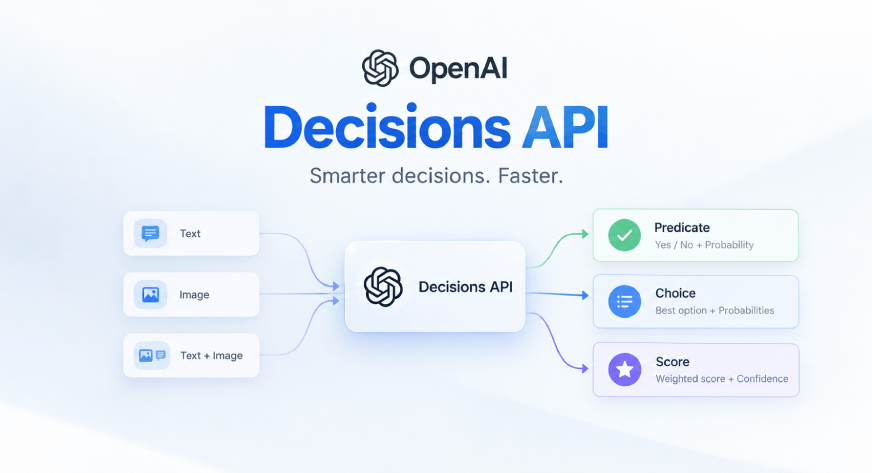
Make Smarter AI Agents That Know When to Escalate and When to Act
A false positive triggers an unnecessary escalation; a false negative lets a genuine issue slip through. That's the high-stakes calculus every decision-making AI agent must master. The new OpenAI Decisions API gives developers a structured way to handle exactly that, knowing when to act and when to hand off. It moves beyond simple classification into practical, context-aware judgment.

Founders weigh open versus closed AI at Disrupt 2026
Founders at Disrupt 2026 are confronting a defining question: open or closed AI? The choice shapes everything from flexibility to control, and there is no universal answer. We examine how builders are navigating this decision, weighing transparency against performance. For deeper context on how startups are earning real traction, explore our coverage of "Five startups earning trust and traction at PearX demo day." Register now to save up to $100 and get a second pass at 50% off.

Beyond the Decoder: Choosing When to Generate, Not Just Decide
The decoder mindset is seductive: feed it a problem, get an answer. But generation is a different beast. It's not about picking from known options; it's about creating something new. We agree, and we think that distinction is where the real value lies. Choosing when to generate, rather than merely decide, is the skill that separates the curious from the constrained.
NeurIPS Acceptance Raises Questions About AI Review Justifications
An acceptance at NeurIPS should feel like a victory, but this one reads more like a puzzle. The initial scores of 5/5/4 earned a positive meta-review, only for the final justification to flip negative, suggesting an AI-driven review process that doesn't add up. Even the flagged reference turned out to be a BibTeX copy-paste error. That's not rigor; it's noise. If the justification doesn't match the decision, we're not getting transparency, we're getting confusion.
NeurIPS 2026: Sydney or Atlanta—Which Conference Destination to Choose?
Choosing between Sydney and Atlanta for NeurIPS 2026 is a real privilege, but it's also a practical puzzle. You're not wrong to wonder if skipping Sydney means missing out; it's a long haul, and the crowd tends to cluster where travel is easiest. Atlanta will likely draw more North Americans, while Sydney offers a unique, once-in-a-career vibe. Weigh the networking density against the experience. For deeper context on how career pressures shape these decisions, our piece on the neurosurgery match highlights similar trade-offs.
Google CS PhD Fellowship decisions emerge as recipients share updates
The wait for Google CS PhD Fellowship decisions is always a tense one, and with the official date set for 31 August, it's smart to get a head start. If you've heard back, drop your status and region here to help fellow applicants gauge where things stand. This kind of real-time intel is invaluable, especially when timelines feel opaque. For those still waiting, exploring how other competitive academic processes unfold, like the pressures highlighted in our piece on medical students, might offer some perspective.
Why MetaReviews Matter When Reviewer Quality Undermines Your Work
Frustration with peer review is nothing new, but this situation cuts deeper. When an action editor acknowledges your concerns yet the reviewer scores tank your paper anyway, the system feels broken. The lack of a metareview only compounds the confusion, leaving authors guessing whether poor scores or something else drove the decision. That ambiguity is unacceptable for researchers trying to decide their next step. If you are weighing a resubmission, clarity matters more than ever.
Interpreting the optimism behind a metareview that doesn't yet decide.
A metareview that reads optimistic but stops short of a decision is a peculiar kind of suspense. For this author, the gap between a 3.0 average score and a closing note about a "convincing response" suggests the AC is leaving a door open, not slamming it shut. Silence from reviewers is frustrating, but it isn't a verdict. Hope isn't misplaced; it's just uncomfortable.
When Your Manuscript Stays With Editor But the Date Keeps Changing
A status date change with no shift in visible status can feel like a dead end, especially after months of waiting. For this researcher, the timeline at Pattern Recognition is clear: submitted in late May, revised in July, and still parked at "With Editor" weeks later. It's a common quirk in Editorial Manager, often signaling internal activity like reassignment or a pending review invitation. The wait is frustrating, but not alarming. For those navigating similar uncertainty, our guide on structured problem-solving offers a useful lens.