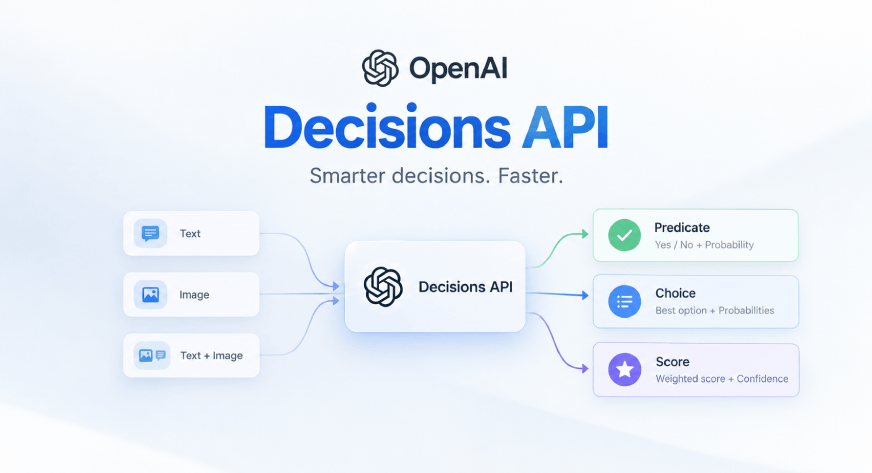
The OpenAI Decisions API is a pragmatic step forward, not a flashy leap, and that is exactly what makes it worth your attention. It addresses the quiet, costly problem of getting AI agents to know when to act and when to hand off, a challenge that has long been papered over with brittle rule sets. For anyone building automated workflows, this tool offers a cleaner path to reliable decision-making without forcing you to become a machine learning expert.
Consider the real-world stakes: a customer complaint that should go to billing gets routed to support, a delivery photo that is clearly fraudulent passes inspection, or a routine query triggers an unnecessary human escalation. Each false move erodes trust and wastes time. The Decisions API is designed to tackle these judgment calls by giving developers a structured way to define clear decision points, escalate, classify, validate, and then letting the model handle the nuance. This is not about replacing human judgment; it is about freeing it from the noise. As we have explored in our coverage of Explore How OpenAI's Decisions API Can Reshape Your Data Workflows, the real power lies in how it integrates into existing pipelines, not in any single feature. And this echoes a deeper pattern we have seen before: the idea of an agentic loop, where a system observes, decides, and acts, is not new. A A 2016 Patent Reveals the Agentic Loop Behind Analytics shows that these concepts of structured decision-making have been simmering for years, waiting for the right infrastructure to make them practical.
What this means for your day-to-day work is a reduction in the friction that comes from building custom classifiers or maintaining endless if-then logic. Instead of training a separate model for every binary decision, you can define the criteria in plain language and let the API handle the classification. This is especially valuable for teams that have been wrestling with the latency of local models for simple tasks. As we noted in Stop Waiting for Answers Your Local Model Already Knows, the wait for a local model to classify a single request can be a bottleneck. The Decisions API shifts that work to a remote endpoint designed for speed and consistency, which can dramatically streamline your flow.
The specific detail to watch is how OpenAI handles the trade-off between false positives and false negatives within the API's configuration. A tool that lets you tune this balance per use case is far more valuable than a black box that returns a single answer. If you can adjust the threshold for escalation based on the cost of a mistake, you gain control over the outcome, not just the output. That is the kind of practical lever that turns an interesting API into a daily workhorse.