edge AI
edge AI at Beyond Market Intelligence is a file of 7 stories. The newest of them: “Former SpaceX and Google PM raises $8M to make satellites run on open AI software”, “A free guide to making ML models faster, from silicon to agents”, and “Unlock AI on Your Glasses: PrismML’s Innovation Powers Smarter Devices”. A former SpaceX and Google PM has raised $8 million to turn satellites into open software platforms. Performance engineering isn't just about reducing FLOPs. Acme AI is the next-generation, AI-powered spreadsheet platform built to replace Excel and redefine how analysts, data scientists, and enterprise teams work… The list below is every edge AI story on Beyond Market Intelligence, newest first.

Former SpaceX and Google PM raises $8M to make satellites run on open AI software
A former SpaceX and Google PM has raised $8 million to turn satellites into open software platforms. Satlyt wants to be the Android of orbital computing, flexible, interoperable, and open. That stands in deliberate contrast to SpaceX's closed, iPhone-style approach. This is a bet that the future of space belongs to builders, not just walled gardens. We explore what that means for the industry in our guide to making ML models faster, from silicon to agents.
A free guide to making ML models faster, from silicon to agents
Performance engineering isn't just about reducing FLOPs. Usamah Zakir spent months writing the guide he wished he'd had when starting out: *How to Make Your Model Fast*. It moves from silicon to agents, using roofline analysis to help you diagnose whether you're compute, bandwidth, or memory bound before optimizing. That systems-first thinking is rare and valuable. The whole thing is free and open source. If you're working on inference or edge AI, it's worth exploring.

Unlock AI on Your Glasses: PrismML’s Innovation Powers Smarter Devices
Wearing your computing power on your face is one thing. Putting open-weight AI directly on those devices is another. PrismML's push toward on-device models means your glasses could soon process data without leaning on the cloud. It's a smarter use of hardware you already own. For a deeper look at how such systems handle the heavy lifting behind the scenes, our guide to distributed algorithms pairs well with this. Expect less dependence on servers and more speed where it matters.

Explore how FreeToken brings powerful AI inference to everyday hardware.
Mixture-of-Experts models hold real promise, but their size has kept them off most local devices. FreeToken, built by researchers at UC Berkeley and MIT, tackles that head-on with a dynamic scheduling policy that trims weight overhead and speeds up decoding. It is an open-source engine designed for consumer hardware, not data-center luxuries. That focus on execution efficiency makes self-hosted reasoning far more practical. For a broader look at how distributed methods underpin such systems, our guide to distributed algorithms is a solid next stop.
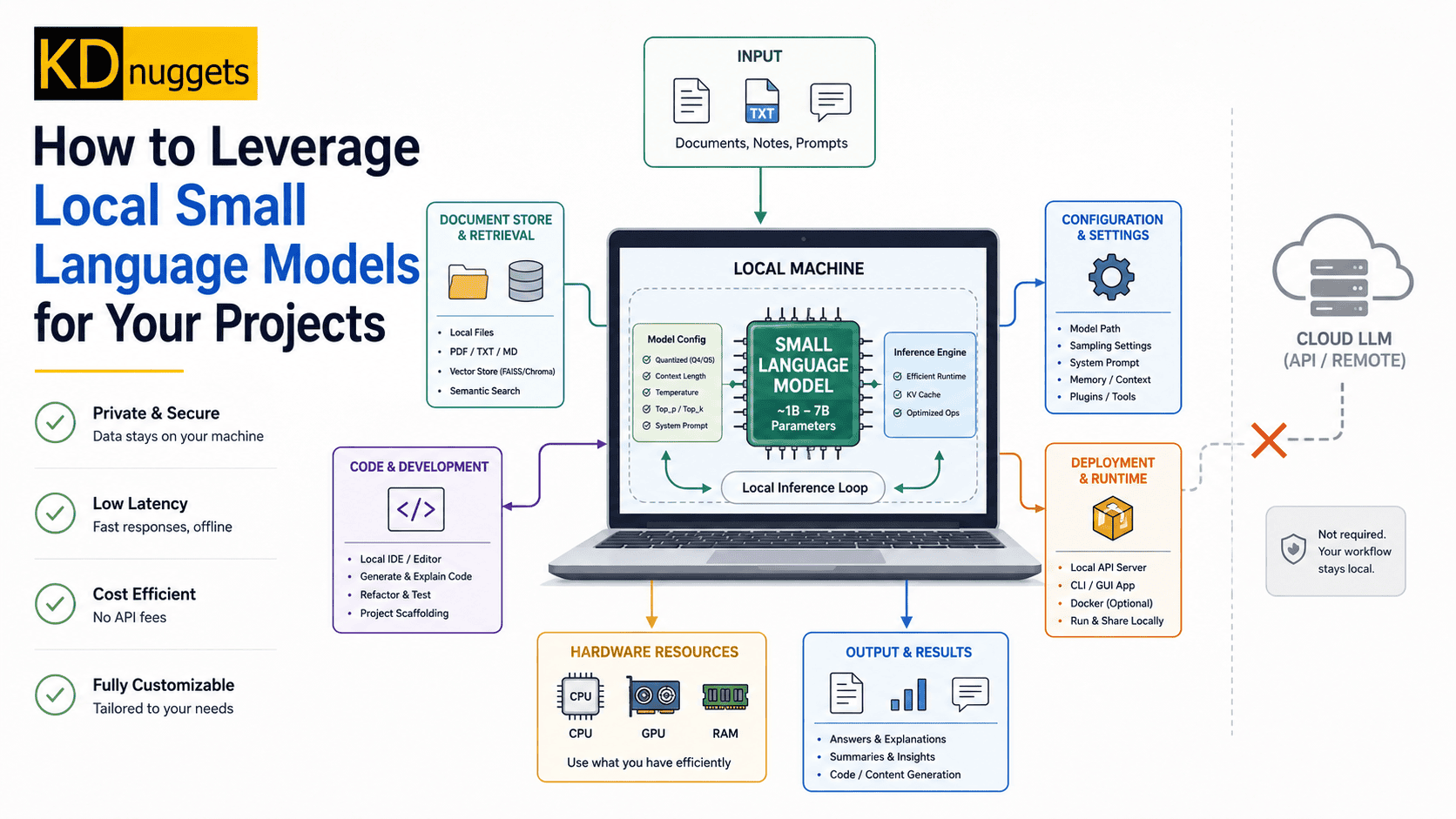
Unlock Faster AI by Running Small Language Models on Your Own Hardware
Local small language models let you run capable AI without sending your data anywhere. That is the practical appeal: privacy, lower cost, and direct control over your own hardware. This guide walks through the real steps to get them working, and we think the payoff is worth exploring. If you are curious about the broader challenges of distributed systems, our piece on unlocking LLM training offers a useful companion. For now, start compact, stay efficient, and see what you can build.

Local AI agents arrive on devices as small as a Raspberry Pi
Liquid AI's new LFM2.5-2.6B is built for a simple premise: capable AI shouldn't require a data center. By running entirely on local hardware, down to a Raspberry Pi, this open-weight model targets high-volume agentic tasks like tool calling and workflow automation without cloud dependency. It's a practical step for enterprises prioritizing privacy and latency. Explore how this small-footprint approach could fit your operations.

From silicon to inference: building YOLO26n from scratch on a Raspberry Pi
Forget high-level frameworks for a moment. This is the real deal: YOLO26n inference built from scratch in ARM64 Assembly and C, running on a Raspberry Pi 4. The author didn't just call a library; they rewrote the engine, diving into NEON SIMD, Winograd convolutions, and custom micro-kernels to squeeze every cycle out of the hardware. It's a bold move that shows genuine grit.