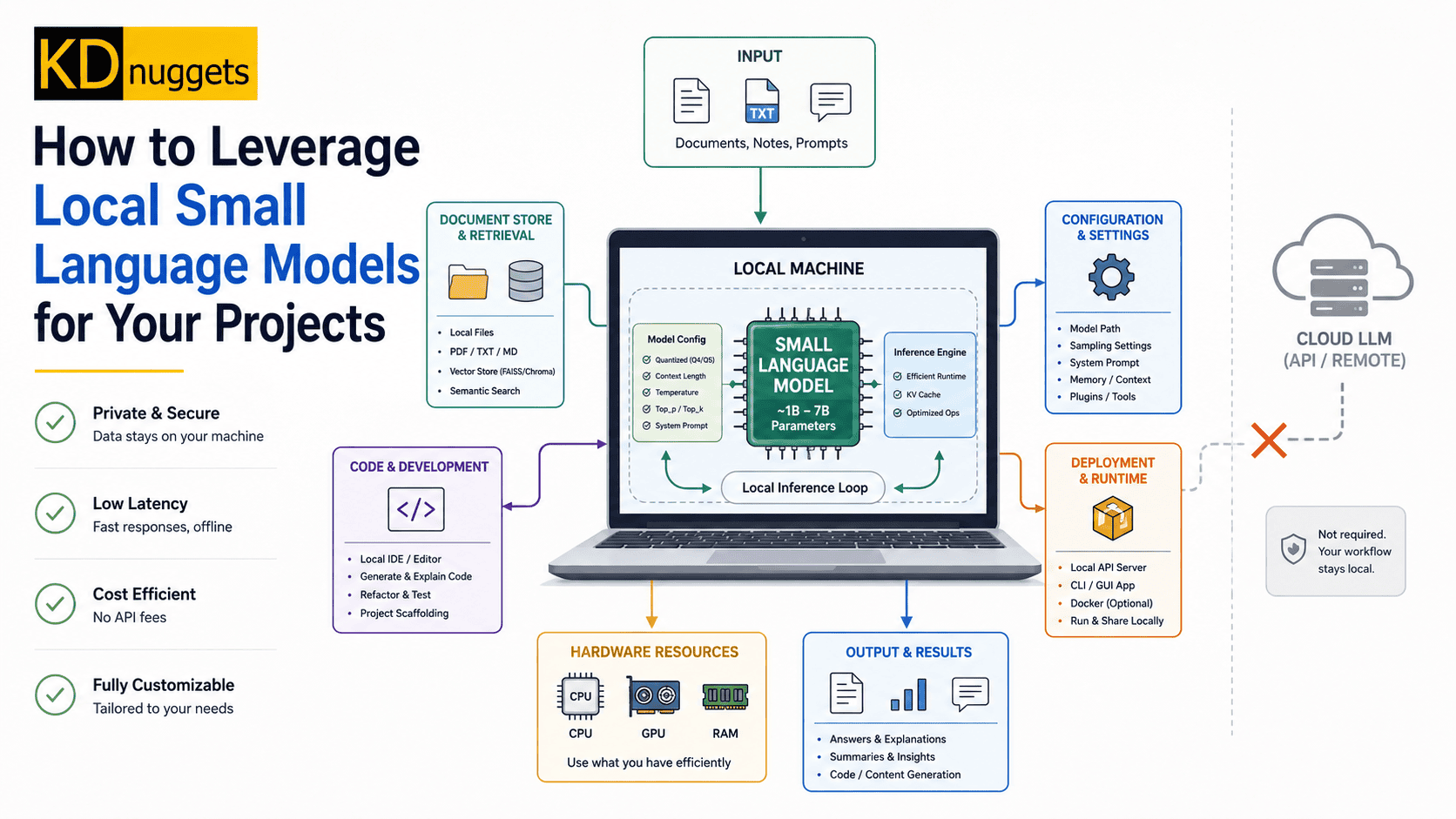
The quiet promise of running a large language model on a laptop instead of a cloud server is not about saving a few dollars on API calls. It is about taking back a measure of control that most users have quietly surrendered. A practical guide to local small language models is a useful entry point into a bigger conversation: who owns the data, who sets the limits, and who decides what the model is allowed to do. If you have ever felt a twinge of unease while pasting a spreadsheet of client names into a public chat interface, this is the direction worth exploring. The shift to local models is less about performance benchmarks and more about the simple, radical idea that your private work does not need to leave your desk to be useful.
We have written before about the strange discomfort of interacting with an AI clone and the ways it forces you to question the technology's limits. That piece, Talking to My AI Clone Taught Me to Question the Tech, touched on the emotional and ethical friction that appears when AI feels too personal. Local small models do not solve that friction, but they change the terms of engagement. When the model runs on your hardware, you are not just a user; you are the operator. That means fewer surprises about what gets stored, who sees it, and what happens when the network drops. An emphasis on speed and cost is fair, but the quieter benefit is autonomy. You are no longer renting intelligence by the token; you are owning a tool that works on your schedule, under your rules.
That said, local models are not a magic reset button. They come with their own constraints: smaller context windows, more setup friction, and the need to understand your own hardware. But that is not a weakness; it is a feature. The guide correctly avoids promising a frictionless experience, and that honesty matters. The process of Unlock LLM Training: A Practical Guide to Distributed Algorithms shows that even advanced AI workflows require a fundamental grasp of how systems interact. Local models are no different. They ask you to learn a little more, but the reward is a system that behaves predictably. For anyone tired of the black box, that trade is worth making. It is not about rejecting the cloud; it is about choosing when the cloud is necessary and when it is just a habit.
This also lands at an interesting moment for trust. As we have noted with Verify Your AI's Understanding: A Simple Check for Tax Season, verification is becoming a core skill for anyone serious about AI. Local models do not remove the need to check outputs; they just give you more room to do it without a third party looking over your shoulder. The takeaway is concrete: if you have a task that is repetitive, sensitive, or offline, a small local model is not a compromise. It is a deliberate choice to trade a little raw power for a lot of clarity. The next time you reach for an AI assistant, ask yourself what you are giving away. Then consider whether the answer is something you want to keep.