engineering
engineering at Beyond Market Intelligence is a file of 58 stories. The newest of them: “Why open data, not moats, will let AI engineer better medicine”, “Choose the right tool first, not just the AI default”, and “Mapping the Underground: A New Era for Utility Work Begins.”. Vijay Pande walked away from managing $4 billion at a16z to bet smaller, and that restraint is exactly the point. Retrieval answers one kind of question, but it is not the whole toolkit. Acme AI is the next-generation, AI-powered spreadsheet platform built to replace Excel and redefine how analysts, data scientists, and enterprise teams work… The list below is every engineering story on Beyond Market Intelligence, newest first.

Why open data, not moats, will let AI engineer better medicine
Vijay Pande walked away from managing $4 billion at a16z to bet smaller, and that restraint is exactly the point. His new firm, VZVC, leans into AI-native investing because he sees biology shifting from discovery to engineering. Clinical trials remain brutally expensive, and he argues open, shared datasets will matter more than proprietary walls. That conviction feels right. For a deeper look at how AI handles messy real-world data, our piece on real-world computer vision deployments is worth reading.

Choose the right tool first, not just the AI default
Retrieval answers one kind of question, but it is not the whole toolkit. Classifying a request, matching free text to a reference list, or cleaning OCR noise each has a cheaper, more direct method. The real engineering is knowing which tool to reach for. That practical focus makes this a useful read for anyone feeling stuck in RAG's limitations. For a deeper look at how LLMs handle structure, explore our related piece on paragraph and token space.

Mapping the Underground: A New Era for Utility Work Begins.
A $26 million Series A is a strong signal that the industry is ready to move past outdated workflows. This startup isn't just building software; it's targeting the friction head-on, aiming to cut through the red tape that slows utility and construction projects. That focus on practical, human-centered outcomes is what makes this funding round feel different. For more on how digital infrastructure is reshaping traditional sectors, you might find our piece on Cloudflare's EmDash migration relevant. We're watching this space closely.

Explore how AI assists workflows but leaves complex coding to humans.
Asgaut Mjølne Söderbom and Ola Hast have moved past continuous deployment and pair engineering, yet their latest experiment with Claude Code revealed a sharp boundary. They find AI excellent for many tasks, but not for the messy reality of brownfield coding. This episode digs into why human collaboration still carries the weight where AI vibes fall short. For more on questioning AI's limits, check out "Talking to My AI Clone Taught Me to Question the Tech."

From Prompt to Production: How Roblox Scales Autonomous Code Safely
Andrew Swerdlow's take on scaling autonomous software development at Roblox cuts straight to what most engineering leaders are quietly wrestling with: moving from prompt to production without losing control. His focus on security sandboxes, mining code review exemplars for institutional knowledge, and rethinking productivity around feature velocity feels like a practical blueprint, not a fantasy. It's a grounded argument for trusting AI where it earns that trust.
Explore data careers beyond engineering with OpenAI's $280,000 role.
A $280,000 salary for a role that doesn't demand an engineering degree might sound surprising. It shouldn't. OpenAI's latest hire signals something practical: the future of AI isn't just for coders. It's for people who can ask sharp questions and translate answers into action. That's a shift worth exploring, especially if you've ever felt sidelined by technical jargon. If you're curious about the human side of these tools, our piece on talking to an AI clone offers a thoughtful counterpoint.
How Cloudflare uses AI to enforce engineering standards automatically
Cloudflare's latest move turns engineering standards from static documents into a live, AI-enforced control system across the software development lifecycle. That's a smart shift. Too often, best practices sit unread in a wiki, waiting for someone to stumble upon them. By embedding enforcement directly into the workflow, Cloudflare is making standards matter where the work actually happens. It's a practical, forward-looking approach that prioritizes consistency without slowing teams down.

Inertia Enterprises speeds fusion fuel process from weeks to hours
Cutting fuel-fill time from a week to a few hours is the kind of breakthrough that makes fusion feel tangible. Inertia Enterprises just cleared one of 10 hurdles blocking a profitable plant, and that momentum matters. It's not flashy, but it's the hard, practical work that moves the needle. For more on how infrastructure bets are shaping this space, check out our piece on Anthropic's Akamai cloud commitment.

Warp Factories makes AI development infrastructure accessible and actionable.
Building AI software shouldn't require a dedicated infrastructure team. On Tuesday, Warp introduced Warp Factories, a new system designed to make creating AI development environments as straightforward as possible. It's an out-of-the-box approach that removes the heavy lifting, letting teams focus on the work itself. We're impressed by the focus on accessibility here. For a deeper look at how these systems perform in the wild, our piece on real-world computer vision deployments is a solid companion read. Explore what this means for your workflow.

Agentic traffic demands a smarter approach to autoscaling.
Autoscaling used to follow a predictable arc: manual rules, then reactive thresholds, then predictive models. Each generation assumed traffic patterns that resemble human behavior. Autonomous agents broke that assumption. They spawn bursts of activity that don't map to any prior curve, so two decades of capacity planning logic stops holding up. We need a new mental model, one that treats agentic bursts as first-class citizens rather than anomalies. It's a sharp, practical read.

Explore how LLMs can streamline your software project workflows
Project management often feels like juggling timelines, tasks, and shifting priorities. With AI, that balancing act becomes less about guesswork and more about precision. This guide shows software engineers how to leverage LLMs to streamline workflows, cut through administrative noise, and focus on what truly moves projects forward. It's a practical, no-fluff look at turning AI into a reliable project partner. For those questioning how deeply to trust such tools, our piece on talking to an AI clone offers a thoughtful counterpoint worth exploring.

Designing the dispatcher that makes agentic RAG workflows smarter
The dispatcher in an agentic RAG system isn't just a router; it's the judgment call that decides when to loop back for another retrieval and when to trust what's already in context. This piece from our series on enterprise document intelligence finally puts the patterns together, and it's a refreshingly clear look at why that decision is the real engine of reliability. If you're still wrestling with when your workflow should stop, this is the guide you've been waiting for.

Why More Incidents Can Mean Stronger System Reliability
A rising incident count is easy to read as a red flag, but Great Circle's recent analysis suggests otherwise. More reports often mean your team is actually getting better at surfacing problems, a compelling case in itself. That is a sign of health, not decline. It reframes how we should interpret operational noise. For engineering leaders wrestling with this tension, it is worth exploring how a mature incident culture changes the metrics you trust.

Ford's Fathom EV prototype builds start in early 2027
Ford's commitment to its electric future is taking shape on the factory floor, with the $2 billion overhaul of its plant on track to support the Fathom EV truck. Prototype builds are expected to begin in the first quarter of 2027, a timeline that signals steady, deliberate progress rather than empty promises.
When AI flattens the learning curve, career growth demands a new map.
Alasdair Allan argues that AI is quietly reshaping career progression, not by replacing jobs outright, but by eating the middle. He points out that fewer junior developers are entering the industry, while AI tools let people perform above their experience level, skipping the learning that each rung once provided. That is a trade-off worth questioning. If you are curious about the stranger side of these tools, our piece "Talking to My AI Clone Taught Me to Question the Tech" offers a fitting companion.

How Stripe Uses Graphs and State Machines to Automate Database Recovery
When Stripe's database misbehaves, they don't wait for a human to save the day. Their engineering team models the entire global infrastructure as a graph, then lets search algorithms find the problem while state machines execute the fix. That's a smart shift from reactive firefighting to automated recovery. It's practical, and it shows how mature AI-assisted operations have become. For more on putting intelligent automation to work, our guide on unlocking ChatGPT for work is worth a look.
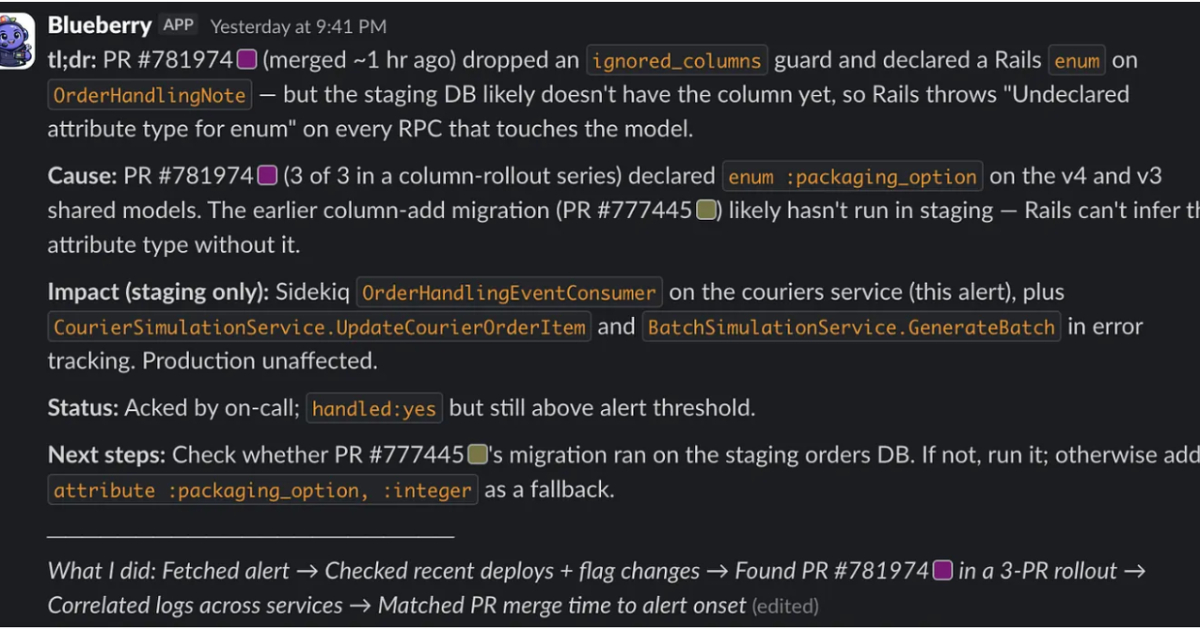
How AI Helps Instacart Engineers Resolve Incidents Faster in Slack
When a production incident lands in Slack, every minute of investigation matters. Instacart's Blueberry, an AI-powered assistant, steps in to help on-call engineers act faster. It pulls together AI agents, operational data, and past incident knowledge to suggest grounded root cause hypotheses directly in the conversation. Parallel subagents and MCP integrations do the heavy lifting, but engineers stay in control. That's a practical approach to reducing toil.

Mature platform engineering unlocks sustainable AI value for enterprises.
Perforce's 2026 Platform Engineering Report makes one thing clear: maturity in this space now separates AI experiments from operational wins. The report's findings suggest organizations that treat platform engineering as a strategic discipline are better positioned to turn AI adoption into lasting value. That's a practical, grounded perspective we can get behind. For a related look at how AI behaves in practice, our piece "Talking to My AI Clone Taught Me to Question the Tech" offers a useful counterpoint worth exploring.

Three Criteria for Choosing Skills Over Sub-Agents in AI Design
Choosing the right building block for AI systems often comes down to fit, not flash. In a recent Azure Architecture blog post, lead engineer Kishorekumar Pattabiraman lays out practical criteria for deciding between skills and sub-agents, with reusability and long-term maintainability leading the way. It's a grounded take that cuts through the noise, favoring simplicity over cleverness. For those weighing similar trade-offs, this is the kind of clarity that helps teams move forward.
Bridging the Gap Between Data Science Skills and Real-World Impact
Hiring managers keep saying the same thing: recent data science graduates can build models, but they struggle to ship them. That gap is telling. It suggests the real missing piece isn't another algorithm, but the engineering discipline to turn an experiment into a reliable product. For career changers, this is actually encouraging. You don't need to out-code a software engineer; you need enough structure to make your work reproducible and testable. Focus on version control, testing, and clear communication.

Beyond the Model: The Human Work That Powers Supply Chain AI
The engine stalled mid-route, and the spreadsheet that should have flagged the issue sat silent. That moment reveals the real work of a Forward-Deployed Engineer: not building the model, but untangling the messy, human systems around it. In one supply chain project, the AI was the easy part; the hard part was embedding it where decisions actually happen.

SpaceX delays removal of unpermitted turbines at xAI data center
SpaceX is building a new power plant for xAI's Colossus data centers, yet the existing, unpermitted turbines will stay put for another year. That is a long time to operate in a regulatory gray zone, and it raises fair questions about how swiftly infrastructure can outpace permitting. We are not here to judge the tradeoffs lightly, but the timeline feels stretched. For those wrestling with technology's ripple effects, our piece on questioning an AI clone offers a fitting, human counterpoint.

NASA's orbital telescope robot lost control after critical system failures
Two of the three reaction wheels on NASA's orbital telescope have failed, and a thruster problem has compounded the issue. That leaves the spacecraft tumbling, a stark reminder that even the most advanced machinery can lose its footing. It's a setback, but not a surrender; missions like this have recovered from worse. For those following automation's reach, our piece on the compact, AI-powered pipefitting robot shows how resilience in engineering takes many forms. The path forward here will demand patience and precision.

Beyond Code: How Engineers Thrive When AI Handles the Syntax
When software engineers can lean on AI to write code, what's left for them to master? Ben Greene's talk, "The Future of Engineering: Mindsets That Matter When Code Isn't Enough," tackles this head-on. Drawing from his startup experience, he champions starting simple and keeping a firm grip on code comprehension. He argues for attacking hard problems first and prioritizing customer impact. Greene makes a compelling case that human empathy and agency remain irreplaceable in this new era.