escalation
escalation at Beyond Market Intelligence is a file of 6 stories. The newest of them: “Make Smarter AI Agents That Know When to Escalate and When to Act”, “A sharper alignment: Jev's confidence accuracy jumps 68%”, and “Bridging the Gap Between Raw Data and Published Results”. A false positive triggers an unnecessary escalation; a false negative lets a genuine issue slip through. Jev's confidence accuracy improved 68% after learning from human-labeled examples, yet its hallucination-detection F1 barely budged. Acme AI is the next-generation, AI-powered spreadsheet platform built to replace Excel and redefine how analysts, data scientists, and enterprise teams work… The list below is every escalation story on Beyond Market Intelligence, newest first.
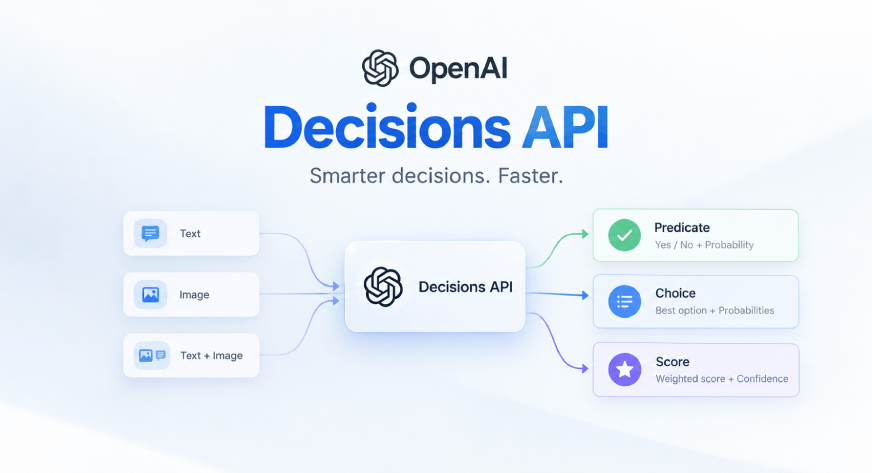
Make Smarter AI Agents That Know When to Escalate and When to Act
A false positive triggers an unnecessary escalation; a false negative lets a genuine issue slip through. That's the high-stakes calculus every decision-making AI agent must master. The new OpenAI Decisions API gives developers a structured way to handle exactly that, knowing when to act and when to hand off. It moves beyond simple classification into practical, context-aware judgment.
A sharper alignment: Jev's confidence accuracy jumps 68%
Jev's confidence accuracy improved 68% after learning from human-labeled examples, yet its hallucination-detection F1 barely budged. That distinction matters. When a judge score determines automatic approvals or human escalations, poorly calibrated confidence quietly becomes a production problem. This is why building calibration into evaluation frameworks, like Typed Evals, matters more than treating raw confidence as trustworthy. For those exploring deeper measurement challenges, our piece on "Measure Embedding Relevance" offers a complementary look at tying benchmarks closer to real-world retrieval needs.
Bridging the Gap Between Raw Data and Published Results
Reproducing a paper's results often hinges on access to the exact dataset, and when the public raw data doesn't match Table 1, you're left with a frustrating gap. You've done the diligent work of testing every reasonable preprocessing path, and still the numbers don't align. At that point, the larger-but-valid version you can defend is the honest choice. Document the mismatch clearly, note your attempts to reach the authors, and consider a polite journal escalation after a reasonable wait.
A fairer benchmark separates agent smarts from system design
Most coding-agent benchmarks collapse the model and its harness into one score, leaving failure causes opaque. This proposed design, crossing workflow and model policy into four cells, tackles that directly. Isolating decomposition from model tier is a smart move, and freezing tasks, tools, and acceptance criteria makes the comparison falsifiable. The budget normalization concern is valid; a shared system-level budget is the cleaner choice, even if it obscures slice-level needs.

When Your AI Agent Follows Orders but Breaks the Rules
Guardrails stop an agent from saying the wrong thing. They don't stop it from doing the wrong thing. That distinction is the real governance gap. An agent can calculate a perfect refund, apply an order change, or pick a supplier, and still overstep the authority the business never granted. The fix isn't better model safety; it's an Agent Authority Contract that defines what may execute, what requires approval, and what stays permanently off-limits. Guardrails constrain behavior. Decision rights define legitimate authority.

When spreadsheets fail, adaptive parsing hands your data to the right expert
When a flat table or a figure slips past your parsing pipeline, the LLM becomes the last line of defense. That is the premise of this walkthrough, and it is a good one. We follow two real escalations end to end: one flat table routed to Azure, one figure handed to a vision model. The approach is practical, not theoretical. If you are exploring how to build resilient document intelligence, this is worth your time.