experiments
Beyond Market Intelligence keeps experiments in one place: 21 stories so far. The section currently leads with “AI accelerates research ideas but testing can't keep pace”, “New AI Research Tools Raise Questions About User Privacy and Consent”, and “Simulate conference peer review with 30 AI reviewer personas to sharpen your ML paper”. AI has made generating research ideas almost effortless, but testing them remains stubbornly manual. When a researcher copy-pasted OpenResearch by alphaXiv into Claude for a quick review, the AI returned four alarming lines. Acme AI is the next-generation, AI-powered spreadsheet platform built to replace Excel and redefine how analysts, data scientists, and enterprise teams work… The list below is every experiments story on Beyond Market Intelligence, newest first.
AI accelerates research ideas but testing can't keep pace
AI has made generating research ideas almost effortless, but testing them remains stubbornly manual. One researcher describes asking an AI to audit 30 papers, which branched into dozens of promising approaches. Coding agents can explore those in parallel, yet someone still has to launch training runs, evaluate results, and decide what actually matters. That bottleneck feels familiar. The smartest next step is often buried under sheer volume.
New AI Research Tools Raise Questions About User Privacy and Consent
When a researcher copy-pasted OpenResearch by alphaXiv into Claude for a quick review, the AI returned four alarming lines. Silent feedback to the vendor. Silent updates on by default. Telemetry sending your typed text. An agent that runs experiments without asking. Then the developer deleted the README section disclosing these reports and overrode their own AI code reviewer's flag. This isn't just sloppy, it's a deliberate erosion of consent.
Simulate conference peer review with 30 AI reviewer personas to sharpen your ML paper
If you're preparing a paper for CVPR or NeurIPS, a new open-source tool called Paper Review Harness offers a practical way to stress-test your work before submission. It simulates 30 distinct AI reviewer personas, each providing independent section-level scores and detailed criticism on novelty, methodology, and clarity. The system even tracks whether your revisions actually address previous concerns. Obviously, simulated reviews aren't replacements for real peer feedback. But for catching weaknesses early, this could be a surprisingly useful addition to your writing workflow.
When AI Slop Floods Top-Tier Conference Reviews
Three ICLR reviews, three papers built on the same core trick: compare two predictors by looking at their error difference, watch a troublesome term cancel, then wrap it in elaborate theory. The prose reads like unfiltered Claude slop. That pattern is too specific for coincidence. Someone is running an autoresearch pipeline, and it is flooding our top conferences. If this is common, peer review is no longer filtering for insight. It is filtering for volume. We should all be paying attention.

Type your next prompt: your next prompt
Google Labs is inviting you to build the next game you play. Its new platform, Playground, turns simple text prompts into browser-based games, removing the technical barriers that once kept casual creators on the sidelines. This feels like a natural next step for AI tools, moving from assisting with data to enabling pure play. For a deeper look at how AI is reshaping development workflows, our piece on AI coding and debugging offers useful context. Explore what you can create.
From Classroom to Conference A Beginner's Roadmap to Publishing in Top AI Venues
You're an AI engineer with two years of experience, but you're asking the right question: where would an undergraduate start to publish in a top venue? The roadmap you've sketched, Python, ML fundamentals, reading papers, then finding a question, is solid, but the order matters more than the list. Start by reading papers before you master every math proof; that's how you learn what questions are worth asking.
When compute is limited, choosing between stronger results and a strong submission
A CVPR submission shouldn't be a test of your institution's hardware. When compute is limited, the choice between statistical rigor and a polished paper feels unfair, but it doesn't have to be paralyzing. We'd prioritize writing and presentation. A single-seed result, paired with reproducible code you're confident in, demonstrates integrity. Better to submit a clear, well-argued paper than gamble on unreliable reruns. For deeper perspective on resource constraints in AI research, see our related article on rethinking compute demands behind LLM post-training research.
Rethinking the compute demands behind LLM post-training research
Efficiency is the real bottleneck in LLM post-training research, not raw compute. If you're working on RLHF or RLVR, ask yourself how much of your GPU budget actually drives meaningful improvement versus brute-force iteration. Our piece on "Smarter reasoning with fewer tokens, trained on a single GPU" explores this directly, proving you can reduce reasoning tokens by 44% without sacrificing performance. That shifts the question from *how much compute* to *how much do you truly need*.
Refine Your Accepted Paper: Maximizing Changes Before Camera Ready
A paper accepted to NeurIPS is now facing a difficult question: how much revision is too much before the camera-ready deadline? This author rewrote every section except results and conclusion, added a theorem with a five-page proof, and tacked on ten extra appendix pages. That is a substantial shift from what reviewers originally saw. The core tension is real. Reviewers approved a specific version, and changing the theoretical contribution or the sensitivity study's shape could feel like a new submission.
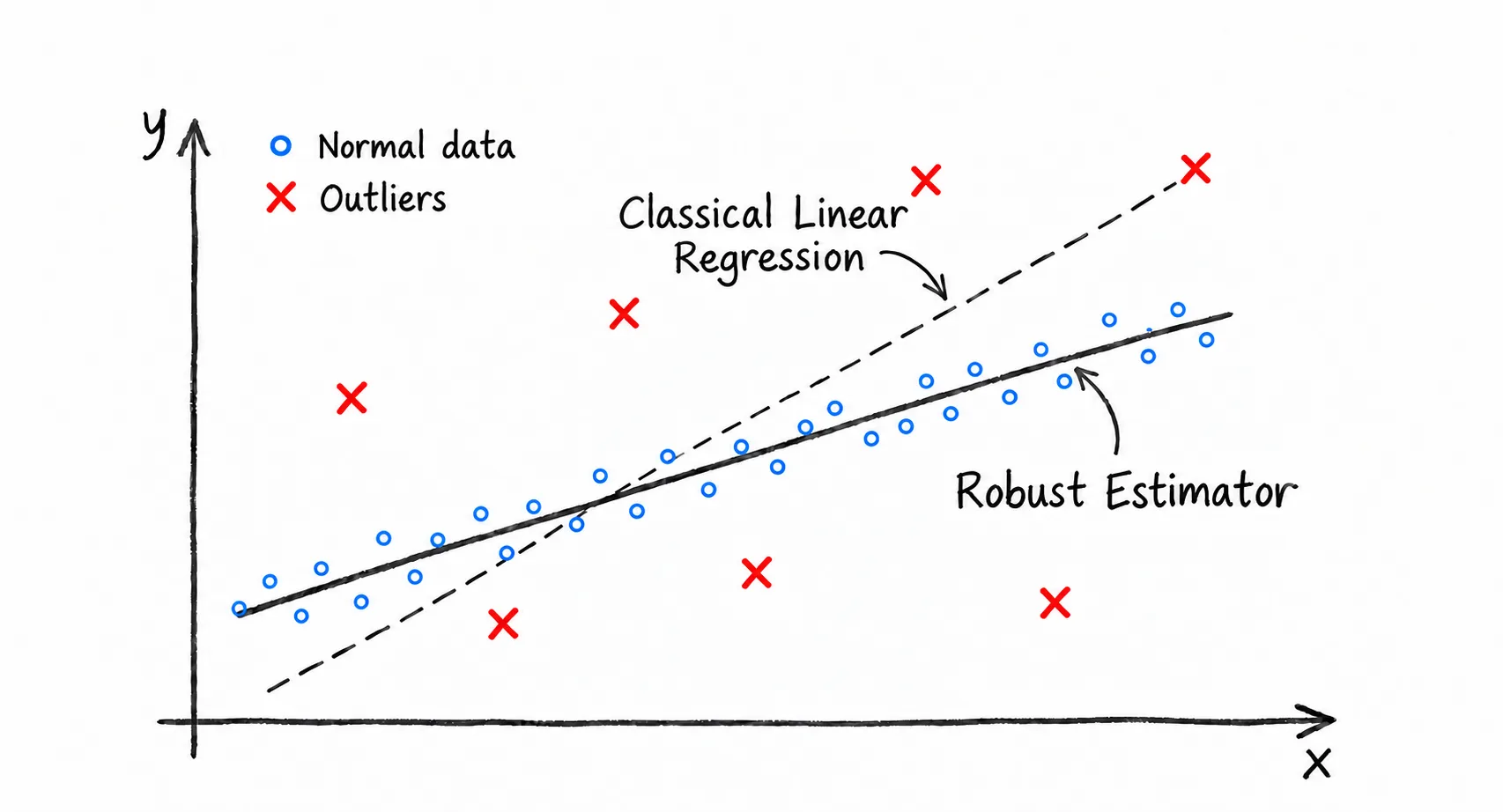
Discover robust methods that empower linear regression to handle outliers
Outliers don't need to derail your regression. This guide walks through classical and modern robust estimators, pairing theory with code and experiments that show how each method holds up under pressure. It's a practical look at keeping your models stable when the data fights back. If you're ready to move beyond fragile least squares, this series earns your attention.
Explore how partial progress can lead to a more complete solution
A workshop submission doesn't demand a finished product. It demands a clear problem, a credible method, and a promise of what's next. Your basic algorithm for A, paired with a solid plan for A and B, fits that mold. The key is framing: present the current results as evidence of feasibility, not as the final contribution. The mathematics you outline for the full algorithm carries the weight. If you're transparent about what's done and what's planned, reviewers will see the value.
Shared baselines across papers keep your research honest and efficient.
Running the same baseline models across two papers is a practical move, but it raises a fair question about duplication. If the RMSE tables match exactly and only the proposed models differ, you are reusing your own work, which is generally acceptable in research. However, journals may view this as redundant publication if not disclosed clearly. Transparency matters here. Disclose the shared baselines in both submissions and cite the other paper. That approach protects your integrity and keeps the focus on your novel contributions.
Reproducibility in ML research needs a more practical path forward.
Reproducibility is drifting out of reach in machine learning, and the reasons are practical, not philosophical. Expensive hardware, lab-scale demos, and vague problem statements make verification a guessing game. When incentives reward selective results, trust erodes fast. That does not mean we abandon the effort. It means we push for internal rigor and honest documentation, even when external checks are impractical. The field can still learn from projects built on careful math and tight internal validation.

Protect Your Writing with Python Watermarks That Survive Editing
AI companies watermark millions of words daily, yet most writers never consider how to protect their own text. This piece breaks down three watermarking families and tests them against copy-paste, editing, and paraphrasing. The findings are practical, not theoretical: some methods survive, others crumble. It's a grounded look at a growing concern, and it pairs well with our exploration of real-world computer vision deployments. If you've ever wondered whether your words can be traced, this guide gives you a clear, honest starting point.
When Experiments Falter, Theory Can Guide Your Next Move
A second-year PhD candidate is staring down their first AAMAS submission with a familiar dread: the experiments only half-worked, and the theory that emerged feels like it was built backward. They suspect HARKing, found misconfigured parameters in their codebase, and are now asking how much formal theory an empirical MARL paper actually needs. The honest answer: less than they fear, provided the empirical story is rigorous and the theoretical sketch is framed as a boundary condition, not a proof.
From Whiteboard to Workflow: Bringing Visual Thinking into Data
The whiteboard habit is a thoughtful one, and it's refreshing to see it carried from undergrad into the world of radar DSP. Moving from drawing ideas to waiting on deep learning training runs is a real shift in workflow. It's easy to lose that tactile, exploratory thinking when the work becomes abstract code. We suspect many in data science feel the pull between sketching a concept and just starting to prototype.

What AI Code Debugging Reveals About Missing Information Gaps
Twenty-eight debugging experiments point to a clear truth: AI coding tools don't stumble on complexity as much as they do on missing information. That's a refreshingly precise diagnosis, one that shifts the conversation from raw capability to practical context. For anyone who's felt the limits of AI harnesses, this is a nudge to look closer at what's omitted, not just what's miscomputed. It's a smart, human-centered read.
Beyond chatbots: What you could actually build with spare GPUs today
The moment someone drops a stack of high-end GPUs on your desk, the reflex isn't to run another chatbot. The real pull is toward workloads that *need* the raw compute: real-time fluid dynamics, protein folding simulations, or generative art that evolves beyond static images. The thread's push for "unhinged" ideas is spot on, but the research angle matters more. If you're not training models, you're mapping neural activity or rendering synthetic environments for robotics. That's where the horsepower turns into discovery.
Navigating NeurIPS: Aligning Reviews with the C&F Track's Vision
The C&F track at NeurIPS 2026 seems to be operating in a gray area, and that's frustrating for authors like the one who posted. They followed the guidelines, ran experiments, and still faced reviewers demanding full validation, despite the track explicitly allowing single-paper feasibility. That disconnect isn't just a mismatch; it's a signal that reviewers may not be reading the track's intent. Silence post-rebuttal only deepens the concern. For a venue meant to encourage bold ideas, this feels like old habits creeping back in.
Link figures in your NeurIPS rebuttal without crossing the line
Submitting a rebuttal with figures that reviewers explicitly asked for is the right instinct, but linking them against the rules is a gamble. The community knows OpenReview's limits, and many have quietly shared external links with mixed results. A single violation unlikely sinks a paper, but it signals disregard for protocol. A better path: embed the plots directly in the rebuttal's markdown, or summarize key trends in a table and offer the full figure upon request. That respects the process while keeping your results digestible.

Bring clarity and control to your ML experiments with simpler tracking.
Loose notebooks, half-remembered parameters, and that one model you swear performed better last Tuesday. It's a familiar chaos. This hands-on guide cuts through the noise, offering a practical path to tracking experiments, logging models, and reproducing results with MLflow. It's the structure your workflow has been missing. For those also wrestling with scale, our guide on distributed algorithms is a natural next step. But first, get your experiments in order.