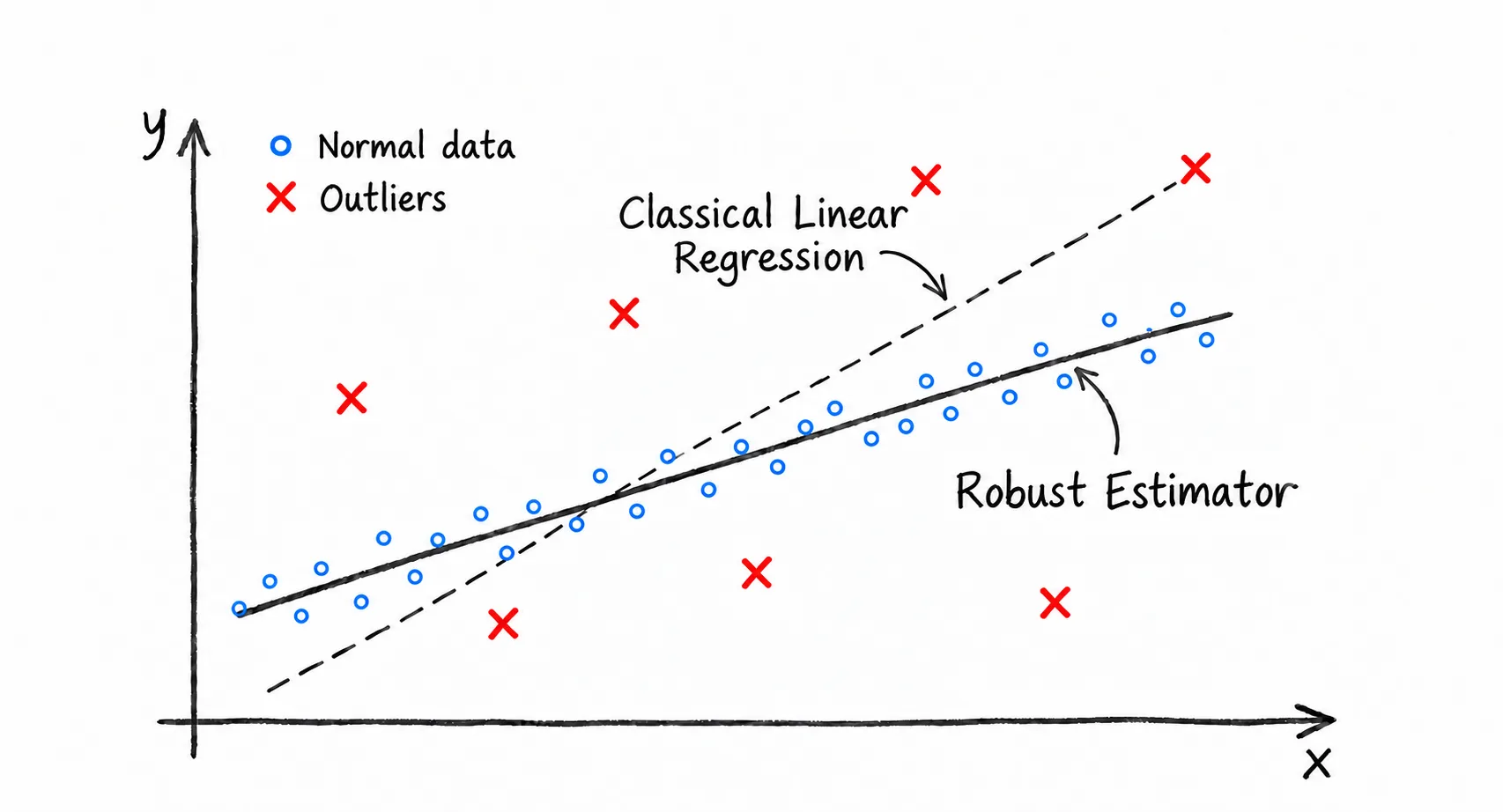
Most data professionals have felt the quiet panic of watching a single bad point drag an entire regression line sideways. Robust estimation, which compares classical and modern estimators through theory, code, and experiments, speaks directly to that frustration. It is not a plea to abandon familiar tools, but an invitation to understand why ordinary least squares falters when outliers appear, and what alternatives offer instead. This matters because so many of us were taught one method, trusted it implicitly, and never questioned its assumptions. It asks us to pause and consider that the problem may not be our data, but our default toolkit.
What stands out is the practical bridge the author builds between mathematical theory and real-world application. Classical estimators like ordinary least squares are elegant, but they optimize for a world where every point behaves. Modern robust estimators, by contrast, are designed to resist the pull of anomalies, trading a bit of theoretical efficiency for a lot of practical stability. The experiments are not abstract exercises; they show measurable differences in performance when outliers are present. This is where the piece connects to a broader theme we have explored before, such as in Unlock LLM Training: A Practical Guide to Distributed Algorithms, where understanding the underlying mechanics of a system often reveals why certain approaches fail under stress. Similarly, here, the lesson is that robustness is not a luxury but a necessity when your data refuses to behave.
It also nudges us toward a mindset shift that feels timely. We are increasingly surrounded by messy, real-world data, and the tools we rely on must evolve. This is not unlike how Exploring Paragraph Structure: How LLMs Navigate Token Space challenges us to rethink how large language models organize information, moving beyond surface-level token positions to deeper structural patterns. Both pieces reward readers who are willing to move past surface-level familiarity. The takeaway is not that classical methods are useless; rather, it is that knowing when to abandon them is a superpower. If you have ever watched a single outlier silently dominate your model, robust estimation is worth your time, because it gives you the language and the methods to fight back.
The concrete point we would leave you with is this: run your own experiment. Take a dataset you know well, introduce a few deliberate outliers, and compare how ordinary least squares and a robust estimator perform. It gives you the code and the framework, but the real learning comes from seeing the divergence with your own eyes. That is the moment the theory becomes instinct, and it is the kind of insight no amount of reading can replace.