fields
fields at Beyond Market Intelligence is a file of 5 stories. The newest of them: “Turn rows of data into columns with one intelligent move”, “Discover how Python dataclasses transform code with validation and computed fields.”, and “From a Million Files to One Clean Table: Structured Extraction for Real Queries”. Manually transposing 385 spreadsheets is a recipe for burnout, especially when the fields you need are always in the same spots. Most developers treat dataclasses as a shortcut for writing `__init__` and `__repr__`. Acme AI is the next-generation, AI-powered spreadsheet platform built to replace Excel and redefine how analysts, data scientists, and enterprise teams work… The list below is every fields story on Beyond Market Intelligence, newest first.
Turn rows of data into columns with one intelligent move
Manually transposing 385 spreadsheets is a recipe for burnout, especially when the fields you need are always in the same spots. This isn't a skill problem; it's a tool problem. The request is simple, but the repetition makes it painfully inefficient. Automating this with a script is the only sane path forward, and it's worth exploring a solution that turns this tedious chore into a one-click win.
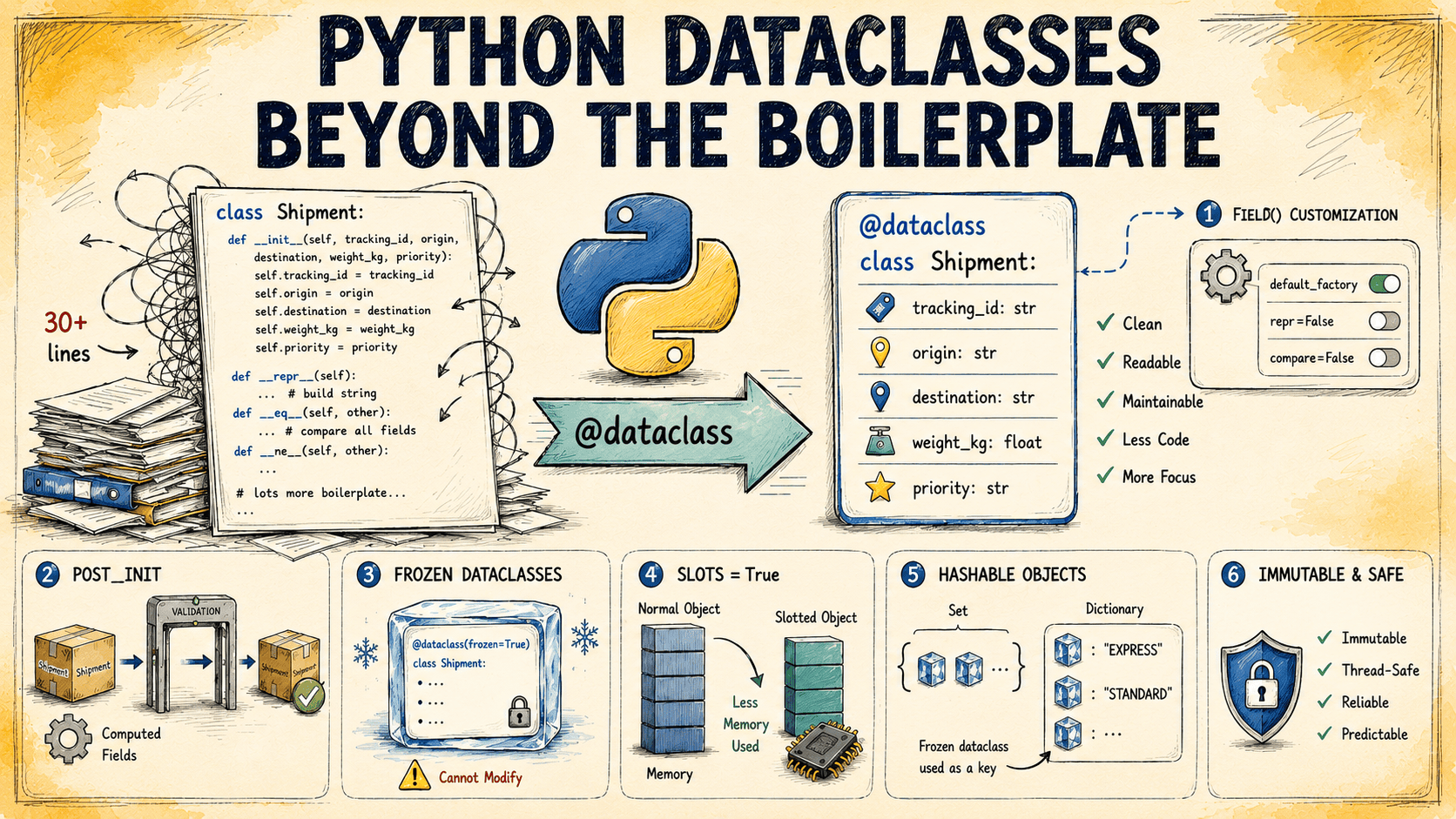
Discover how Python dataclasses transform code with validation and computed fields.
Most developers treat dataclasses as a shortcut for writing `__init__` and `__repr__`. That's only the surface. Custom fields, validation, and computed attributes turn dataclasses into a real tool for modeling data. Immutability and memory optimization get attention too. If you're already exploring smarter Python techniques, "Unlock Python's Potential: Advanced Techniques for Smarter Coding" pairs well with this deeper look. The goal isn't less code. It's better structure.

From a Million Files to One Clean Table: Structured Extraction for Real Queries
Two people, one hour, six to ten fields. That is the entire setup for turning a single document type into a million structured rows, and the two signals that define a real column are the ones that keep a filter from breaking later. It is a focused, practical read. If you want to see how paragraph structure guides an LLM through token space, our related piece on that topic pairs well here.

Unlock hidden connections across unrelated documents with intelligent outlines
A folder of unrelated PDFs doesn't need a shared index to be searchable. Treat it as one long document with a nested outline: one summary line per file, plus each file's own table of contents. Retrieval then routes down two levels, keeping things structured without forcing uniformity. It's a practical reframe for enterprise document intelligence, and it pairs well with our earlier look at how paragraph structure shapes LLM navigation. Explore the method; it's simpler than it sounds.

Explore a Concrete 3D Path Through the Jacobian Conjecture
The Jacobian Conjecture sounds abstract, but this piece grounds it in something we can actually see. The author takes a dense mathematical statement and reframes it through a concrete 3D function, using geometry and algebra to make the counterexample click. It's a smart, approachable way to engage with a complex idea. If you enjoy this kind of clarity, you might also appreciate our look at the Forrester function as a machine learning tool. Both offer fresh angles on mathematical thinking.