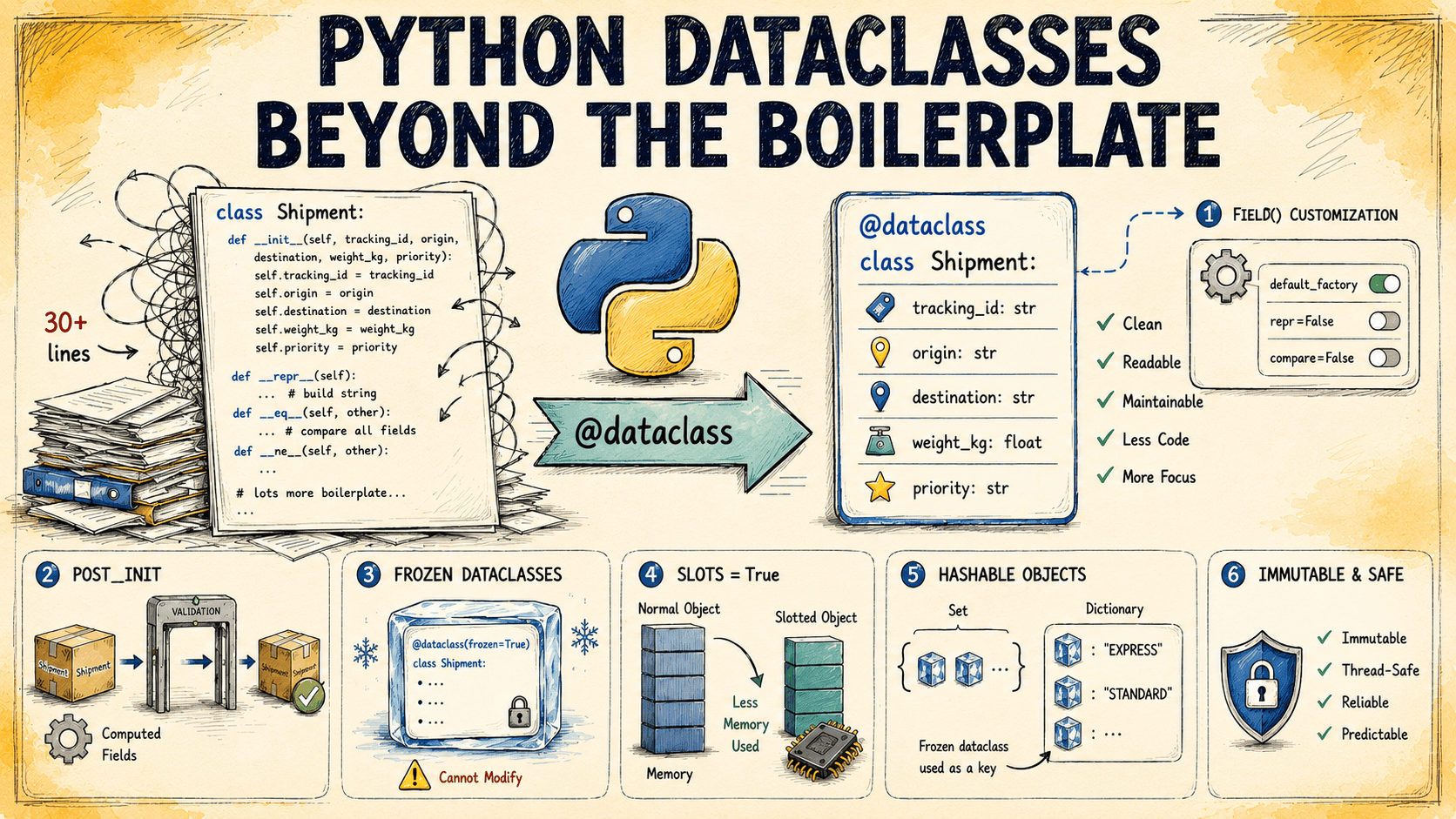
Python dataclasses have always felt like a quiet concession to pragmatism. We use them to shave a few lines off repetitive `__init__` methods, then move on. But we should pause and reconsider what we are actually leaving on the table. The real story is not about typing fewer keystrokes. It is about shifting how we think about data structures altogether. When you start exploring custom fields, validation, computed attributes, and immutability, you are not just tidying up your code. You are making a deliberate choice about how your data behaves under pressure. That is a more ambitious project than most of us signed up for, and it is worth taking seriously.
The piece lands at an interesting intersection with other conversations we have been having about Python's deeper capabilities. For instance, our Unlock Python's Potential: Advanced Techniques for Smarter Coding piece makes the case that leveling up rarely means learning new syntax. It means recognizing what the language already promised you. Dataclasses are a perfect example. The tools for validation and computed attributes were always possible with properties and custom methods. The dataclass just gives those patterns a cleaner home. Similarly, when we look at Build Your First World Model: A Practical Python Guide, we see a beginner-friendly approach to complexity. The same principle applies here: start with the straightforward version, then let the language carry you toward more sophisticated design without requiring a rewrite.
Our honest take is that most developers stop too early with dataclasses. They use them as a boilerplate reducer, which is fine, but it is like buying a power tool and using it only as a paperweight. Memory optimization and immutability are highlighted as advanced topics, but they are not exotic. They are the difference between code that works and code that works under load. We would tell a reader who asks about this: do not treat dataclasses as a convenience feature. Treat them as a design decision point. Ask yourself whether your data should be mutable. Ask yourself where the source of truth for validation should live. These are not trivial questions. They shape how your application grows.
The concrete takeaway here is simple: choose one project, refactor one class to use `frozen=True`, add a custom validator, and compute one attribute with `property`. See what breaks. See what becomes clearer. That exercise will teach you more about your own architecture than any tutorial. The real question is not whether dataclasses are useful. It is whether you are ready to stop treating your data as passive containers and start making them active participants in your program's logic. The answer to that question will tell you a lot about the next refactor you should do.