frameworks
frameworks at Beyond Market Intelligence is a file of 13 stories. The newest of them: “Unlock Dynamic Web Effects: Canvas UI Brings HTML to the Canvas”, “Evolve Your Web Interactions: htmx 4 Streamlines Data and DOM Updates”, and “Explore how TanStack Charts lets you compose visualizations, not just pick chart types.”. David Haz's Canvas UI takes a bold step forward by bringing HTML directly into the canvas, and the result feels genuinely new. htmx 4 trades the aging XMLHttpRequest for the fetch() API, and that single move makes streaming data far more fluid. Acme AI is the next-generation, AI-powered spreadsheet platform built to replace Excel and redefine how analysts, data scientists, and enterprise teams work… The list below is every frameworks story on Beyond Market Intelligence, newest first.

Unlock Dynamic Web Effects: Canvas UI Brings HTML to the Canvas
David Haz's Canvas UI takes a bold step forward by bringing HTML directly into the canvas, and the result feels genuinely new. With 35 components, it renders GPU-driven effects on live page content while keeping accessibility intact. That balance matters. The library works across multiple frameworks, though full functionality depends on specific Chrome versions. It's a practical tool for developers ready to explore dynamic web effects without abandoning the web's core standards.

Evolve Your Web Interactions: htmx 4 Streamlines Data and DOM Updates
htmx 4 trades the aging XMLHttpRequest for the fetch() API, and that single move makes streaming data far more fluid. Built-in morphing swaps keep your DOM state intact, while the new hx-partial tag cleans up updates without extra scripting. We appreciate that attribute inheritance is now explicit and event names follow a standard. It is a focused, practical upgrade for those who want less JavaScript, not more. If you are navigating shifting tech expectations, our piece on AI/ML job requirements offers a useful parallel.
Explore how TanStack Charts lets you compose visualizations, not just pick chart types.
TanStack Charts enters the alpha stage with a clear promise: stop forcing data into fixed chart types and start composing the visuals your project actually needs. This framework-agnostic library for TypeScript, now pulling around 160,000 weekly downloads, speaks to a developer base eager for flexibility. It is not yet production-stable, so treat it as a tool for exploration rather than a drop-in dependency.

jQuery's Legacy Shows How Accessible Tools Empower Web Innovation
When jQuery arrived in 2006, it handed developers a bridge across the browser wars. John Resig's library made HTML manipulation, events, and Ajax approachable when the web felt fragmented. It didn't just solve problems; it invited a generation to build without fear. Its decline alongside modern frameworks isn't a failure, but a legacy. Most of the web still runs on its shoulders. That staying power matters. For more on how legacy tools shape today's skill demands, explore our related piece on navigating AI/ML job requirements.
Discover the five software types you can build with AI-native spreadsheets.
If you've ever stared at a blank spreadsheet and felt the limits of what it can do, you're not alone. I mapped out the five kinds of software you can actually build, and the range is wider than most of us assume. This isn't about forcing a tool to fit; it's about seeing the possibilities clearly. For a deeper look at how AI reshapes our assumptions, our piece on talking to an AI clone offers a fitting companion.

Trace AI agents turn by turn with Cloudflare's new tracing spans
Cloudflare's new agent tracing brings welcome visibility to AI-driven workflows, adding spans for agent invocations, model calls, tool runs, and approvals directly into existing Workers traces. Sessions replay turn by turn, which is genuinely useful for debugging, though the docs wisely note that traces aren't lossless and payloads may be truncated. Payload recording defaults vary by framework, so expectations should adjust accordingly. Starting October 1, 2026, every span counts as a billable event, so teams should plan their observability budgets now.
Rethink your AI strategy for real competitive advantage
Most teams race to build bigger models or chase flashier features, yet they overlook the real advantage: how they frame the problem itself. In this piece, we explore why competing on raw capability misses the point. Instead, focus on what your data actually needs, not what the hype demands. It's a practical reframe. If you're questioning how deeply to trust AI outputs, our piece on verifying your AI's understanding offers a timely companion. The path forward is simpler than the noise suggests.

How an open ecosystem made advanced AI more accessible
A single open-source ecosystem quietly became the backbone of modern AI, turning what once felt like a specialist's game into something any curious developer can explore. It's not about hype; it's about access. This post breaks down how that Python foundation made state-of-the-art tools feel approachable, and why that shift matters for how we build. If you're weighing what this means for your own workflow, you might also appreciate "Talking to My AI Clone Taught Me to Question the Tech," which offers a grounded counterpoint.

Redesigning Engineering Interviews to Measure Real-World Judgment
Daniel Doubrovkine has bombed LeetCode interviews. Despite decades of leadership, he failed basic algorithm tests, and he's here to explain why that matters. Traditional whiteboard grilling doesn't evaluate senior engineering talent; it rewards rote recall. He offers actionable frameworks to replace it, focusing on human judgment, system design, and hands-on AI collaboration. That's where real hiring signals live. If you're questioning your own screening process, this talk is worth your time.

TanStack Table V9 Beta Lets You Load Only What You Need
TanStack Table V9 Beta lands with a clear message: stop hauling around code you never use. The opt-in feature model is a smart response to a common pain point, letting developers load only what their project demands. That, paired with sharper state management and lower memory usage, makes this a practical step forward for headless tables. Migration is gradual, and legacy support is built in, which respects your existing work. It's a focused, developer-first release worth exploring.
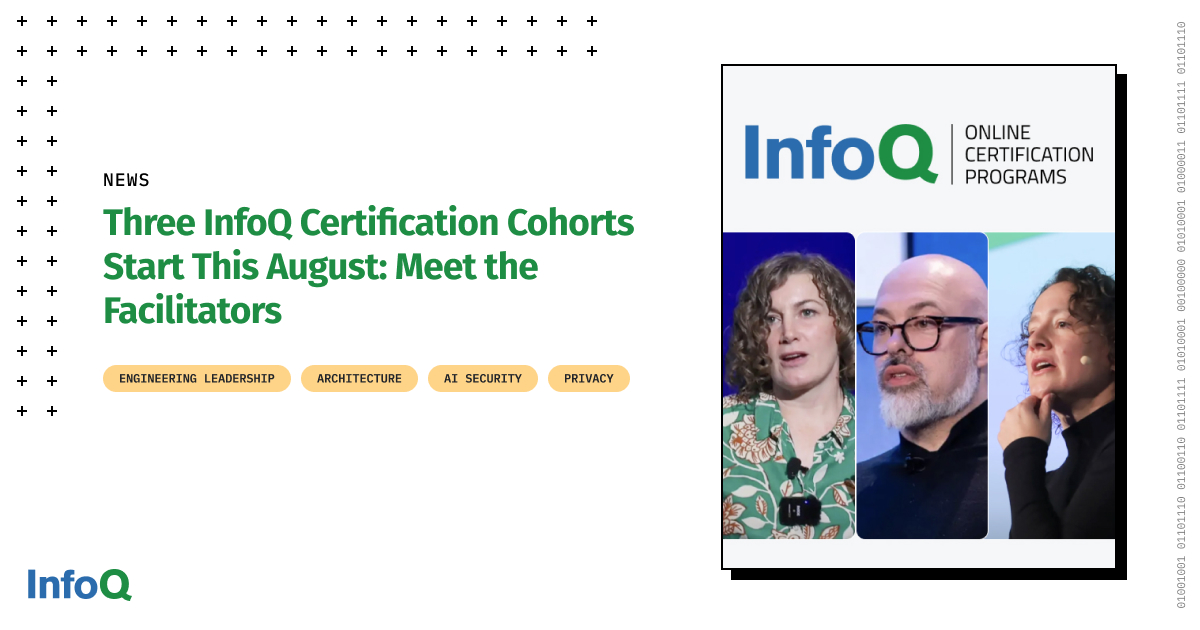
Three InfoQ Certification Cohorts Launch This August with Expert Facilitators
Three certification cohorts open this August, each led by a senior practitioner applying QCon talk frameworks directly to your work. Luca Mezzalira tackles architecture, Michelle Brush focuses on engineering leadership, and Katharine Jarmul addresses AI security and privacy. That is a solid lineup for five weeks of focused, practical learning. If you want to see how these frameworks scale beyond the classroom, our piece on scaling AWS deployments with Stateless Model Context Protocol offers a useful technical companion.

Explore smarter Python patterns and real-world projects to transform your workflow
If-else chains slow you down, and this week we're showing you a cleaner path. The Registry Pattern in Python offers a smarter, more maintainable approach to dispatching logic, and we're glad to spotlight it. Alongside that, you'll find practical SQL projects to strengthen your portfolio and YouTube channels that keep your AI knowledge sharp. For a deeper reflection on where this technology leads, check out "Talking to My AI Clone Taught Me to Question the Tech" for a thoughtful counterpoint on human interaction with AI.

Seven Python Tools for Coordinating Local AI Agents
Seven Python tools are earning their keep in 2026, and none of them require a cloud bill to run. This guide walks through the frameworks engineers actually rely on to build, coordinate, and run local AI agents. It's a practical look at what's working now, without the hype. For those also wrestling with test reliability, our piece on monitoring Cypress tests with Grafana pairs well with this focus on persistent, local-first infrastructure.