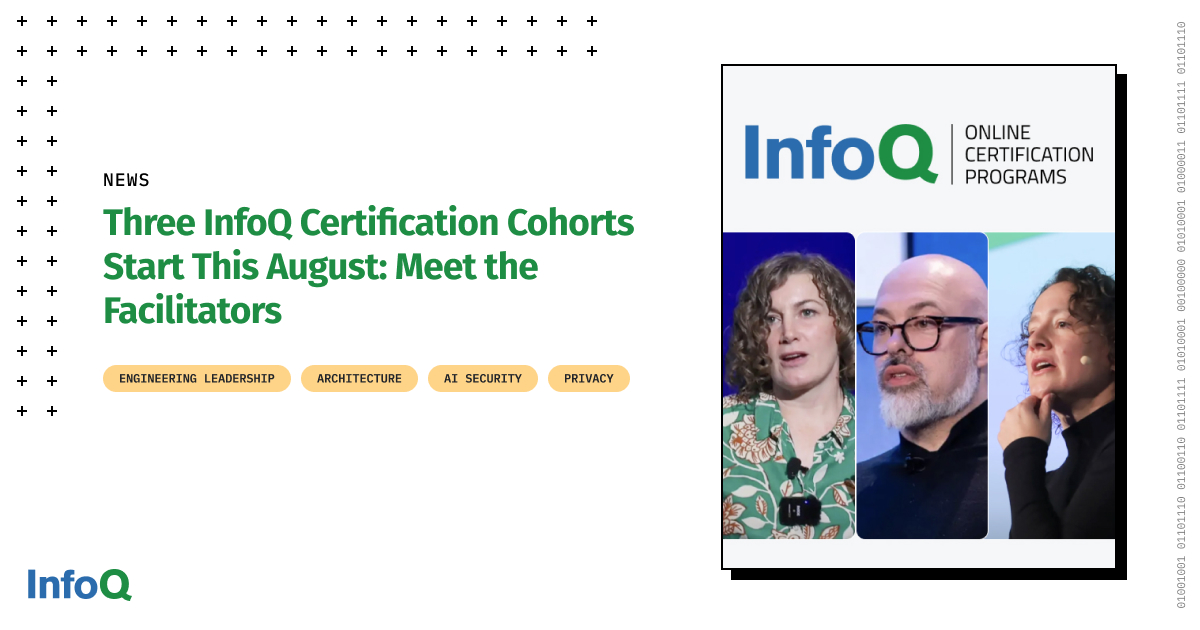
Three certification cohorts opening in August is not a headline about credentials. It is a quiet statement about how practitioners actually grow. InfoQ has announced five-week online programs led by Luca Mezzalira on architecture, Michelle Brush on engineering leadership, and Katharine Jarmul on AI security and privacy. The structure matters more than the topics: senior practitioners applying QCon talk frameworks directly to the work participants already do. That is the detail worth sitting with, because it signals a deliberate move away from passive learning toward applied, context-driven development.
This approach aligns with a broader pattern we have been tracking across our coverage. When we explored InfoQ Explores High-Performing Teams with New Certification Program, the emphasis was on team design and delivery flow, not abstract theory. The same logic appears here. Architecture is not learned by memorizing patterns; it is learned by confronting real constraints and making trade-offs. Engineering leadership is not acquired through reading about feedback models; it is shaped by navigating actual team dynamics. Even AI security and privacy, a domain that feels urgent and technical, benefits most when participants bring their own systems and questions into the room. The certification becomes a byproduct. The real output is the work itself.
What we find compelling is how this format reframes expertise. A facilitator like Mezzalira or Brush is not there to deliver a polished lecture. They are there to help you see your own problems through a sharper lens. That is a different relationship with knowledge, one that assumes you already have context and need better frameworks to make sense of it. This connects directly to the practical challenges we see in our coverage of Bridging Retrieval and Action: A New Approach to AI Tasks, where the gap between understanding a concept and applying it correctly is often where projects stall. The same gap exists in leadership and architecture. A cohort that forces you to map new ideas onto your own environment closes that gap faster than any amount of reading.
Our take for anyone considering these programs is straightforward: do not join for the certification. Join because you have a specific problem that has resisted your current toolkit. Bring that problem with you. The facilitators are senior for a reason, and their value is in the questions they ask about your work, not in the content they present. The five-week structure is short enough to stay focused and long enough to see real change, provided you come with something real to work on.
The one thing we will be watching is how InfoQ measures outcomes beyond completion. A certificate says you finished. It does not say you improved. If these cohorts can demonstrate that participants shipped better architecture, led more cohesive teams, or shipped more secure AI systems, they will set a standard that other programs will struggle to match. That is the metric that matters. Watch for it.