gateway
gateway at Beyond Market Intelligence is a file of 7 stories. The newest of them: “Cloudflare's new gateway keeps decryption separate from its own traffic”, “How DoorDash Built a GenAI Platform for 5,000 Users”, and “How Meta's ZGateway Slashes Connections 19x While Processing a Billion Operations Per Second”. Cloudflare's OHTTP Gateway is drawing attention for what it refuses to do: decrypt traffic arriving from its own Workers or proxied hosts. DoorDash bet big on open-weights models after starting with vendor-first setups, and that shift is the spine of this story. Acme AI is the next-generation, AI-powered spreadsheet platform built to replace Excel and redefine how analysts, data scientists, and enterprise teams work… The list below is every gateway story on Beyond Market Intelligence, newest first.

Cloudflare's new gateway keeps decryption separate from its own traffic
Cloudflare's OHTTP Gateway is drawing attention for what it refuses to do: decrypt traffic arriving from its own Workers or proxied hosts. That separation matters, because it keeps client identifiers and request contents out of the same hands. It's a thoughtful constraint in a privacy landscape where trust is often the first casualty. For deeper platform context, our coverage of Cloudflare welcoming Deno's expertise offers useful background on how the company is evolving its developer stack.

How DoorDash Built a GenAI Platform for 5,000 Users
DoorDash bet big on open-weights models after starting with vendor-first setups, and that shift is the spine of this story. Swaroop Chitlur and Sidd Kodwani walk through building a GenAI platform for over 5,000 internal users, tackling LLM gateways, agent gateways, and the constant trade-off between accuracy, latency, and cost. For teams wrestling with similar scale, their architectural bets offer a practical blueprint. Read "Small models, smarter labels: confidence scoring without the hype" alongside this for a complementary take on model evaluation.
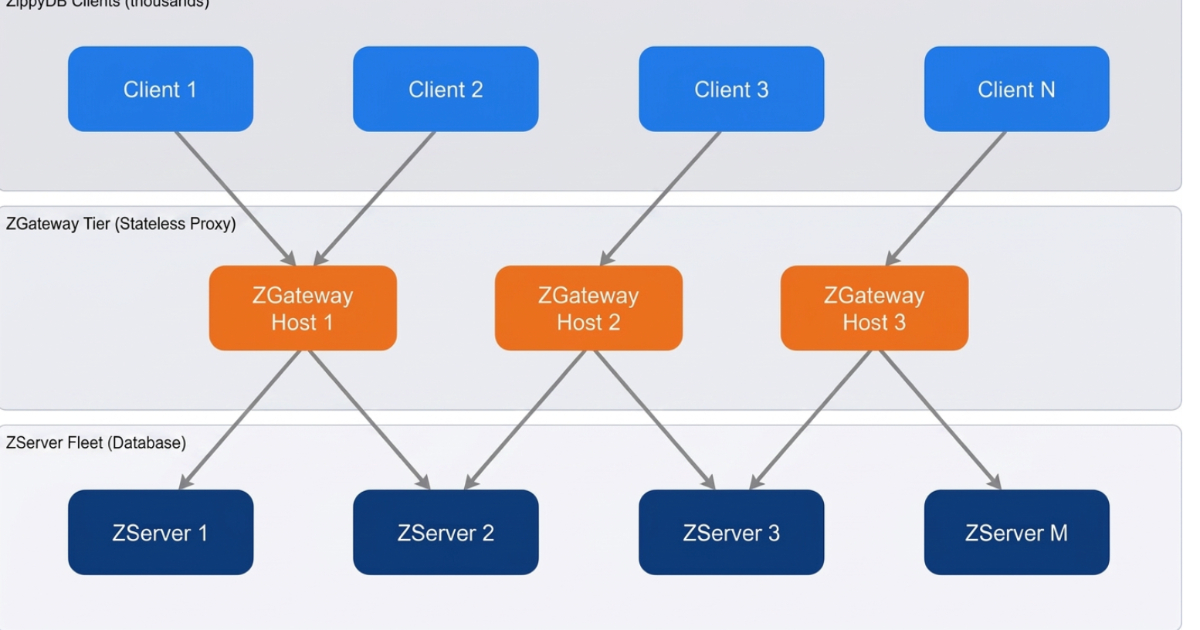
How Meta's ZGateway Slashes Connections 19x While Processing a Billion Operations Per Second
Meta's ZGateway is doing something quietly remarkable: slashing persistent connections by 19x while processing over a billion operations per second. That's not just efficiency; it's a rethinking of how stateless proxies can centralize traffic without becoming a bottleneck. By handling 40% of ZippyDB traffic, it proves scale and simplicity can coexist. For teams wrestling with connection sprawl, this is a model worth studying. And if you're curious about Meta's broader engineering bets, our piece on Linear's StyleX migration offers another angle.

Gateways can't fix what identity layers don't yet secure.
Start with the agents you can actually name. If you cannot identify which agent is acting, who delegated the work, and what credentials are in play, no gateway will save you. Enforcement feels like progress, but it is the fifth control, not the first. Build the dependency chain in order: inventory, identity, scoped credentials, telemetry, then enforcement. Skip ahead and you will burn your first hour of incident response just figuring out what should have been obvious.

Stripe's reported $7B OpenRouter deal signals a new era for AI payments.
OpenRouter's CEO calls it "Stripe for AI," and Stripe's reported $7B+ acquisition talks suggest that framing is more than ambition. It signals a clear bet on simplifying how AI model access gets paid for. For teams tired of stitching together gateways and billing, this could be the consolidation that makes the ecosystem feel less fragmented. It's a bold move, and one worth watching closely. If you're exploring how AI tools reshape workflows, our piece on questioning AI clones offers a useful counterpoint.

MCP Drops the Handshake to Let Agents Route Without JSON Parsing
The MCP 2026-07-28 spec drops the initialize handshake and session header, adding required method and tool-name headers so gateways route traffic without parsing JSON. Some developers call it a rediscovery of REST, while others argue the standard was always the point. Both sides have merit, though the shift feels less like a regression and more like a practical concession. For a deeper look at how statelessness changes deployment, our piece on scaling AWS server deployments with stateless MCP is worth a read.

Four security layers to protect your MCP production environment
Securing MCP in production isn't just about locking the front door. Nik Kale argues that real safety comes from enforcement at the earliest trustworthy control points, not just the gateway. His defense-in-depth approach spans four architectural layers: safe execution, management infrastructure, outbound trust, and semantic integrity. It's a practical framework for teams moving beyond pilots. If you're still mapping MCP's basics, our visual guide to MCP helps ground the concepts before you dive into production hardening.