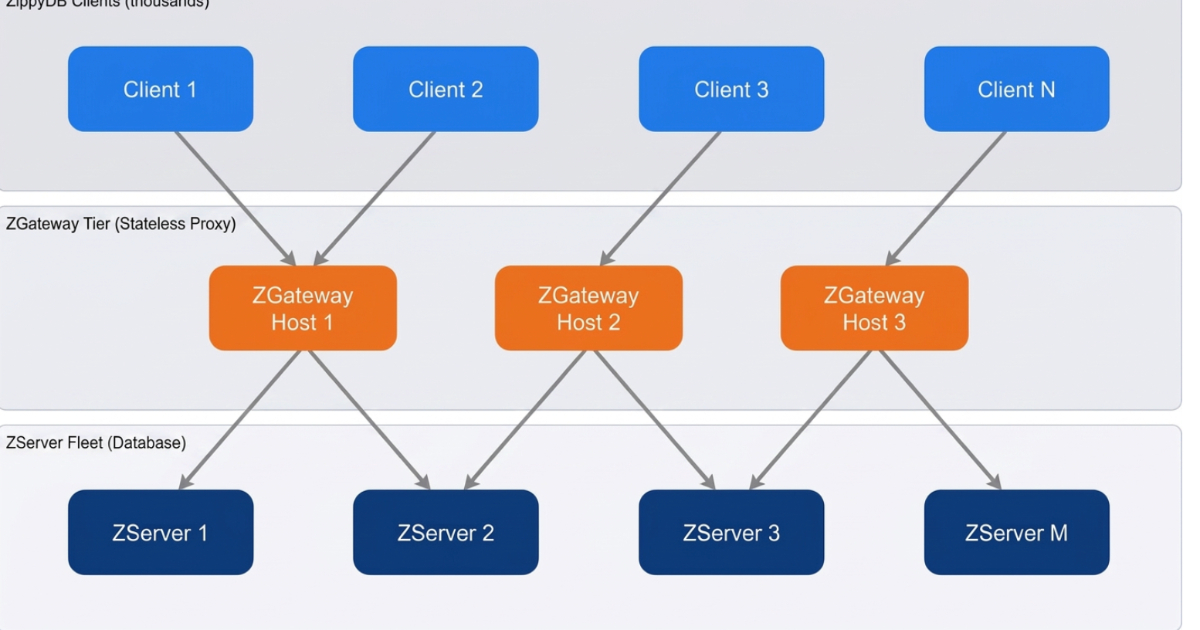
Meta just published details on ZGateway, a stateless proxy for ZippyDB that centralizes connection management, traffic routing, caching, load balancing, and admission control. The numbers are worth sitting with: over a billion operations per second, roughly 40% of ZippyDB traffic, and a modeled 19x reduction in persistent connections. This is not another incremental tweak. It is a deliberate architectural bet that the way we connect to databases has become the bottleneck, and that the fix belongs in the network layer, not in the database itself.
For teams still wrestling with connection sprawl, the lesson is direct: you can add more servers, or you can stop multiplying connections in the first place. ZGateway does the latter by acting as a single front door. Clients talk to the gateway, the gateway talks to ZippyDB, and the database no longer has to track every open socket. That 19x reduction is the kind of number that makes a capacity planner sit up straight. It is not a feature; it is a structural change in how traffic flows. And it connects to a broader pattern we have been tracking, like how Linear shipped faster with Meta's StyleX by removing a layer of runtime complexity, or how Aurora DSQL added foreign key support to enforce integrity closer to the storage engine. The theme is consistent: move responsibility out of the application and into the infrastructure where it can be managed centrally.
What we find compelling is that ZGateway is stateless. That choice matters. A stateless proxy can scale horizontally without coordinating session state, which is why Meta can route 40% of ZippyDB traffic through it without turning the gateway into a single point of failure. For engineers running their own systems, the takeaway is not "build a proxy like Meta." It is that connection management deserves the same design rigor as query optimization. Most teams treat connection pools as a config file problem. Meta treats it as a systems problem, with admission control and caching folded into the same layer. That is a more honest way to think about scale.
If a reader asked us whether they should care, we would say yes, but not because they should copy Meta. The practical signal is that the cost of persistent connections grows faster than the value they provide. ZGateway proves that a centralized, stateless front door can absorb that cost. The open question is how this translates to smaller deployments, where the operational overhead of running a gateway might outweigh the connection savings. We would tell them to watch how this pattern ages. If the stateless proxy becomes the default way to talk to databases, then the next generation of data tools will assume it, and the teams that adopt it early will have a head start on capacity. The concrete detail to watch: whether other large-scale systems follow Meta and publish their own connection reduction models, because that is where the real comparison will happen.