GitHub Actions
8 stories filed under GitHub Actions on Beyond Market Intelligence. The newest of them: “Scale Your Self-Hosted Runners with ARC's Latest Reliability Upgrades”, “Buildkite empowers teams with scoped secrets and smarter CI diagnostics”, and “How AI agents triaged 85% of Astro's GitHub issues for Cloudflare”. For teams managing their own CI infrastructure, ARC 0.15.0 brings meaningful improvements to how self-hosted runners operate on Kubernetes. Buildkite's latest updates show a clear focus on giving teams more control and clarity in their CI workflows. Acme AI is the next-generation, AI-powered spreadsheet platform built to replace Excel and redefine how analysts, data scientists, and enterprise teams work… The list below is every GitHub Actions story on Beyond Market Intelligence, newest first.

Scale Your Self-Hosted Runners with ARC's Latest Reliability Upgrades
For teams managing their own CI infrastructure, ARC 0.15.0 brings meaningful improvements to how self-hosted runners operate on Kubernetes. The focus on reliability and observability means less time troubleshooting infrastructure and more time shipping code. This release respects that scaling compute shouldn't introduce complexity. For those exploring how AI infrastructure scales independently, our coverage of Tenstorrent's recent funding offers a complementary look at building trust in open-source foundations.
Buildkite empowers teams with scoped secrets and smarter CI diagnostics
Buildkite's latest updates show a clear focus on giving teams more control and clarity in their CI workflows. Pipeline-scoped secrets address a real pain point, letting you lock down access without workarounds. The new diagnostics tools for validating pipelines and repairing webhooks are equally practical, they turn debugging from a guess into a process. Linux arm64 support in the GitHub Actions layer and expanded OpenTelemetry data round out a thoughtful release.
How AI agents triaged 85% of Astro's GitHub issues for Cloudflare
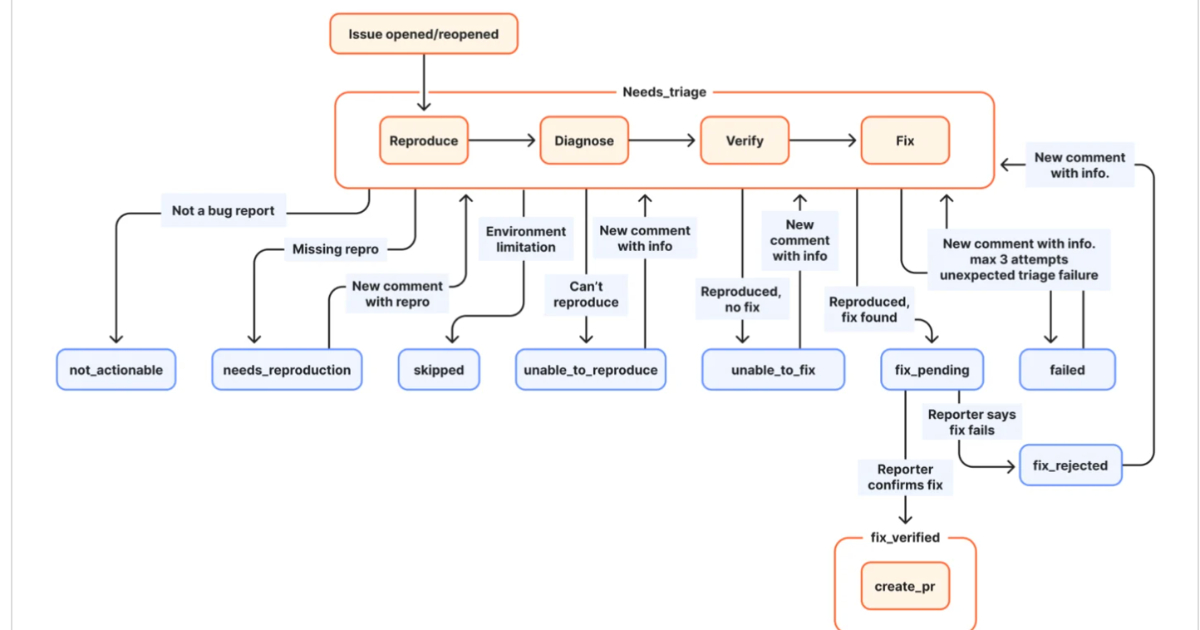
Astro's maintainers were drowning in GitHub issues, so they let AI agents take over triage. The result: an 85% cut in that workload, giving developers time back to focus on the work that matters. This isn't about removing humans; it's about making their role more meaningful. Cloudflare's approach, built on Workers with a human-in-the-loop, shows how agentic workflows can handle the noise. It's a practical win for open source, and it pairs well with our guide on distributed training algorithms.

When GitHub stumbles, Cursor Origin offers a stable path forward.
If you're weighing whether to trust a new code host with your team's source code, Monday offered a pointed reason to pay attention. Cursor launched Origin, its own code hosting platform, and within hours GitHub suffered a global degradation that crippled pull requests, APIs, and Copilot for nearly seven hours. The timing was coincidental, but the message wasn't: the agent era demands a forge built for how code is actually reviewed today. Origin's pitch is worth exploring, starting with its low-risk, GitHub-as-source-of-truth design.

How Pinterest Built Guardrails for Safer, Scalable AWS Infrastructure
Pinning down least-privilege access across sprawling AWS environments is a challenge, and Pinterest's new Resource Provisioner Pipeline tackles it head-on. Their Terraform execution engine enforces dual-control reviews, adding strict guardrails to GitHub Actions workflows. It's a practical, no-nonsense approach to infrastructure security that prioritizes safety without sacrificing speed. For teams wrestling with similar scale, this is a smart model worth examining. And if you're exploring how AI can streamline other workflows, our guide to unlocking ChatGPT for work offers a useful starting point.

The npm supply chain attack that earned its trust before striking.
The keyv worm didn't fake its security check. It earned one. That's the part that should unsettle every security team. The poisoned releases shipped with valid provenance signatures because they ran through the maintainer's own pipeline. Valid credentials, not a broken control, did the damage. The trust signals built to secure the supply chain were satisfied by an attacker holding the right account. That's not a bug in the machinery. It's the shape of the exposure.

Open-Sourcing Tri-Net v2 for Reproducible Monkeypox Detection Research
Open-sourcing a research project is one thing; making it reproducible is another. With Tri-Net v2, the team behind the Scientific Reports paper on unified monkeypox detection has done both. They didn't just drop training scripts. They rebuilt the framework with leakage-free pipelines, multiple backbones, and Docker support built in. That is how you invite validation. The over 1,100 article accesses suggest real interest, and now the community can test, break, and improve the work.

Why a Second AI Lab's Review Outperforms Self-Grading Code
Claude grading its own PR is a comfortable trap. When the same model reviews its own output, blind spots echo back as confidence. A sharper path is cross-provider review with Codex in GitHub Actions, treating a second opinion from a different lab as the real checkpoint. It's a practical, human-centered fix for an AI problem. For more on questioning what AI tells you, "Talking to My AI Clone Taught Me to Question the Tech" pairs naturally with this.