gradient accumulation
Beyond Market Intelligence keeps gradient accumulation in one place: 3 stories so far. The section currently leads with “Seven Techniques to Train LLMs on Consumer Hardware”, “Gradient accumulation speed varies more than expected across GPU setups”, and “Catch costly PyTorch bugs before they waste your GPU hours”. Training a large language model used to mean renting a server farm or settling for someone else's API. Conventional wisdom says a batch of four is a batch of four, but this test on LoRA with Qwen3-1.7B shows otherwise. Acme AI is the next-generation, AI-powered spreadsheet platform built to replace Excel and redefine how analysts, data scientists, and enterprise teams work… The list below is every gradient accumulation story on Beyond Market Intelligence, newest first.
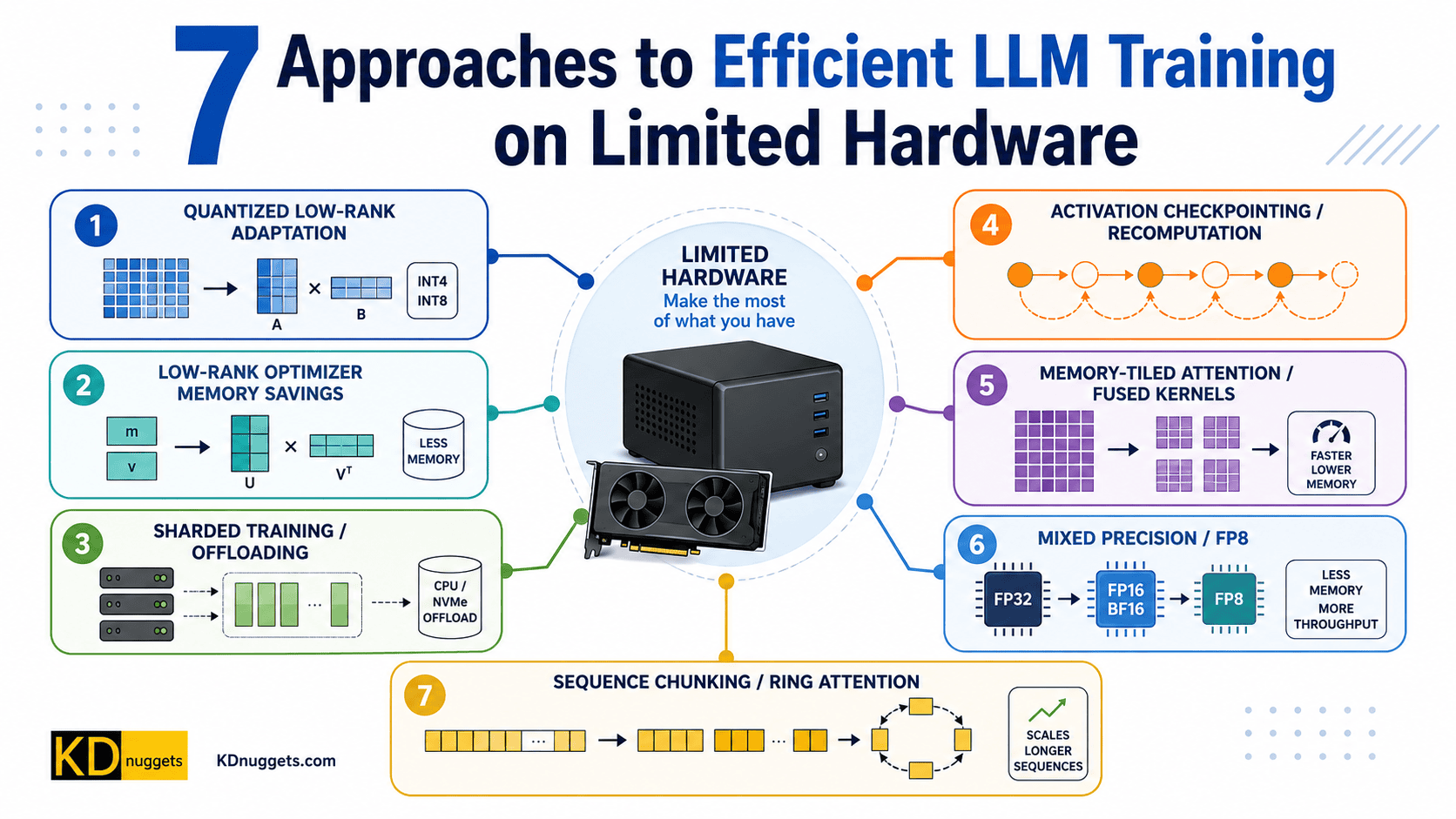
Seven Techniques to Train LLMs on Consumer Hardware
Training a large language model used to mean renting a server farm or settling for someone else's API. This guide challenges that assumption with seven practical engineering techniques for consumer GPUs, proving that memory limits are a constraint to design around, not a wall. It's a grounded, hands-on read for builders who want the control of training their own models.
Gradient accumulation speed varies more than expected across GPU setups
Conventional wisdom says a batch of four is a batch of four, but this test on LoRA with Qwen3-1.7B shows otherwise. The user found that on a T4, running four micro-batches before one optimizer step was 17% slower than a single physical batch of four. On an L4, that gap stretched to 41%. The difference is execution shape, not just optimization math. Treating effective batch and physical batch as the same knob is a mistake.
Catch costly PyTorch bugs before they waste your GPU hours
Torch-preflight is the kind of tool PyTorch developers didn't know they needed until they saw it. The author spent years watching simple mistakes, like forgetting `zero_grad()` or holding onto autograd graphs, burn GPU hours. Instead of waiting for failures, this linter reads your code without importing or executing it, catching those bugs upfront. With 13 rules and VRAM estimation that lands within 4% of measured peaks, it's practical and honest.