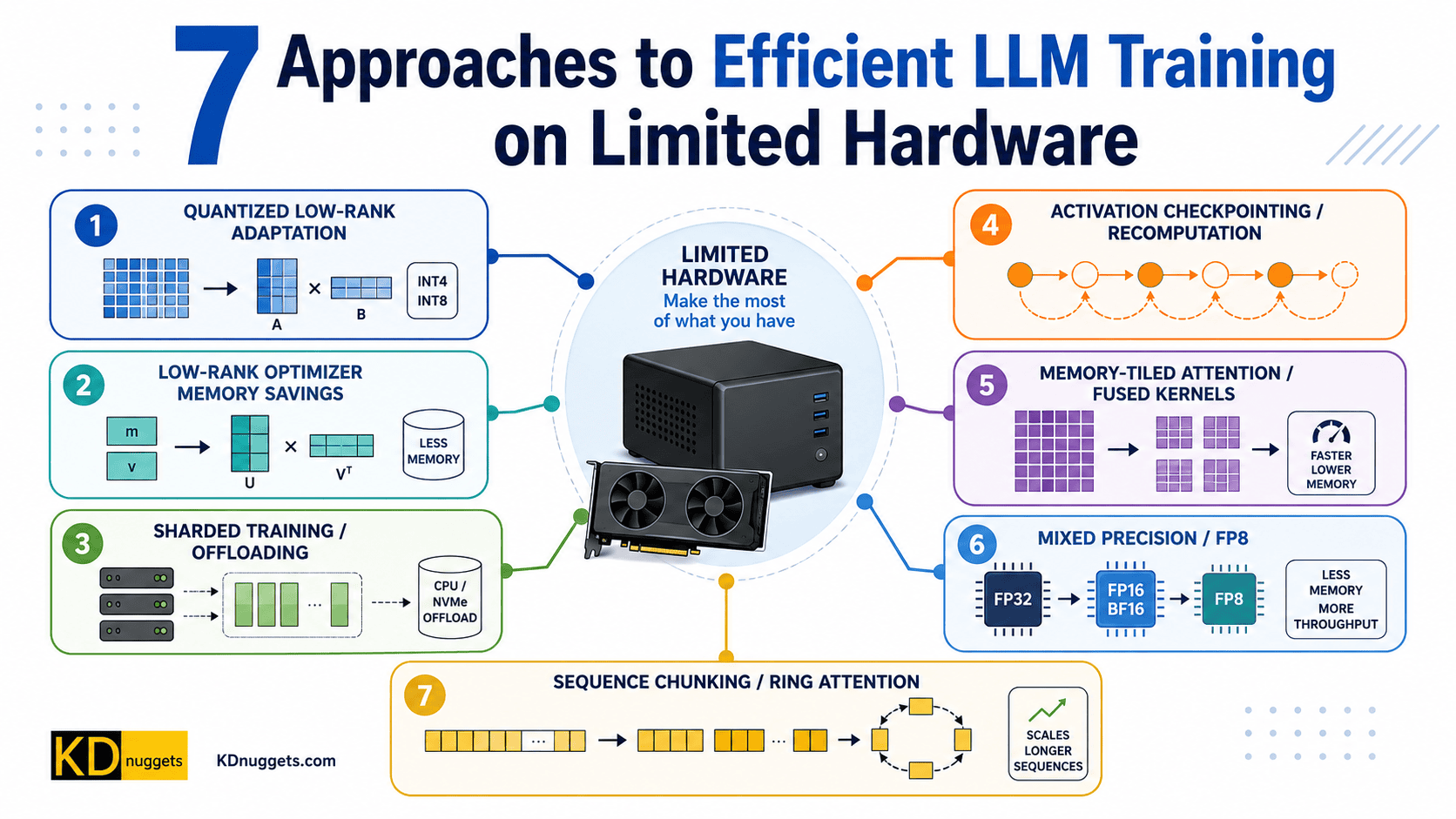
The barrier to training large language models has never been the ideas. It has been the hardware. When we read about the seven engineering techniques for training on consumer GPUs, we see a story about resourcefulness, not just optimization. It is a direct response to the frustration of hitting an out-of-memory error thirty minutes into a training run. For our readers who have felt that ceiling, this is the practical path forward. It is also a natural companion to the work we have covered on Unlock LLM Training: A Practical Guide to Distributed Algorithms, where the focus shifts from the theory of parallel systems to the ground-level execution.
Our honest take is that these techniques are less about squeezing every last megabyte and more about changing your relationship with the problem. When you are forced to work with limited memory, you stop treating the model as a monolith. You start thinking in terms of layers, gradients, and activations as movable pieces. That mindset is what separates people who read about AI from people who build with it. This approach gives you permission to stop waiting for a bigger GPU and start working with the one you already have. This is not about settling for less; it is about removing the excuse that held you back. We would tell any reader who asks that the most important takeaway is to stop seeing memory as a wall and start seeing it as a constraint to design around.
This approach also connects to a deeper shift in how we understand the technology itself. As we explored in Exploring Paragraph Structure: How LLMs Navigate Token Space, the internal mechanics of these models are not magic. They are structured, learnable, and increasingly legible. The same logic applies to training on limited hardware. The techniques may seem technical, but they are simply a reflection of how the model actually behaves under the hood. Understanding that behavior gives you leverage. It is the difference between blindly running a script and knowing why you are freezing certain layers or recomputing activations. That knowledge is what turns a hobbyist into a practitioner.
The concrete point to watch is the shift in who gets to participate. When consumer GPUs become viable for real training work, the barrier to entry drops for individuals and small teams. That means more diverse models, more niche applications, and more voices in the field. The open question is whether the community will embrace these constraints as a creative challenge or continue to chase the highest-end hardware. We are betting on the former. These techniques are not a workaround; they are a statement that progress does not require a data center. If you have been holding back because you thought you lacked the resources, consider this your cue to start. The only thing standing between you and a trained model is the willingness to adapt your approach.