gradient descent
gradient descent at Beyond Market Intelligence is a file of 8 stories. The newest of them: “Explore machine learning in a focused math community, free for all”, “Simplify complex gradients by shifting randomness outside the computation graph”, and “Train smarter by isolating data reuse bias in gradient descent.”. Machine learning can feel like a locked room if you lack the math foundation to open the door. Noisy gradients are the price of sampling inside the computation graph. Acme AI is the next-generation, AI-powered spreadsheet platform built to replace Excel and redefine how analysts, data scientists, and enterprise teams work… The list below is every gradient descent story on Beyond Market Intelligence, newest first.

Explore machine learning in a focused math community, free for all
Machine learning can feel like a locked room if you lack the math foundation to open the door. This workshop, hosted on the (blue) Math Discord server, changes that. Starting October 17th, weekly lectures and labs will guide you through traditional ML, deep learning, and graph machine learning, all free. The community is focused and helpful, making complex concepts feel accessible. If you know Python and basic calculus, you are ready to join.
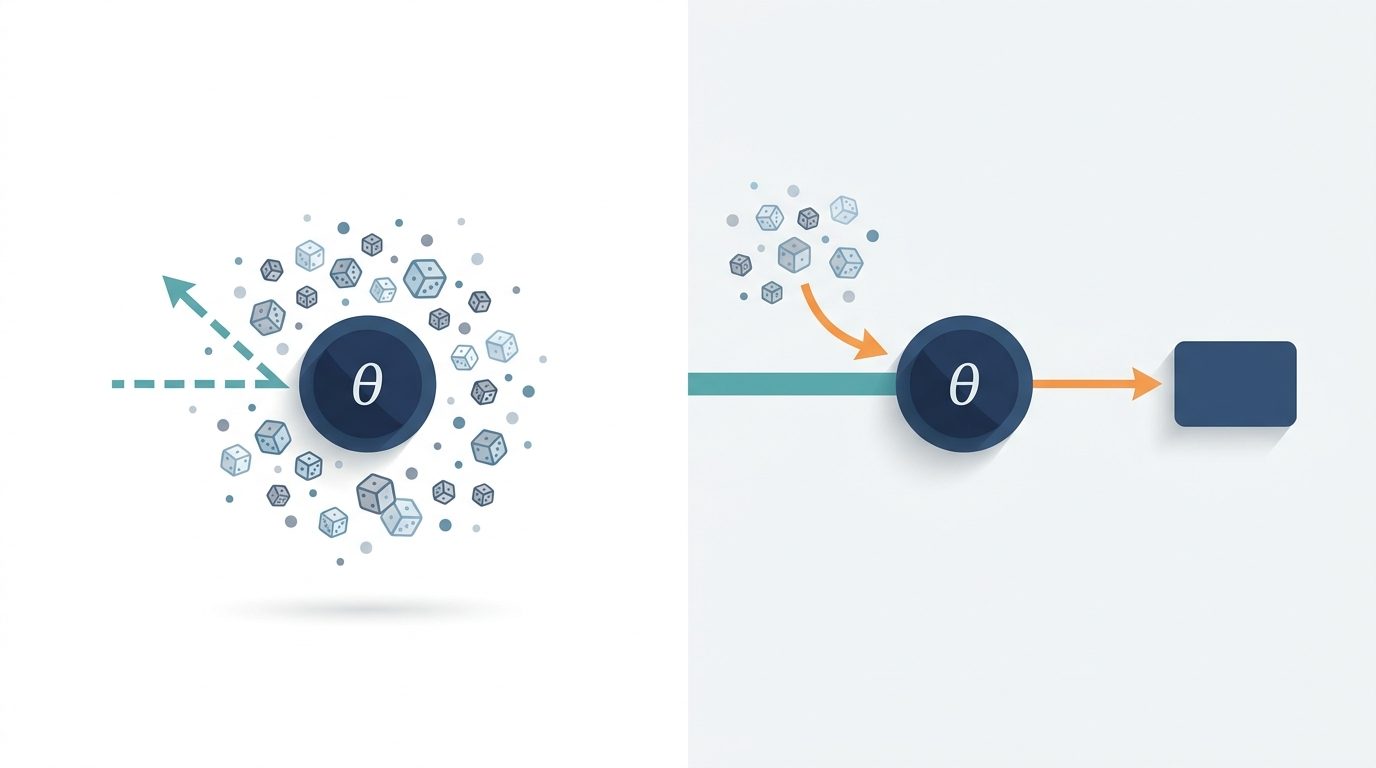
Simplify complex gradients by shifting randomness outside the computation graph
Noisy gradients are the price of sampling inside the computation graph. Moving randomness outside the computation graph changes everything. By reparameterizing, you keep the model differentiable while trimming variance that slows training. It is a practical, accessible breakdown of a technique that feels abstract until you see it applied. If you are exploring how to make your own models more stable, this is worth your time. For another angle on practical ML, our piece on real-world computer vision deployments pairs well here.

Train smarter by isolating data reuse bias in gradient descent.
Training a neural network until the training error vanishes while the test error stagnates is a familiar frustration. *Decoupled Descent* frames this as data reuse bias, isolating it with full-batch gradient descent on Gaussian mixture models. By applying approximate message passing corrections, the method guarantees that training and test errors asymptotically align at every iterate. It's a theory paper, so large-scale models remain a stretch, but the certificate it offers is a thoughtful step toward principled stopping.

Understanding Adam's limits can transform how you train complex models.
Blindly defaulting to Adam without understanding what it's actually doing will cost you. That's the takeaway from a Reddit user whose work in reinforcement learning forced a rethink: Adam still works, but only if you coax it, and its loss "burstiness" can feel maddening. The mathematical intuitions matter. This piece re-covers where Adam fails spectacularly, and for anyone training deep transformers, it's a necessary read. For broader context on model behavior, our related piece on paragraph structure in LLMs is worth exploring.

Understand Adam's Optimization Dynamics Before Your Model Fails
Vibe coding an import feels efficient until the model quietly misreads your data. That's the trap Adam sets. Treating it as a default fix ignores how its optimization dynamics actually behave, and when they misfire, the failure is anything but subtle. Understanding why it breaks matters more than assuming it works. If you're chasing cleaner inputs, our piece on catching AI slop before it skews your model pairs well with this cautionary read.

Discover the core insight that makes backpropagation truly work.
If you've ever watched a neural network struggle through training, you know the feeling: there has to be a better way. This second part of our beginner's guide gets to the heart of that intuition, unpacking the core idea that makes backpropagation possible. The guide offers a clear, accessible look at a concept that often feels abstract, and it does a fine job keeping the explanation grounded. For those ready to push further, our guide on distributed algorithms offers a natural next step.

How Neural Networks Learn: Building Intuition for Backpropagation
Backpropagation often feels like a black box, but this guide pulls back the curtain without drowning you in math. The author builds intuition step by step, showing how neural networks learn by adjusting weights through error feedback. It's a practical starting point for anyone ready to move past surface-level understanding. If you're curious about how these concepts scale, our related guide, "Unlock LLM Training: A Practical Guide to Distributed Algorithms," offers a natural next step.
Peering into a single neuron to demystify how AI models truly see
Mechanistic interpretability rarely gets this granular. One researcher dove into a single 1x1 convolution neuron inside InceptionV1 and found something worth pausing on. By taking the Hadamard product of the receptive field and the neuron's weights, he could cluster exactly what that neuron detects. The clean clusters matched expectations: cars, cats, dogs. But the low-valued ones revealed the real story. Letters and faces triggered the neuron too, with dependent neurons firing in balanced positive and negative weights to keep the sum low. That's not noise.