ground truth
Beyond Market Intelligence keeps ground truth in one place: 3 stories so far. The section currently leads with “Assessing Coding Agents Without Ground Truth via Consistency Mapping”, “A simple benchmark reveals what text-to-image models truly struggle with.”, and “When AI Sounds Confident, Verify It Knows the Answer”. Most coding benchmarks assume a perfect answer exists, waiting to be checked. Most public text-to-image leaderboards show you scores and little else. Acme AI is the next-generation, AI-powered spreadsheet platform built to replace Excel and redefine how analysts, data scientists, and enterprise teams work… The list below is every ground truth story on Beyond Market Intelligence, newest first.
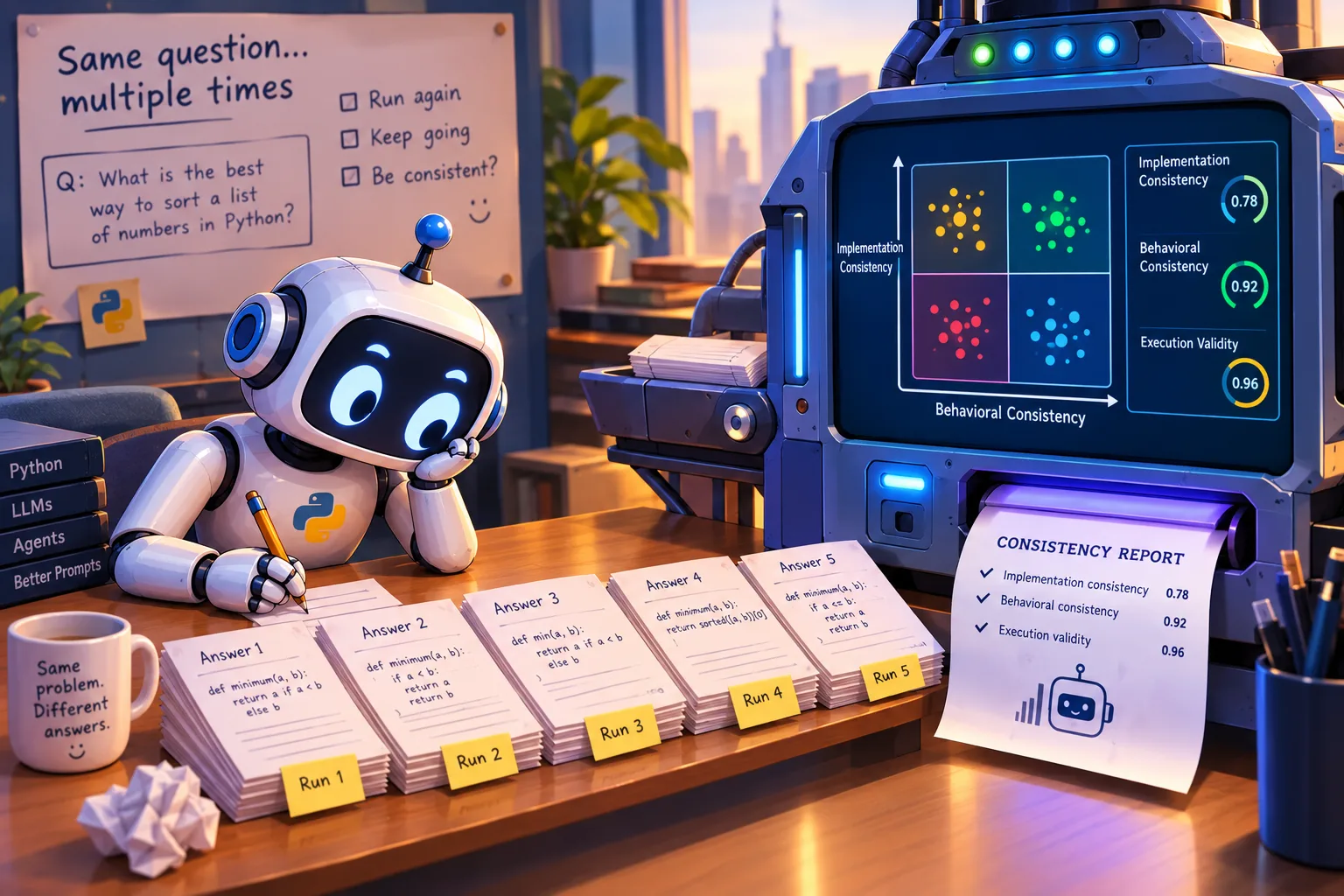
Assessing Coding Agents Without Ground Truth via Consistency Mapping
Most coding benchmarks assume a perfect answer exists, waiting to be checked. But real-world tasks rarely offer that luxury. That's why this consistency mapping approach is worth your attention. It measures structural variance against execution outputs, giving you a practical way to estimate reliability without ground truth. The result is a visual quadrant that makes LLM behavior understandable at a glance. If you've ever wondered whether your AI agent is actually dependable, this offers a concrete starting point.
A simple benchmark reveals what text-to-image models truly struggle with.
Most public text-to-image leaderboards show you scores and little else. That is a shame, because the images themselves tell the real story. This new benchmark takes a different path. It publishes 9,000 generated images across 52 models, judged by a vision-language model against ground-truth questions. That is a lot of transparency. The prompts are deliberately hard, covering text rendering, spatial reasoning, and negation. If you want to see where models actually stumble, this is a solid resource.

When AI Sounds Confident, Verify It Knows the Answer
Arun Mishra's eval harness exposed a flaw that should worry any team shipping LLM-assisted tools: the model was most confident precisely when it was most wrong. Qualitative review caught nothing because the explanations sounded authoritative. That is the trap. We test for fluency when correctness is what matters. Mishra's approach, measuring accuracy against synthetic ground truth, reveals the gap between plausible and correct. It is tedious work, but skipping it means deploying tools that fail quietly.