knowledge management
8 stories filed under knowledge management on Beyond Market Intelligence. The newest of them: “Turn AI into a Thinking Partner That Accelerates How You Learn”, “Move Beyond Static Skills to Build Agent Knowledge That Adapts”, and “Discover How Intent Continuity Transforms Your Data Workflows”. Learning any new topic faster starts with how you structure the conversation with AI. The panic over agent skills is aimed at the wrong target. Acme AI is the next-generation, AI-powered spreadsheet platform built to replace Excel and redefine how analysts, data scientists, and enterprise teams work… The list below is every knowledge management story on Beyond Market Intelligence, newest first.
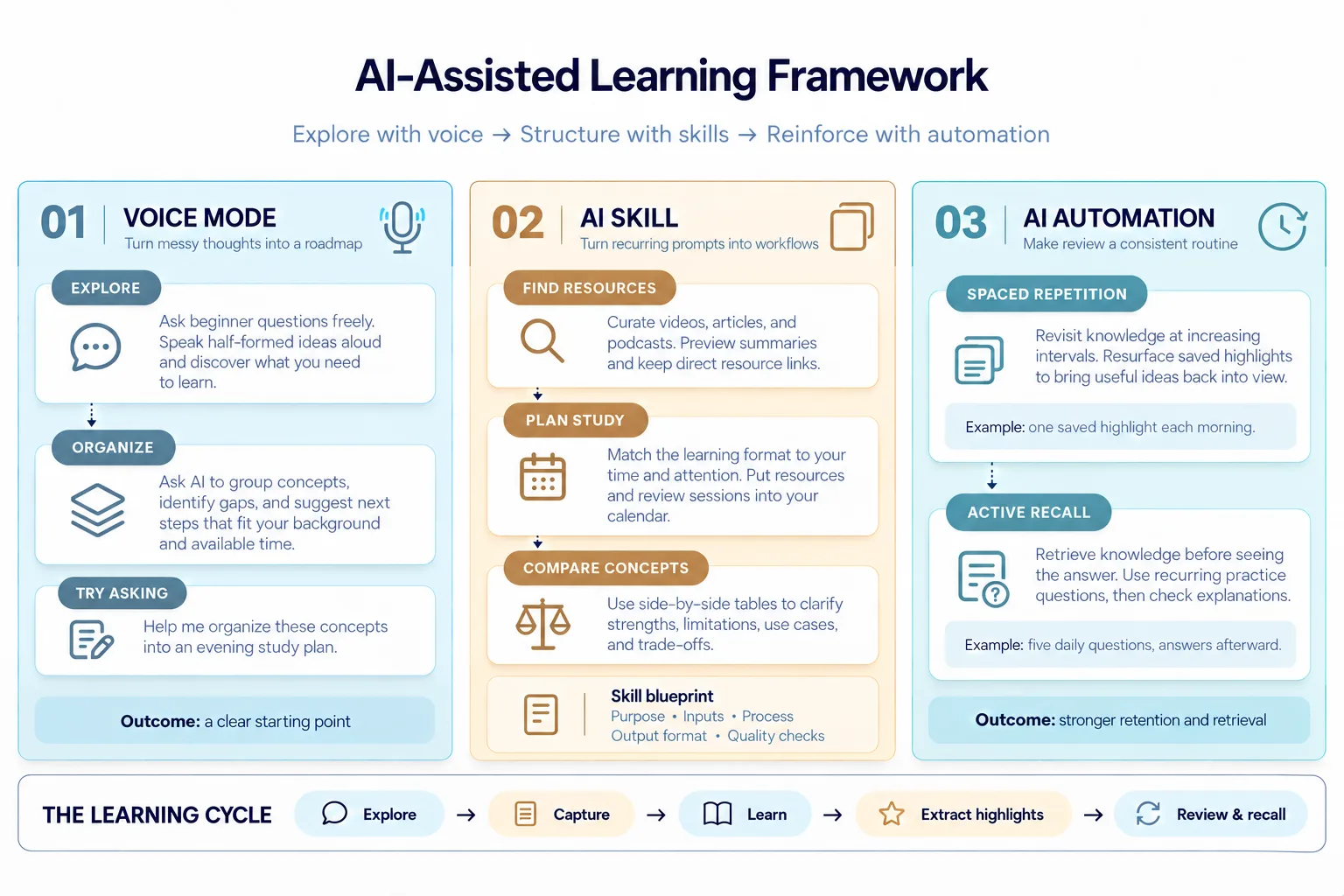
Turn AI into a Thinking Partner That Accelerates How You Learn
Learning any new topic faster starts with how you structure the conversation with AI. This practical framework turns AI into a thinking partner that accelerates understanding rather than just delivering answers. It challenges passive consumption and invites a more active, iterative dialogue. For those testing different approaches, our controlled test of Gemini, DeepSeek, ChatGPT, and Claude on forecasting traps offers a complementary look at how these tools handle real analytical challenges.

Move Beyond Static Skills to Build Agent Knowledge That Adapts
The panic over agent skills is aimed at the wrong target. Static files aren't the bottleneck; the real shift is treating knowledge as a build artifact, something dynamic and versioned. That costs more than dropping a prompt into a folder. It demands a model where skills evolve with your data, not alongside it. We're not talking about inflation, but about engineering discipline. For a deeper look at how such dynamic thinking applies elsewhere, explore the Forrester Function piece. This is where agent capability gets serious.

Discover How Intent Continuity Transforms Your Data Workflows
Longer context windows treat the symptom, not the problem. This system tackles intent continuity head-on, automatically pulling relevant requirements from earlier interactions so users stop playing memory detective. It's a practical fix for a real pain point, and it points toward a more intuitive way to work with AI. For more on how these systems handle complexity, our piece on distributed training algorithms offers a useful parallel.
Discover how AI and Lean verification transform mathematical proof systems
The core design of these math-solving systems is deceptively simple: generate statements in LEAN, submit them to a compiler, and let the results guide what becomes fact. The clever part isn't the generation, it's the orchestration. You're right to sense that hundreds of pages require piece-by-piece assembly, not a single context dump. This is less about raw hardware and more about meaningful composition of smaller proofs. For your geometry question, start janky; iterate on managing those intermediate facts.
From isolated context to shared knowledge: the next step for enterprise AI
Enterprise AI agents are only as reliable as the messiest documents behind them. Most teams treat knowledge as application-specific context, building separate pipelines for each assistant. That works for isolated copilots, but it fractures as agents multiply. Inconsistencies spread, changes propagate unevenly, and teams rebuild the same retrieval infrastructure repeatedly. These are knowledge management problems, not context engineering ones. The fix is architectural: manage knowledge once, as shared infrastructure, and publish reusable representations for every agent.

Build AI Applications That Remember, Not Just Retrieve
RAG systems fetch, but they don't hold on to what matters. That's the gap this guide tackles head-on, offering a vendor-neutral blueprint for building a knowledge layer that actually accumulates understanding, not just query results. The Azure-native walkthrough, mapping Foundry, AI Search, Cosmos DB, and FastAPI to a property-insurance corpus, turns theory into something you can build on. If you're still questioning how much AI truly grasps, "Verify Your AI's Understanding" pairs well with this practical read. It's a grounded, actionable take.

From Scattered Knowledge to an AI-Ready Company Brain
Building a context layer sounds straightforward until you try to move beyond a demo. This piece cuts through the hype to show what it actually takes to turn scattered company knowledge into something an LLM can reliably use. The polished demo is only about five percent of the real work. The rest is messy, unglamorous, and essential. If you are weighing whether your team is ready for this, it is a sobering and useful read.

Give your AI agents a single source of truth for business data
Pinecone's Nexus Engine is now generally available, and it's a practical answer to a messy problem: enterprise data that sits scattered and unstructured. Nexus compiles that business context into a queryable layer, so AI agents stop guessing and start working from curated knowledge. Teams ingest once, then reuse that context across agents, cutting token costs while boosting accuracy. That's a meaningful step toward tools that actually understand the work. For more on where this tech leads, our guide to distributed training offers useful context.