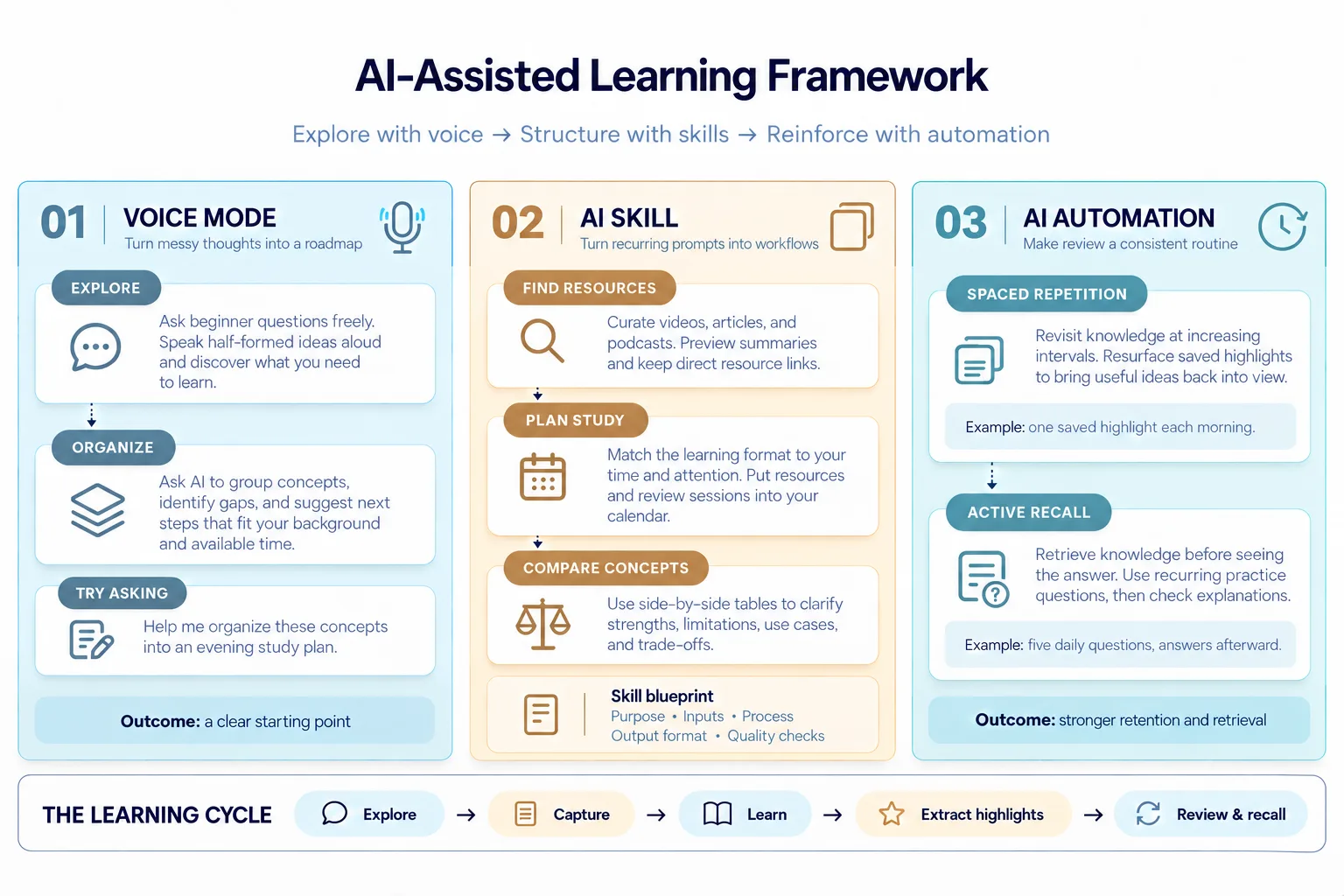
Learning faster isn't about consuming more information. It's about having a partner that challenges how you think. A recent framework for turning AI into a thinking partner gets this right, and it deserves attention because it reframes the tool from a shortcut into a catalyst for deeper understanding. The approach treats AI not as an answer engine, but as a Socratic foil, one that surfaces blind spots, tests assumptions, and forces you to articulate your reasoning more clearly. That distinction matters, especially when so much of the conversation around AI still revolves around speed and convenience.
We have seen similar patterns emerge in other domains. In our We Put Four AI Assistants to the Test With Forecasting Traps, we found that even capable models stumble on subtle biases like reporting delays and structural breaks. The lesson was not that AI is unreliable, but that using it well requires understanding its limitations. The learning framework takes that insight a step further: it turns those limitations into teaching moments. When an AI misses a nuance, the user has to supply it, and that act of correction is where real learning happens. Similarly, our piece on The Real Cost of AI Spreadsheets: Free vs Premium Solutions showed that the value of an AI tool often depends less on the model's raw capability and more on how intentionally you design your interaction with it. The same principle applies here: the framework's power comes from the structure it imposes on the user, not from the AI alone.
The practical takeaway is direct. Most people treat AI like a search engine: ask a question, get an answer, move on. That approach reinforces shallow learning. The framework described in the story flips the dynamic. It asks you to state your current understanding first, then use the AI to pressure-test it. You explain your reasoning, the AI pokes holes, you refine. That back-and-forth mirrors how a good mentor works, not by handing you answers, but by making you defend your thinking. For anyone trying to master a new domain, this is a more effective use of the technology than generating summaries or outlines.
What remains open is how well this method scales. The framework works brilliantly for topics where you already have a baseline of knowledge to interrogate. For completely unfamiliar subjects, the Socratic approach may stall because you lack the foundation to ask meaningful questions. That is a detail worth watching. If the next iteration of this method addresses that gap, perhaps by layering in structured primers before the dialogue begins, it could become a standard practice rather than a clever workaround. Until then, the core insight stands: treat AI as a thinking partner, not a shortcut, and you will learn faster than any tool alone can teach.