large language models
Beyond Market Intelligence keeps large language models in one place: 112 stories so far. The section currently leads with “Unlock Smarter Workflows by Managing Hundreds of Coding Tasks”, “Navigating the Kimi Agent Ecosystem and What It Means for You”, and “OpenAI's product chief on agents, UX, and what's next for AI tools”. Claude Code is built to handle the heavy lifting, but the real skill lies in knowing how to direct it across a hundred or more distinct tasks. Kimi Agent is a name that's come to cover a sprawling family, and untangling it matters before judging any piece of it. Acme AI is the next-generation, AI-powered spreadsheet platform built to replace Excel and redefine how analysts, data scientists, and enterprise teams work… The list below is every large language models story on Beyond Market Intelligence, newest first.

Unlock Smarter Workflows by Managing Hundreds of Coding Tasks
Claude Code is built to handle the heavy lifting, but the real skill lies in knowing how to direct it across a hundred or more distinct tasks. This guide cuts through the noise, offering a practical approach to structuring your prompts and workflows so you're not just issuing commands, but truly collaborating with your coding agent. It's about turning a useful tool into a dependable partner.
Navigating the Kimi Agent Ecosystem and What It Means for You
Kimi Agent is a name that's come to cover a sprawling family, and untangling it matters before judging any piece of it. That's exactly what this exploration does, sorting through the confusion with a clear-eyed lens. The result is a practical look at what works, what doesn't, and why the label alone can mislead. If you've ever felt unsure about similar AI tools, this is a useful starting point.

OpenAI's product chief on agents, UX, and what's next for AI tools
OpenAI's head of product, Thibault Sottiaux, sees a world finally ready for agents, and that's worth paying attention to. In this interview, he gets practical about UX and what it means to report directly to Greg Brockman, grounding the agent hype in real workflow decisions. It's a grounded take from someone shaping the tools we'll actually use. For a more personal angle on AI's limits, you might try "Talking to My AI Clone Taught Me to Question the Tech."

Hugging Face weighs community ties against a $13 billion offer
A $13B price tag would make Hugging Face one of the biggest AI acquisitions yet. But the founders' hesitation isn't about the money, it's about the community that helped build the platform. That tension between a massive payout and preserving what makes the company special is worth watching. If you're curious how messy data can get when AI tools shape your workflows, our piece on catching AI slop before it skews your model offers a practical parallel.
Explore data careers beyond engineering with OpenAI's $280,000 role.
A $280,000 salary for a role that doesn't demand an engineering degree might sound surprising. It shouldn't. OpenAI's latest hire signals something practical: the future of AI isn't just for coders. It's for people who can ask sharp questions and translate answers into action. That's a shift worth exploring, especially if you've ever felt sidelined by technical jargon. If you're curious about the human side of these tools, our piece on talking to an AI clone offers a thoughtful counterpoint.

How to Write Specs That Keep Your AI Projects on Track
The spec passed. The plan passed. Claude ran the tests, reported green, and you trusted it. Then you looked at the diff the next morning and found the output had drifted from your intent in ways the test suite never caught. That is the failure mode nobody warns you about. Writing bulletproof specs is about more than clarity; it is about building guardrails that survive contact with an AI that fills gaps confidently.

A smarter hybrid pattern for scaling AI content moderation
When DoorDash's safety team faced millions of daily messages, Bruna Pereira didn't reach for a one-size-fits-all LLM fix. Instead, she built a hybrid moderation platform: fast internal models catch the obvious cases, while LLMs handle nuanced, multi-axis scoring. No-code workflows and backtesting keep it practical. It's a smart pattern that cut incidents without breaking the bank. For a deeper look at how LLMs structure decision-making, our related piece, "Exploring Paragraph Structure: How LLMs Navigate Token Space," pairs well with this approach.
Shortening prompts costs more; asking for brevity saves.
Recent research definitively answers a critical question: does instructing an LLM to "be concise" actually save money? Across nine models—including GPT-4o and Claude Haiku—our analysis reveals a clear winner: prompting for shorter output consistently reduces costs by 1.5x on average (up to 3x in some cases) while maintaining accuracy. Conversely, shortening input prompts proved counterproductive, increasing costs and diminishing answer quality. This highlights a key insight: controlling output tokens is the most effective strategy for cost optimization, as demonstrated in our paper.

Testing the boundaries of AI safety with Claude's content filters
Anthropic's Opus 4.6 is supposed to be a disciplined model, yet TechCrunch's tests reveal a glaring gap: a simple nudge was enough to bypass its guardrails and generate explicit content. That fragility matters because it shows how easily safety measures can be outmaneuvered, even by casual users. It's a reminder that robust AI governance isn't just about intent; it's about engineering resilience. For more on how Anthropic is navigating infrastructure bets, our piece on Akamai's cloud offers useful context.

How AI quietly reshaped a third of the modern web
A third of web pages published since ChatGPT's launch now show signs of AI authorship. That's a striking signal about how quickly synthetic content has woven itself into the web's fabric. It raises a pressing question: how do we keep our data meaningful when machines are editing so much of what we read? This isn't about shaming the tools; it's about staying clear-eyed.

When an AI judge agrees with itself, trust becomes the question
When an LLM judge keeps agreeing with itself, the feedback loop feels reassuring. It isn't. This story follows a production incident where a model's self-approval masked real flaws, exposing a quiet danger in relying on AI to evaluate AI. It's a practical look at trusting your tools, not blindly. For anyone wrestling with similar doubts, the related piece on questioning your AI's understanding offers a useful parallel. Blind agreement is comfortable; genuine verification takes more work.

Ramp Router lets you switch AI models with a single API
Ramp's new Router takes a pragmatic step forward in how teams handle AI. Instead of locking users into a single large language model, Router lets you switch between options through one API. That's a smart move for companies that want flexibility without rebuilding their workflows. It's not about hype; it's about control and practicality. For anyone tired of vendor constraints, this feels like a meaningful shift.

Explore how AI leaders compete to empower your data privacy.
OpenAI is raising the bar on enterprise data privacy, and it's about time. The company is moving to outflank Anthropic by offering stronger customer protections, a direct response to growing unease over how AI handles sensitive information. This competition is healthy, pushing both labs to treat privacy as a feature, not an afterthought. For businesses weighing their options, that's a win.

Stripe's OpenRouter move is about practical AI infrastructure, not hype
When Stripe says it acquired OpenRouter because of "the singularity," that's a headline, not the whole story. The real motive is far more grounded: owning the payment rails for the exploding ecosystem of AI model routing. It's a smart, forward-looking play that prioritizes infrastructure over ideology. This isn't about chasing a sci-fi future. It's about positioning for the practical, messy reality of how AI is deployed today. For a deeper look at the underlying mechanics, our guide to distributed training algorithms offers useful context.

Why Every Hallucination Detector Misses a Simple Number
A single number tripped up every major hallucination detector, and the reason is hiding in plain sight: ten is not a hundred. That gap between what a model claims and what a human knows is the story here, and it's a sharp reminder that these tools still see patterns, not meaning. We're impressed by the caution this work demands, and it pairs well with the skepticism in *Talking to My AI Clone Taught Me to Question the Tech*.
Scaling DNA modeling with linear attention that remembers what matters
A 25% recall score on a four-token DNA vocabulary isn't just a stumble; it's a sign that the compressed state in linear attention is dropping the thread. This isn't a niche bug, as HyenaDNA hits the same wall. The core tension is clear: state compression trades memory for recall, and long contexts expose that trade-off brutally. We're watching a fundamental limit being tested, not a simple fix.

How DoorDash builds agentic AI from legacy prediction models
Sudeep Das walks us through DoorDash's move from one-shot predictions to a platform built for context-aware recommendations. It's a shift from static models to something more adaptive, using language-native memory and semantic IDs to keep pace with real consumer behavior. The grounded search piece matters too, as it ties relevance directly to conversion. For anyone wrestling with how to scale AI beyond isolated tasks, this is a practical look at what agentic systems actually require.

Choosing Between LangChain and LangGraph for Smarter Agentic Workflows
Choosing between LangChain and LangGraph doesn't have to stall your agentic workflow. This guide cuts through the overlap to highlight four key differences, helping you match the tool to the task. It's a practical read for anyone tired of guessing which framework fits. We appreciate the clarity here, especially since it complements our earlier exploration of distributed training algorithms. If you're building systems that need structure, start with this breakdown. It's a straightforward step toward more intentional design.

Explore how local AI turns images into structured data with Gemma 4
Gemma 4 and Ollama bring image inputs and structured outputs together in a local setup, and that combination is worth exploring. It's a practical step toward multimodal workflows without relying on cloud dependencies. The process feels more accessible than you might expect, which is exactly the kind of progress that matters. If you're curious about how these pieces fit, this guide walks through it clearly.
One team's sprint proves what AI agents can achieve for your workflows.
Three OpenAI engineers just shipped a million lines of code. That's not a headline; it's a starting point. For you, the real work begins with a ten-hour agent run. This story is about scale, but more importantly, it's about what happens when you stop wrestling spreadsheets and let AI handle the heavy lifting. We're not here to sell you hype, just a smarter way forward.
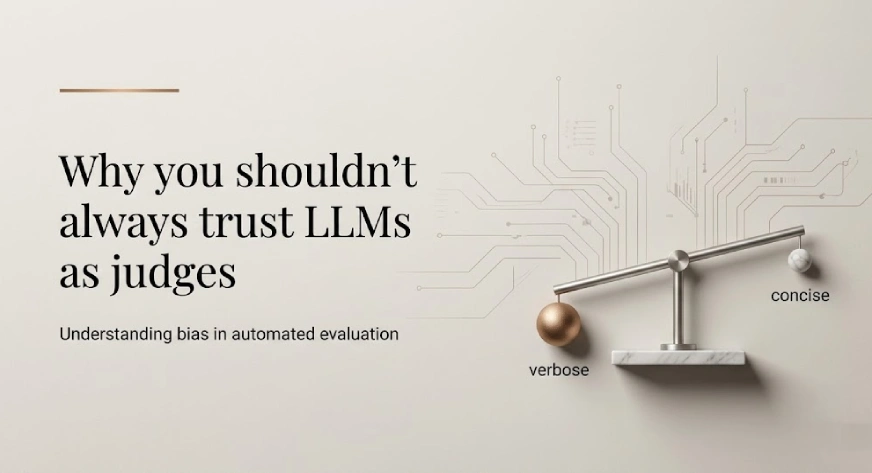
When AI Judges the Evidence, Watch for the Bias in the Verdict
At a DHS 2026 workshop, Bhaskarjit Sarmah posed a challenge we should all take seriously: can we truly trust LLMs as judges? They are fast and cheap, but speed doesn't equal fairness. When we outsource evaluation, we inherit hidden biases that shape outcomes. This is a needed reality check for anyone automating judgment. For a deeper dive into how AI systems adapt, explore how AI agents learn by editing context, not model weights.

Testing Local LLMs Against a 90-Tool Personal Assistant
Twenty-seven production tasks. Two local models. One hardware upgrade. That is the experiment at the heart of this piece, and the results are telling. The question is not whether local AI can match Claude feature-for-feature, but what it truly takes to replace the brain behind a 90-tool personal agent. The answer, unsurprisingly, is nuanced. For anyone questioning their own AI dependencies, this is a grounded, practical read.
Understand Prompt Injection by Mastering How Roles Shape AI Behavior
Prompt injection is often treated like a parlor trick, but it's a window into how LLMs actually think. This breakdown from katxwoods digs into the mechanics, showing why roles aren't just instructions, they're the keys to the system's logic. If you've ever wondered why a simple "ignore previous" works, this is your answer. It's a sharp, practical read that rewards your curiosity. For a broader look at how these systems are built, our guide to distributed algorithms pairs well here.
Finding the sweet spot between model scale and quantization precision
The sweet spot for quantizing LLMs keeps shifting, and the old 4-bit consensus is fading fast. New research points to a more aggressive target, where a 2-bit 70B model can genuinely outpace a 4-bit 35B one, given a fixed memory budget. This is about maximizing capability, not preserving a single model's fidelity. The degradation from quantization is real, but it's often outweighed by the sheer benefit of more parameters. It's a trade-off worth exploring, especially for those running models locally.