local LLMs
local LLMs at Beyond Market Intelligence is a file of 6 stories. The newest of them: “RAG Systems Ace Textbook Tests but Stumble on Fresh Research”, “Why settle for presets when your own local AI can learn your editing style”, and “Accelerate Local LLM Learning: A New Prototype for Faster Fact Correction”. RAG systems aced textbook tests, scoring 12 to 20 out of 20, but stumbled hard on a paper published this year, where scores dropped to zero out of 15. Acme AI is the next-generation, AI-powered spreadsheet platform built to replace Excel and redefine how analysts, data scientists, and enterprise teams work… The list below is every local LLMs story on Beyond Market Intelligence, newest first.
RAG Systems Ace Textbook Tests but Stumble on Fresh Research
RAG systems aced textbook tests, scoring 12 to 20 out of 20, but stumbled hard on a paper published this year, where scores dropped to zero out of 15. That gap reveals a real limitation: models trained to retrieve from static knowledge bases struggle with novel research. It's a wake-up call for anyone relying on them for fresh insights. For a deeper look at how agents can build smarter memory, see our related piece, "From Static Graphs to Living Memory."
Why settle for presets when your own local AI can learn your editing style
Why settle for presets when your own local AI could learn your editing style? That's the question driving one photographer's project to build a local AI editing assistant for landscape and portrait work. The goal isn't filters or image generation. It's an assistant that understands professional techniques, exposure blending, frequency separation, colour grading, and executes them through Photoshop and Lightroom, preserving layers and masks.
Accelerate Local LLM Learning: A New Prototype for Faster Fact Correction
Watching a toddler learn taught Kavanutz something about AI. Jayce, his new prototype, skips the heavy lifting of RAG pipelines and fine-tuning entirely. Instead, it shifts raw context vectors across a fixed pool of 4,048 prototype slots, correcting mistakes in real time. The benchmarks are telling: faster updates, better sample efficiency on sequential tests, and a strict memory ceiling. It's a lean, framework-free proof of concept built on NumPy and Java.
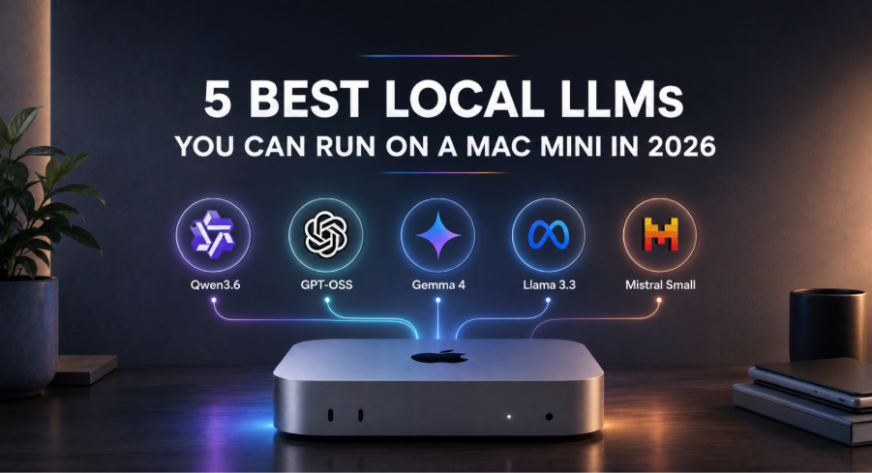
Run capable AI models locally on a Mac mini with these five tools.
Proprietary models deliver impressive results, but they often lock you into someone else's infrastructure. For those who value configurability over raw power, local LLMs are the answer. The Mac mini, with Apple Silicon and unified memory, has become a surprisingly practical host for on-device AI. If you are exploring distributed training to complement your local setup, our guide to distributed algorithms offers a solid next step. For now, discover which models run best on your Mac mini.

Bring Structure to Local LLMs with a Practical Implementation Guide
Structured output turns a local LLM from a clever autocomplete into a dependable tool for real workflows. It's not about caging the model; it's about giving it guardrails so answers arrive clean and usable. The implementation is straightforward once you map your schema, and when things break, you debug with validation errors instead of guesswork. That practical edge makes it worth the setup. For another angle on AI's limits, "Verify Your AI's Understanding: A Simple Check for Tax Season" pairs nicely with this.
Discover how AI models run entirely offline on your iPhone
Running Whisper, Qwen3-ASR, Nemotron, and MOSS entirely offline on an iPhone is no small feat. Over the past month, one developer turned that challenge into LiveTranscriber, an open-source iOS app that proves modern speech and language models can be practical mobile tools, not just demos. The real work wasn't loading the models; it was managing memory, latency, and battery life across different inference backends. That's the kind of engineering that moves on-device AI forward.