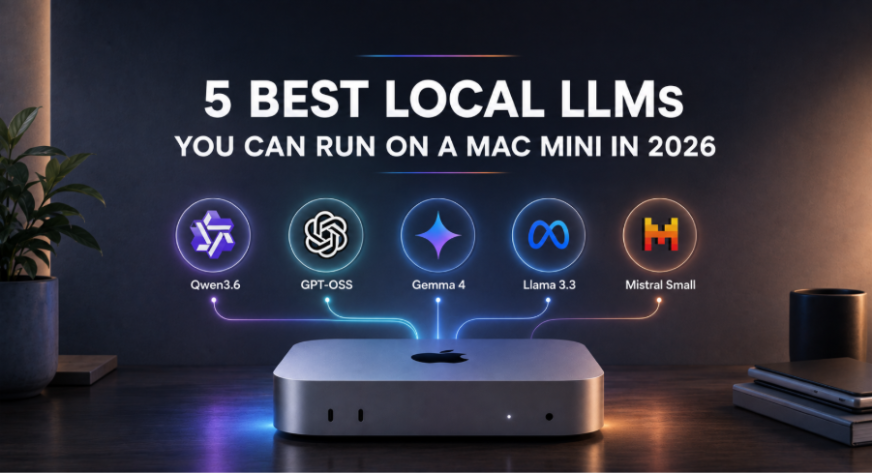
The Mac mini has quietly become one of the most interesting machines for local AI, not because it competes with cloud giants on raw benchmarks, but because it puts configurability back in your hands. The piece on the five best local LLMs for that hardware captures something we keep circling back to: proprietary models are impressive, yet they operate on someone else's terms. When you run a model locally, you decide the context window, the quantization, the privacy boundaries, and the cost structure. That is not a niche preference; it is a statement about who controls your workflow. For anyone who has felt the ceiling of a hosted API, the Mac mini with Apple Silicon and unified memory is not a toy. It is a legitimate sandbox.
This matters more when you consider how quickly the skill set for AI work is shifting. We have argued before that Navigating AI/ML Job Requirements: A Shift in Expected Skills is less about knowing every framework and more about understanding trade-offs. Local models force exactly that understanding. You cannot hide behind an API call; you have to know why a smaller model behaves differently on your own hardware. That is why we would tell a reader asking about local LLMs to stop treating this as a performance race. The real value is in the learning curve that comes from debugging a model that runs entirely on your desk. It is the difference between consuming AI and actually engineering with it, a distinction that also shows up in Unlock LLM Training: A Practical Guide to Distributed Algorithms, where the fundamentals of scaling matter more than any single tool.
Our honest take is that the Mac mini's rise as a local AI hub is not about Apple's marketing or a sudden spike in consumer curiosity. It is about the convergence of enough memory, efficient silicon, and accessible tooling like Ollama and LM Studio. That combination lowers the barrier without dumbing down the process. You still need to know what you are doing, but the entry point is no longer a server rack. For the reader who feels constrained by traditional spreadsheets or clunky data tasks, the same logic applies: the tool should serve your need for control, not the other way around. This is why we also point to Verify Your AI's Understanding: A Simple Check for Tax Season, because verifying outputs locally is often more practical than trusting a black box.
The specific takeaway here is not which model wins on a leaderboard. It is that the Mac mini gives you a reason to care about model efficiency again. Watch how quickly your own preferences shift once you realize that a smaller, well-tuned local model can handle many daily tasks without sending data anywhere. That is the detail to keep an eye on: not the next release, but whether your own definition of "capable" starts to change.