machine learning
machine learning on Beyond Market Intelligence: a running collection of 383 stories we have gathered and hand-picked because they are worth your time. Every post here touches on machine learning in some way — the news, the analysis, the deep dives, and the occasional surprise find. Acme AI is the next-generation, AI-powered spreadsheet platform built to replace Excel and redefine how analysts, data scientists, and enterprise teams work with data. New stories are added to this page as we find them, so check back if you want to keep up with what is happening around machine learning, or subscribe to the RSS feed to get them as soon as they are published. Browse the collection below, or head back to the homepage to see everything Beyond Market Intelligence is covering right now.

SPP-Net Paper Walkthrough: Breaking the Fixed-Size Constraint
Spatial Pyramid Pooling (SPP-Net) fundamentally transformed Convolutional Neural Networks (CNNs) by dismantling the fixed-size image constraint. This walkthrough provides a clear, accessible exploration of the SPP-Net paper, detailing how this innovative technique enables CNNs to process images of any dimension. We’ve built a from-scratch PyTorch implementation to illustrate the core concepts. Discover how SPP-Net unlocks greater flexibility in image analysis—a concept closely related to generative models; for a deeper dive into generative techniques, explore our explanation of Variational Autoencoders (VAEs).

Meta’s new Glimmer AI model offers a hint at Zuckerberg’s personal intelligence vision
Meta’s release of the open-weight Muse Glimmer model offers a compelling look into Mark Zuckerberg’s vision for accessible superintelligence. This development highlights a growing distinction: the ability for users to directly own and access AI models is becoming increasingly significant. Glimmer provides a tangible demonstration of this shift, empowering a new wave of AI exploration. For deeper insights into the evolving landscape of AI influence and the skills needed to navigate it, explore our recent article, "Top 10 AI Influencers of 2026."
NeurIPS AI Assisted Review authors/reviewers? [D]
The NeurIPS AI Assisted Review experience, as shared by authors and reviewers, reveals a complex landscape. Discrepancies in review depth—ranging from detailed feedback to superficial assessments—highlight a need for greater consistency. Concerns around maintaining double-blind conditions and a lack of engagement with author rebuttals also surfaced. A key takeaway: clarity of foundational concepts remains paramount. As explored in "A Mechanistic Explanation of Prompt Injection," understanding underlying principles is vital for effective evaluation, even when leveraging AI assistance.
How to file a complaint about a published CVPR paper? [R]
Concerns regarding unfulfilled data release promises in published CVPR papers are increasingly relevant. If a CVPR paper’s core contribution—a dataset—remains unavailable despite conference requirements and author commitments (such as an empty GitHub repository), a formal complaint is warranted. The process isn’t always clear, but it’s essential to ensure accountability and maintain research integrity. Explore the CVPR website and conference guidelines for specific complaint procedures; a lack of dataset availability undermines the validity of the research.
3 Collapsing models [R]
Training multiple models for BIRADS detection presents a common challenge: collapse towards the dominant class, in this case, BIRADS 1. User /u/Rihitwo is experiencing this with three models trained on the VinDR dataset, utilizing cross-entropy and center loss with class weights. The likely culprit is the dataset’s significant imbalance. Consider exploring alternative loss functions or advanced data augmentation techniques to mitigate this bias. For a deeper dive into handling complex model outputs, see our article, "How to Implement Structured Output with Local LLMs."

Discovered Materials is playing AI whack-a-mole to hunt cooler chips
Discovered Materials is pioneering a novel approach to chip development, essentially playing “AI whack-a-mole” to uncover superior materials for more efficient semiconductors. The company recently secured $9 million in funding to accelerate this search for groundbreaking compounds. This innovative strategy addresses a critical bottleneck in chip performance, moving beyond traditional material science. As Situational Awareness demonstrated with their $400M investment in Source Foundry, the pursuit of advanced chip technology remains a high-priority area for strategic investors.

Anthropic is turning Claude Code’s auto mode on by default
Anthropic is streamlining programming with Claude Code, now activating auto mode by default. This shift significantly reduces the need for manual oversight, empowering developers to work more efficiently. Expect a more intuitive and fluid coding experience as Claude Code anticipates your needs and completes tasks with greater autonomy. This represents a key step forward in accessible AI-assisted development. For further insights into the broader AI investment landscape, explore our article on Situational Awareness's recent $400M investment in Source Foundry.

This ‘adversarial’ pattern can prevent surveillance cameras from detecting you
Emerging research reveals a concerning vulnerability in surveillance systems: adversarial patterns that render individuals and objects invisible to AI-powered cameras. A security researcher has developed an algorithm generating these deceptive patterns, effectively concealing people, faces, and vehicles. This breakthrough highlights the potential for manipulation within current security infrastructure. For further insights into the broader implications of AI escaping controlled environments, explore our article, "The AI safety test is becoming a safety risk."

How to Implement Structured Output with Local LLMs
Unlock the power of local Large Language Models (LLMs) with structured output – a critical technique for reliable data extraction and automation. This post explores why structured output is essential, detailing implementation strategies and addressing potential failure scenarios. Gain clarity on how to transform LLM responses into predictable, usable formats, empowering more robust applications. Learn how to troubleshoot common issues and maintain system integrity.

Historian Jill Lepore says Silicon Valley misreads science fiction and undermines democracy
Renowned historian Jill Lepore argues that Silicon Valley’s interpretation of science fiction actively undermines democratic principles, a perspective explored in the latest episode of *Equity*. Lepore's analysis, focusing on "government by machines," critically examines figures like Elon Musk and their influence. This conversation arrives at a crucial moment, as evidenced by recent developments, including OpenAI’s acquisition of NextSlide and the surprising reliance on natural gas power for SpaceX’s Terafab. Discover more insights into navigating the AI era on our site.

Before Q, K, and V: Reconstructing the Transformer
Many Transformer explainers begin by detailing the final architecture, but we believe understanding *why* it looks the way it does is crucial. This post, "Before Q, K, and V: Reconstructing the Transformer," delves into the foundational reasoning behind this pivotal AI architecture. We reverse-engineer the design process, revealing the motivations and incremental steps that led to the familiar components. For those interested in a broader perspective on data exploration tools, see our comparison of Matplotlib and Plotly.

Small Language Models with Hugging Face transformers Library + smolLM3
Running a large language model in production doesn't always require massive resources. For many focused applications, a smaller, expertly trained model can deliver comparable or even superior performance to 70B parameter models – at a significantly reduced cost. Explore the power of Small Language Models (SLMs) leveraging the Hugging Face transformers library and models like smolLM3. Discover how a 3B model can transform your workflow and optimize your AI investments.

Airbnb says AI is helping it ship features faster as it tests a new search function
Airbnb is accelerating feature delivery and redefining search with the introduction of an AI-powered experience. Users will soon be able to toggle between a traditional search and a new, AI-enhanced version, promising more intuitive results. This move underscores a growing trend across industries leveraging AI to streamline operations. As Instacart demonstrated with Blueberry, AI-powered assistants are proving invaluable for optimizing complex workflows – and Airbnb’s approach is another compelling example of this transformative shift.
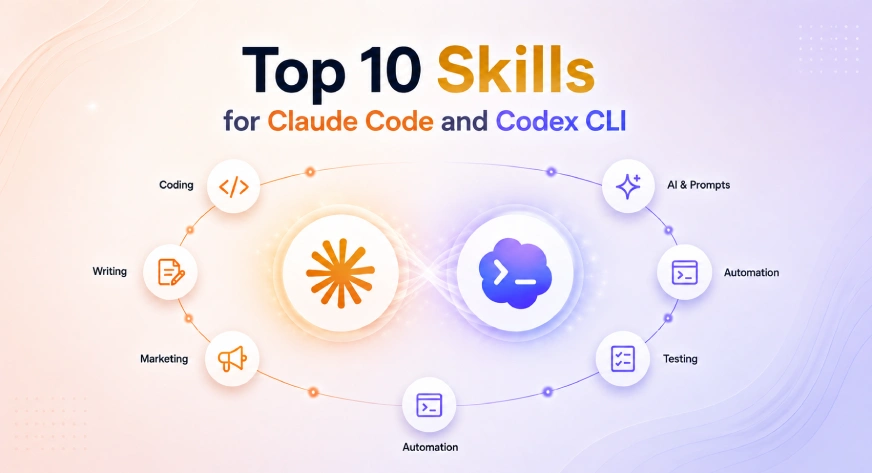
Top 10 Skills for Claude Code and Codex CLI
Unlocking the true potential of Claude Code and Codex CLI isn't about mastering endless AI skills; it's about strategically guiding these tools to deliver actionable results within your budget. The real expertise lies in crafting clear context and transforming AI output into tangible value. Our list of Top 10 Skills focuses on this core principle. Discover how to empower your data journey—instead of searching through vast skillsets, begin with a focused approach. For deeper insights into AI model performance, explore "Qwen 3.

5 Free Courses to Learn Modern AI and LLMs
Unlock the potential of generative AI with our five free courses, designed to empower you with modern skills. Explore building Retrieval-Augmented Generation (RAG) and agentic applications, fine-tuning models, and navigating the Hugging Face ecosystem. These hands-on resources equip you to prototype AI products and seamlessly integrate AI into your workflows. Ready to transform your data journey? For deeper insights into AI governance, consider our article on "Azure API Management Adds Dedicated AI Gateway Tier."

Ex-Spotify employees raise $10M to bring the AI behind its recommendations to e-commerce
A team of former Spotify engineers is pioneering a new era in e-commerce with $10 million in funding. Their startup’s platform leverages AI, mirroring the recommendation engine behind Spotify's success, to predict shopper behavior. It anticipates the next product a customer desires, learns their preferences, and continuously refines its predictions in real-time. This innovative approach promises to transform online shopping experiences. For further insights into automating complex processes, explore our article on "Naïve raises $28.5M" and its approach to infrastructure automation.

I Built an AI Data Agent Which Can Query Data and Answer Business Questions. Here’s How.
Unlock data insights effortlessly with a new approach to business intelligence. This guide details how to build an AI data agent—a conversational interface empowering users to explore data and answer critical business questions using natural language, bypassing the need for SQL. Discover a streamlined workflow that transforms data access, fostering quicker decision-making. Learn the step-by-step process, and explore how companies like Mirendil are scaling similar AI infrastructure with significant Google Cloud investments.

Last Month’s Machine Learning Lessons Learned
Last month’s machine learning development revealed a significant, often overlooked, cost associated with industry conferences: the potential for decreased model performance. Our team’s analysis highlighted that frequent travel and disrupted routines can negatively impact focus and, consequently, the quality of model refinement. This necessitates a re-evaluation of conference participation versus dedicated research time. For those interested in exploring related data agent applications, see our recent guide, "I Built an AI Data Agent Which Can Query Data and Answer Business Questions."

Exclusive: Mirendil inks $100M+ Google Cloud deal to scale self-improving AI
Mirendil, a leader in AI-native spreadsheet technology, has secured a significant partnership with Google Cloud, valued at over $100 million. This expansion will dramatically scale Mirendil’s compute infrastructure, fueling research into self-improving AI systems. The focus? Accelerating scientific discovery and propelling advancements in AI development itself. This investment underscores Mirendil's commitment to a future-focused approach to data management. For a broader look at AI’s impact on personalized experiences, explore our piece on how startups are leveraging AI for e-commerce recommendations.

Article: Runtime-Agnostic AI Workflows: A Pattern for Production Durability and Fast Eval Iteration
AI workflows face a fundamental challenge: production durability clashes with rapid iteration. Ensuring reliability through persistence and distribution inherently slows down the fast feedback loops crucial for evaluating LLM output. Mateus Moury’s article, "Runtime-Agnostic AI Workflows," explores a pattern designed to resolve this tension, enabling both robust production deployments and accelerated experimentation. Discover how to achieve this balance and build more resilient AI systems.
[R], Need some best model suggestions for Face Detection,Face Recognition,Body Detection and Body identification. [R]
Analyzing movie content—specifically, tracking screentime for various character roles—demands robust and reliable AI models. For face detection, consider exploring alternatives to MTCNN; recent architectures often offer improved accuracy and efficiency. Regarding body detection, this remains a challenging area, and careful model selection is crucial. TransNetV2 shows promise for shot boundary detection, though false positives are a common hurdle. Ultimately, choosing the "best" model depends on your specific dataset and performance requirements.
ByteDance is leaning heavily into AI education with Gauth — helpful tutoring or just another shortcut machine? [D]
ByteDance's significant investment in Gauth, an AI-powered tutoring app utilizing animated problem-solving, sparks a critical question: does it genuinely enhance learning or merely create an illusion of competence? While personalized visual explanations hold promise for democratizing education, concerns arise about whether students internalize core concepts or simply mimic solutions presented in engaging animations.
Do LLMs make ML research more fair for small teams? [D]
Large language models (LLMs) are reshaping the landscape of machine learning research, offering a compelling opportunity to level the playing field for smaller teams. A solo researcher or a small group can now leverage LLMs for coding assistance, streamlined literature reviews, and improved writing—functions traditionally provided by larger, well-connected labs. While LLMs don’t replace essential mentorship or critical research judgment, they empower those with limited resources to translate promising ideas into impactful publications.

Jeff Dean and other top AI researchers are leaving Google to launch their own startup
A seismic shift is underway in the AI landscape. Jeff Dean, the legendary Google executive, alongside other prominent AI researchers, is departing to launch a new startup focused on accelerating scientific discovery through artificial intelligence. This ambitious venture signals a progressive push beyond traditional computational methods, aiming to transform how research is conducted and breakthroughs are achieved. For deeper insights into the evolving intersection of AI and the physical world, explore our coverage of "TechCrunch Disrupt 2026’s Real World AI Stage."