MCP server
Beyond Market Intelligence keeps MCP server in one place: 10 stories so far. The section currently leads with “Five lightweight ways to give AI agents tools without an MCP server”, “Explore How GitLab 19.5 Brings Governed AI Agents Into Your Workflow”, and “A new security model keeps AI agents capable without exposing your credentials”. Not every AI agent needs a heavy MCP server to get its work done. GitLab 19.5, released October 15, puts agentic software development and governance at the center of the platform. Acme AI is the next-generation, AI-powered spreadsheet platform built to replace Excel and redefine how analysts, data scientists, and enterprise teams work… The list below is every MCP server story on Beyond Market Intelligence, newest first.
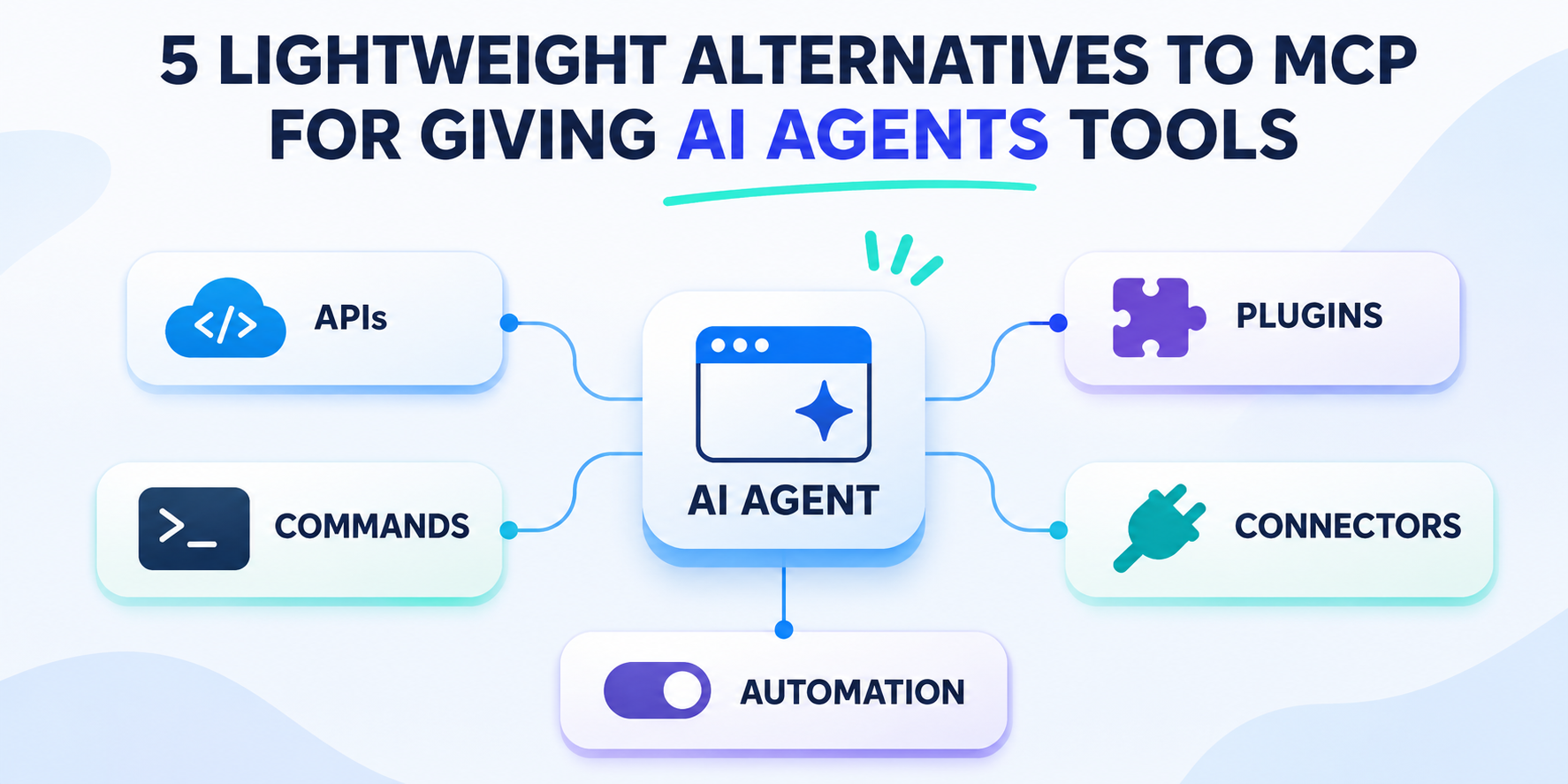
Five lightweight ways to give AI agents tools without an MCP server
Not every AI agent needs a heavy MCP server to get its work done. A Python dispatcher, framework tools, REST adapters, subprocesses, and webhooks each offer a lightweight alternative, and knowing which fits your use case saves real engineering time. We compare all five so you can spot when MCP actually earns its weight. For more on agent behavior, see our coverage of Zhou Yu's dynamic simulations.

Explore How GitLab 19.5 Brings Governed AI Agents Into Your Workflow
GitLab 19.5, released October 15, puts agentic software development and governance at the center of the platform. Its MCP server is now generally available, opening the door for external AI agents to work alongside your team in more meaningful ways. This is about control meeting capability. If you are designing your identity architecture before your data models, you already understand why governed agents matter. Explore how GitLab is making that balance practical, not theoretical.

A new security model keeps AI agents capable without exposing your credentials
Edera's Object Capability Bounded Authority model gives AI agents real power without handing over the keys to your kingdom. By separating what an agent needs to do from the credentials behind it, hypervisor-enforced capabilities limit actions to specific tasks while keeping secrets out of the workload itself. That's practical security thinking. For a deeper look at securing modern workflows, our coverage of GitHub Actions Lockfiles explores a related approach to dependency protection.
Explore how an open-source community is reshaping access to AI research
Papers with Code is back, and this time it belongs to everyone. Hugging Face has open-sourced the revived AI research tracker under an Apache 2.0 license, inviting the community to build the best paper interface together. Niels Rogge, working with Claude and Codex, resurrected the original site Meta acquired and shut down. The codebase is now public on GitHub, with a FastAPI backend, React frontend, and a publicly available API.
How to choose the right AI tool by asking what keeps your LLM in check
The moment you trust an LLM to act on your behalf, you need a clear answer to one question: what stops it from disobeying? Spec-driven test automation offers a practical answer. By defining precise expectations before the model acts, you create a guardrail that keeps AI focused and accountable. It's a shift from hoping an LLM behaves to knowing it will. For more on AI risk, explore our piece on why your next insider threat might come from an AI agent.

From Model to API in One File: Flama's AI Architecture Now on arXiv
Flama's new arXiv paper makes a compelling argument: a model should be a file, not a deployment puzzle. Packaging weights, artifacts, and metadata into a single `.flm` means you can inspect, score, and promote a model without spinning up a server. The same file runs on vLLM or MLX depending on your hardware. That's practical engineering. And for those building agents, the connection to escalation logic in our related piece on smarter AI agents is worth exploring.
Turn Python libraries into MCP servers with Integrum's reflective approach
Turning Python libraries into MCP servers shouldn't require a rewrite, and Integrum proves it. This open-source library uses reflection to wrap existing modules, scikit-learn, for example, so AI agents can call them directly. The author gave Gemma 4 access to build a random forest classifier on the Iris dataset, and it worked. That's more formal than letting agents write code from scratch, and easier to verify. It's a practical step forward.

Unlock natural language control of your smart home with AI agents
Your Google Home just got a whole lot more conversational. Google is rolling out early access to a new MCP server, letting AI agents like Claude and ChatGPT manage your connected devices, pull up camera summaries, and handle smart home tasks through plain language. The move feels like a natural next step for making home automation genuinely accessible. It's not about replacing your routine; it's about simplifying it.

Explore how AI agents simplify WhatsApp Business setup and management
Setting up a WhatsApp Business account has always meant wading through templates, testing, and troubleshooting. Meta's new MCP server changes that by letting AI coding agents like Claude and Cursor handle the boring parts. It is a practical step toward making developer workflows less tedious, and we are here for it. For more on how AI handles precise tasks, check out "Verify Your AI's Understanding: A Simple Check for Tax Season." The shift is subtle, but it is worth exploring.

Your CRM now lives inside Claude, transforming how you manage relationships.
Salesforce just told the world its own screens are optional. The company spent 27 years perfecting the CRM interface, then spent Tuesday arguing sellers should live inside Claude instead. That takes nerve, and it's also the smartest thing they've done in years. The value was never the buttons; it's the data and workflow logic buried underneath. By handing that to Anthropic's model, they're betting on usage over seats. For anyone tired of clicking through a deal pipeline, that's not a threat. It's relief.