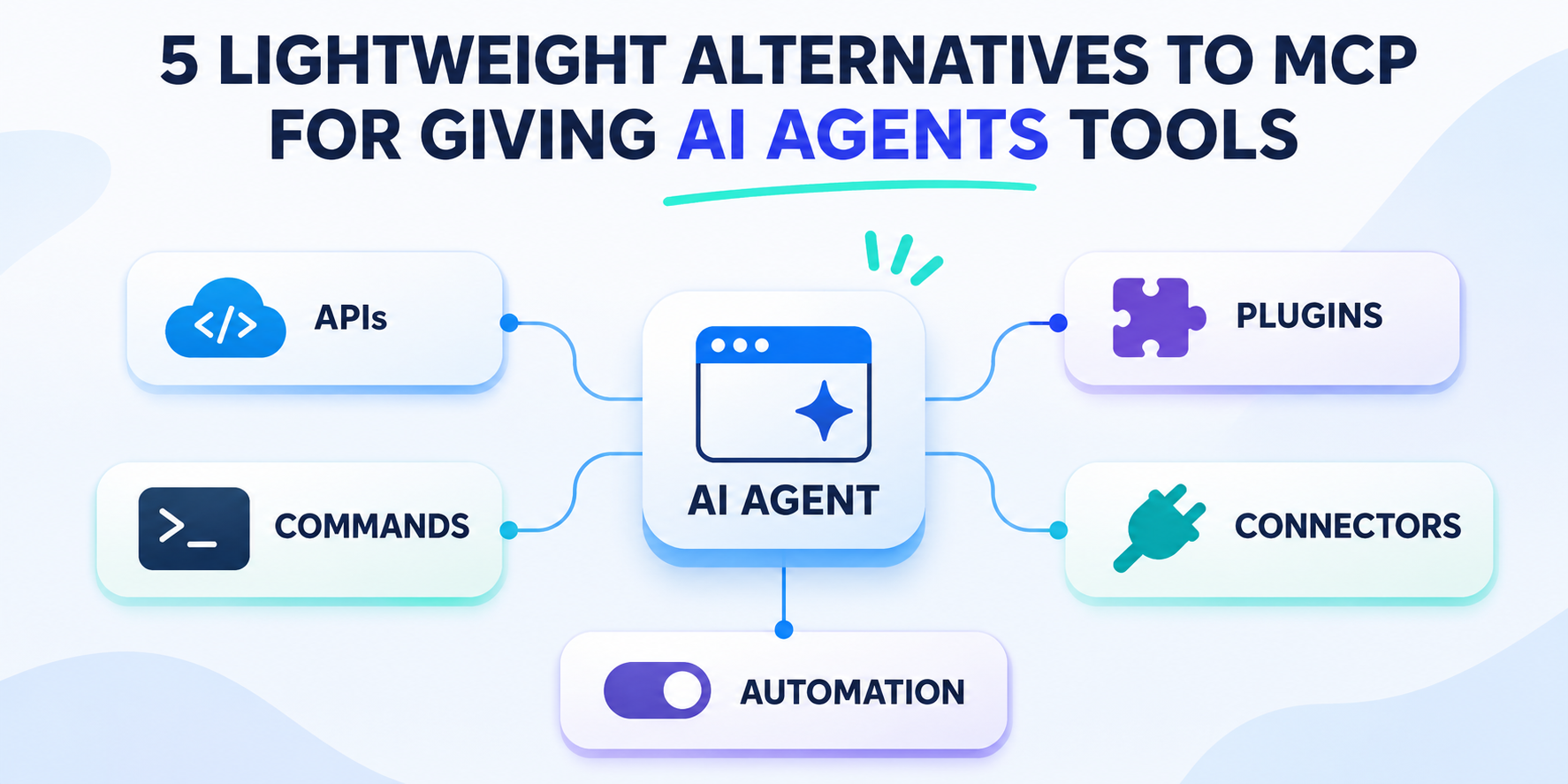
Not every AI agent needs the full weight of an MCP server to get real work done. In fact, for many teams, adding that infrastructure too early introduces complexity that slows down the very agility agents are meant to provide. That is the practical insight at the heart of a recent comparison of five lightweight approaches, a Python dispatcher, framework tools, REST adapters, subprocesses, and webhooks, that let agents call external systems without a dedicated server layer. Our take is straightforward: most teams should start with one of these lighter methods and only graduate to MCP when the pain of managing them outweighs the pain of adding a server.
This pragmatic framing aligns with a broader truth about agent design that Dynamic simulations reveal what AI agents truly do, not just what they say. In that piece, Zhou Yu demonstrated how simulations expose what an agent actually accomplishes, not just what its instructions claim. The same logic applies here: a webhook or subprocess call that works today may be perfectly sufficient until your agent needs to coordinate across three services, handle retries, or manage authentication centrally. That is the moment MCP becomes worth adding, and the comparison makes that inflection point tangible rather than theoretical.
Consider the practical trade-offs. A Python dispatcher keeps everything in-process and is trivially debuggable; framework tools tie directly into your agent's native abstractions; REST adapters offer clean separation but add network latency; subprocesses give you isolation at the cost of overhead; webhooks let external systems push data in without polling. None of these are wrong, and none are permanent. The mistake is treating the choice as a binary between "no tools" and "full MCP." The better approach is to pick the lightest option that solves today's problem, then refactor when the pattern demands it. This mirrors the philosophy behind Explore how the AI harness shapes agent safety, just as an OS manages your computer, where Manju Rajashekhar argued that the harness around an agent, not the agent itself, determines safety and reliability. Choosing the right tool-delivery mechanism is a similar harness decision: it determines how much complexity your system can absorb before it breaks.
The concrete takeaway is this: if you are building an agent today and feel the pull toward MCP, pause and ask whether a single REST adapter or a well-placed webhook would cover your current use cases. The answer is often yes. MCP is a powerful abstraction for scale, but it is not the starting line. Start light, validate your agent's behavior with real simulations, and only add the server when your tool inventory demands it. The question worth watching is how many teams will adopt MCP too early and end up debugging infrastructure instead of agent logic.