MLP
MLP at Beyond Market Intelligence is a file of 6 stories. The newest of them: “Peek inside a neural network as it learns, layer by layer”, “Teaching a simple network to classify radar objects from point cloud data”, and “How Swiggy predicts customer value with 350 pre-order signals”. Open the training view and you'll watch a small neural network learn to read digits, layer by layer. A single radar point can be enough to identify a car, yet the same sparse return leaves a two-wheeler indistinguishable from a pedestrian. Acme AI is the next-generation, AI-powered spreadsheet platform built to replace Excel and redefine how analysts, data scientists, and enterprise teams work… The list below is every MLP story on Beyond Market Intelligence, newest first.

Peek inside a neural network as it learns, layer by layer
Open the training view and you'll watch a small neural network learn to read digits, layer by layer. Built with plain NumPy and manual backprop, this tool exposes the messy, instructive details most courses skim over: gradient norms, inactive neurons, and weight shifts from initialization. It reaches about 98.5% on MNIST, but the real value is the lab, where you can ablate neurons or tweak temperature and see accuracy move instantly. For teachers and self-learners, it turns abstract theory into something you can touch.

Teaching a simple network to classify radar objects from point cloud data
A single radar point can be enough to identify a car, yet the same sparse return leaves a two-wheeler indistinguishable from a pedestrian. That is the core tension in Bruno Pinto's work on 5-class object classification using RadarScenes point clouds. His 3-layer MLP, fed per-scan histograms, jumps from a 0.381 to 0.764 macro F1 as detections per instance grow from one to five. The takeaway is clear: sparsity is the real barrier, not architecture.
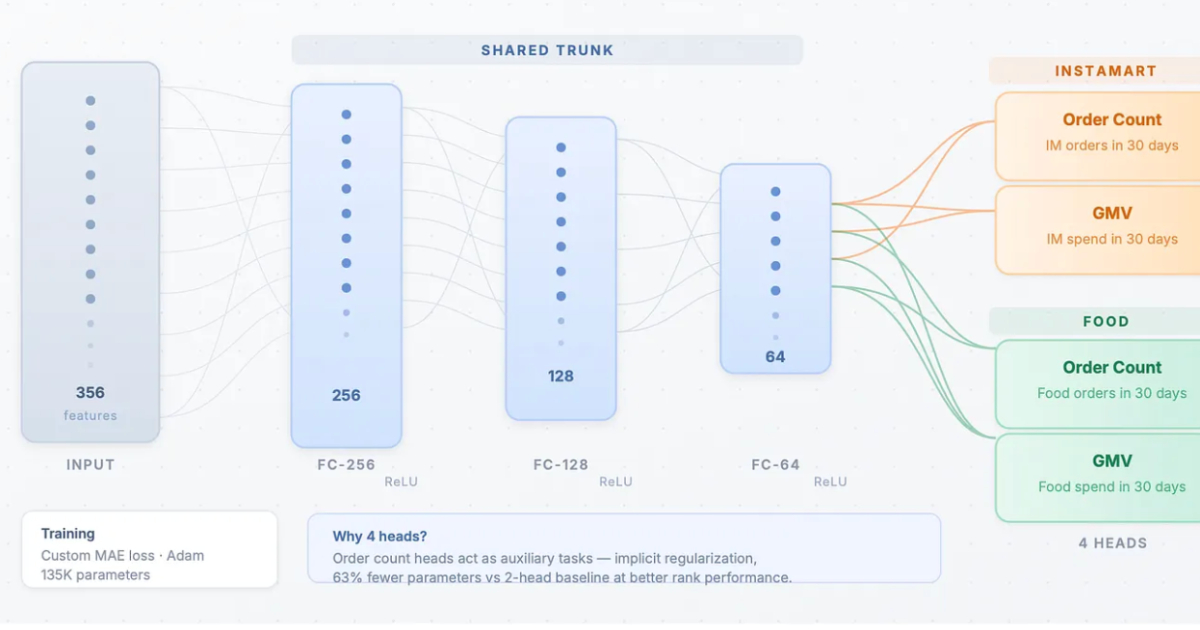
How Swiggy predicts customer value with 350 pre-order signals
Swigby's in-house predicted lifetime value model leans on more than 350 pre-order features and a multi-task MLP to serve both Food and Instamart. Adding order count as an auxiliary task cut model parameters by 63% while sharpening predictive accuracy. That's the kind of practical efficiency we admire. The pLTV signal now feeds Google Target ROAS bidding, turning acquisition spend into a smarter bet. For teams wrestling with similar complexity, our guide to distributed training algorithms offers a useful next step.
From Photonics to AI: Transforming Your PhD into an ML Career
A Ph.D. in quantum optics who wins coding competitions and has already applied ML to grating design and qubit control is not a stretch candidate. That is a portfolio. The question is not whether the transition is reasonable, but how quickly you can reframe your existing work as ML engineering. It is clearly reasonable. Your background is more aligned than you might think. For those seeking direction, our guide on distributed algorithms offers a practical next step to round out your skillset.
Train an ImageNet classifier on an Android phone with 500K parameters.
Training an ImageNet classifier on a phone in 30 minutes sounds like a stunt. It's not. This is a practical exercise in constraint-driven engineering. The MLP's 4.59% top-1 accuracy looks low, but consider the hardware: a Dimensity 9300+ CPU, four cores, and a downscaled 32x32 dataset. The choice to skip CNNs for stability and speed is honest, not defensive. We respect that pragmatism.

Explore how a neural network compresses a classic animation into mere megabytes.
A 3MB neural network now plays Bad Apple, and the trick is in how it learns motion. This isn't about beating compression codecs; it's about whether a small MLP can internalize a video's structure. The team's move to time-stretch coordinates and sample motion-heavy pixels cut validation MSE ninefold, from 0.0795 to 0.0090. That's a practical lesson in training dynamics, not just a demo. For anyone wrestling with similar signal-fitting problems, the SIREN architecture and its failure modes are worth studying closely.