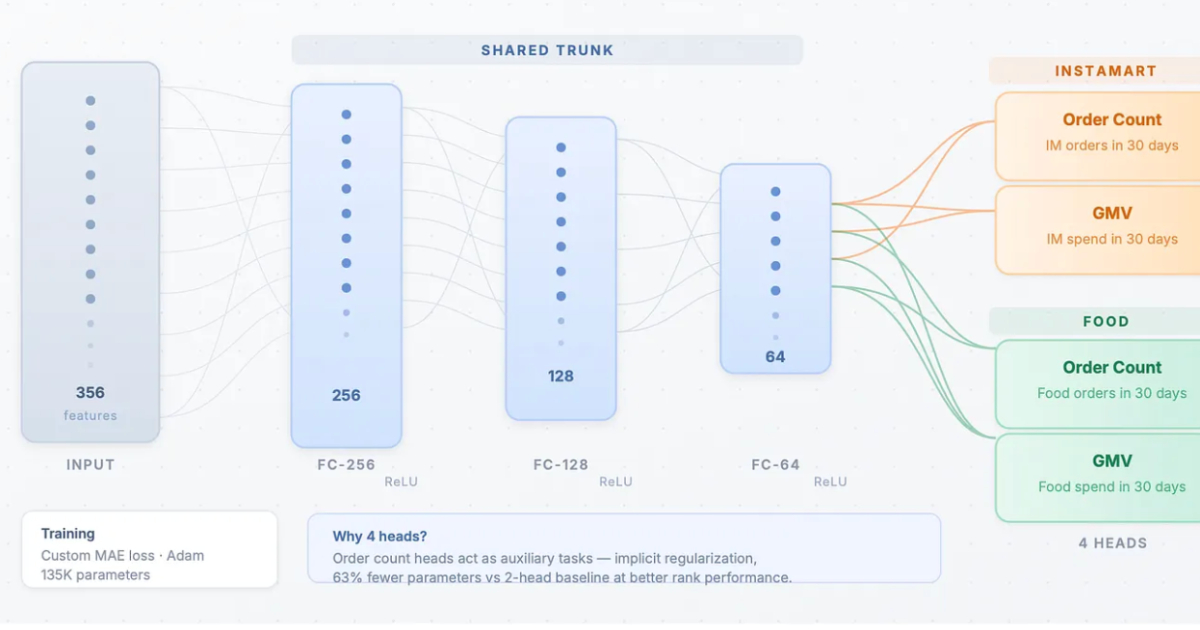
Swiggy's decision to build a predicted lifetime value model from more than 350 pre-order features is the kind of quiet, technical ambition that usually stays behind closed doors. The headline is straightforward, but the substance is worth pausing over. By pairing a multi-task MLP for Food and Instamart with an auxiliary order-count task, the team reportedly cut model parameters by 63% while improving predictive performance. That is not a small win. It is a reminder that efficiency and accuracy are not opposing forces in machine learning; they can be engineered together when you choose the right constraints. For anyone who has wrestled with sprawling feature stores or bloated models, this is a concrete lesson: sometimes the path to better performance is not more parameters, but a sharper objective.
What stands out here is the deliberate move to use the pLTV signal with Google Target ROAS bidding for customer acquisition. This is where the story moves from model architecture to business impact. Swiggy is not just predicting value for the sake of a metric; they are wiring that prediction directly into how they spend money to acquire users. That is the kind of integration that separates teams playing with ML from teams using it as a strategic lever. If you are a data leader, the takeaway is direct: your lifetime value model is only as useful as the systems it feeds. A 63% reduction in parameters matters less if the signal is not being operationalized where the budget decisions happen. Swiggy is showing that the real win is closing the loop between prediction and action.
The connection to broader AI systems is worth drawing out. In our Unlock LLM Training: A Practical Guide to Distributed Algorithms, we explore how distributed training is less about raw scale and more about orchestrating complexity. Swiggy's approach mirrors that philosophy on a smaller stage. They did not chase a larger network; they found a way to make a smaller one smarter. Similarly, our piece on Exploring Paragraph Structure: How LLMs Navigate Token Space touches on how structure, not just size, dictates capability. Swiggy's multi-task setup is an architectural choice that imposes useful structure on the learning problem. And for teams looking to apply these ideas, our Unlock ChatGPT for Work: A Practical Guide to Getting Started offers a grounded entry point into working with AI in practical settings.
The honest reaction here is that most companies do not need more models; they need better-scoped problems. Swiggy's work is a useful counterexample to the impulse to throw more compute at every prediction task. The open question is whether this kind of architectural efficiency translates beyond their specific context. Order count as an auxiliary task makes intuitive sense for a delivery platform, but it may not generalize to your business. That is fine. The principle, not the implementation, is what you should carry forward. If you are building a pLTV model, start by asking what secondary signal could reduce your parameter count while sharpening your primary prediction. Then, make sure your output is actually being used to inform a bid, a budget, or a campaign. The specific number to watch is not 350 or 63%; it is whether your model changes a decision. That is the only metric that matters.