model architecture
Beyond Market Intelligence keeps model architecture in one place: 9 stories so far. The section currently leads with “Evolve Your Recommendations: Real-World Insights on Adaptive Systems”, “From Codebase to Dataset: Fine-Tuning AI on Your Own Projects”, and “How recurrent depth lets AI think beyond linear reasoning.”. Adaptive recommendation systems are rarely defeated by model architecture alone. Turning a well-built React or Next.js project into a fine-tuning dataset is a puzzle worth solving, especially when you're aiming for quality over generic code dumps. Acme AI is the next-generation, AI-powered spreadsheet platform built to replace Excel and redefine how analysts, data scientists, and enterprise teams work… The list below is every model architecture story on Beyond Market Intelligence, newest first.

Evolve Your Recommendations: Real-World Insights on Adaptive Systems
Adaptive recommendation systems are rarely defeated by model architecture alone. Mallika Rao shows that real complexity emerges in production, where real-time feedback loops, retrieval freshness, and multi-stage orchestration must all bend to latency and cost constraints. This is practical insight, grounded in operational reality. For deeper context on how such systems are built, explore our piece on *Agent Harnesses* to see similar engineering discipline applied elsewhere. Rao's work is a reminder that evolution happens under pressure, not in isolation.
From Codebase to Dataset: Fine-Tuning AI on Your Own Projects
Turning a well-built React or Next.js project into a fine-tuning dataset is a puzzle worth solving, especially when you're aiming for quality over generic code dumps. The real challenge isn't just extracting files; it's crafting instructions that mirror how you'd actually ask for a component or a page. Pairing screenshots with code and preserving cross-file context are the hard parts, but they're where the value lives.

How recurrent depth lets AI think beyond linear reasoning.
OpenAI's Astra model is stepping outside the lines of sequential reasoning, and safety experts are paying close attention. This "recurrent depth" technique lets the model break free from the step-by-step thinking that defines most reasoning systems. It's a bold move, one that could unlock faster, more flexible AI. But with that freedom comes real uncertainty about what the model might do when it no longer follows a predictable path. We're not sounding alarm bells, but we are watching closely.
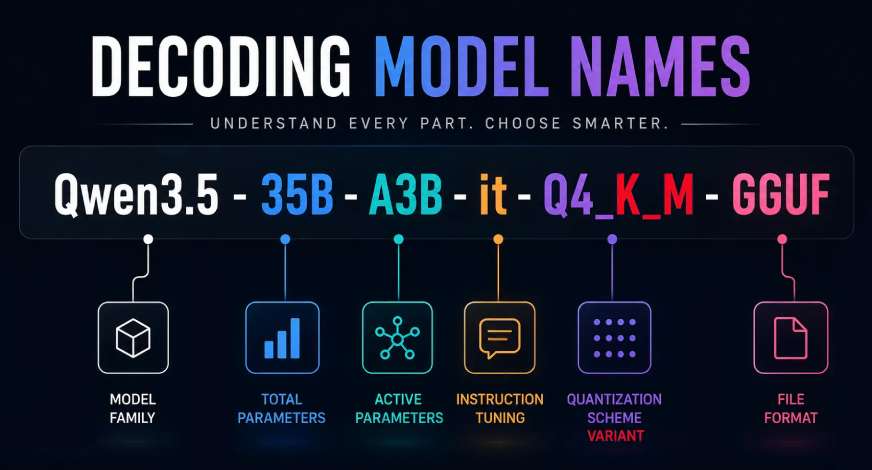
Decode Any LLM Model Name and Choose With Confidence
Qwen3.8-27B-A3B-It-2507-gguf-q2ks-mixed-AutoRound looks like random noise at first. It isn't. Each segment in that string tells you something concrete: model size, architecture, activation pattern, even quantization. That's the kind of clarity users need when choosing a local LLM. This guide breaks the shorthand down piece by piece, turning confusion into confidence. If you're also curious how models structure their thinking, our piece on exploring paragraph structure in token space pairs well with this. Start decoding, and make your next download an informed one.
Explore how Kimi K3 makes powerful AI more accessible and affordable.
A 2.8-trillion-parameter model that only activates a fraction of its weights per token sounds like a paradox, but that's exactly what makes Kimi K3 interesting. Moonshot AI built it with a Mixture-of-Experts architecture to keep inference costs down while pushing coding and agentic performance. It's a practical alternative to proprietary systems, especially when you weigh open weights against near-frontier capability. We think that trade-off is worth exploring.
Scaling DNA modeling with linear attention that remembers what matters
A 25% recall score on a four-token DNA vocabulary isn't just a stumble; it's a sign that the compressed state in linear attention is dropping the thread. This isn't a niche bug, as HyenaDNA hits the same wall. The core tension is clear: state compression trades memory for recall, and long contexts expose that trade-off brutally. We're watching a fundamental limit being tested, not a simple fix.

The 47‑Page Blueprint That Reveals What a Frontier Model Really Takes
Kimi K3 doesn't hide behind hype. Its 2.8-trillion-parameter model shipped with 47 pages of open recipe, and reading them reveals a truth we don't often say aloud: most of building a frontier model isn't the model. It's the data, the compute orchestration, the judgment calls. That transparency feels almost radical. For anyone curious how far the field has come, this report is a grounded, human-scale entry point.

Explore how a third pretraining axis transforms end-to-end data generation.
Most language models are trained along two axes: data and compute. Gladstone and colleagues argue for a third: the modeling objective itself. Their work on explorative modeling suggests that how we frame the learning task is as important as the data we feed it. This isn't a tweak; it's a different approach to end-to-end generation. For a deeper look at how such models navigate structure, our guide on paragraph structure in token space is a useful next stop.
Why Your AI Model Slows 170x on a T4 vs A100
A 170x slowdown between a T4 and an A100 is not a generational gap; it's a signal that something structural is off. For a point-tracking model with dense 4D correlation volumes and transformer layers in pure FP32, you're likely hitting the T4's lack of Tensor Core support for your exact ops, forcing a fallback to inefficient kernels. But that alone shouldn't explain the magnitude. Profile kernel-level timing first. Look for operations like `grid_sample` or `einsum` that might be serializing on the T4's memory bandwidth.