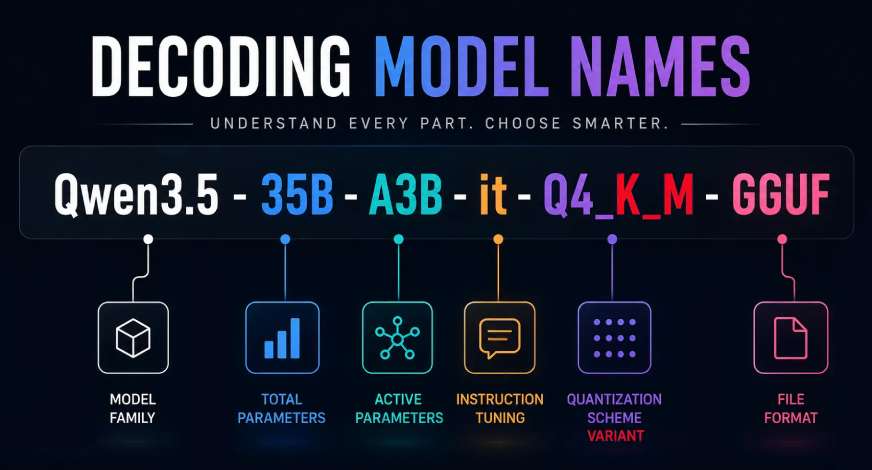
If you have ever tried downloading a local LLM, you have likely stared at a filename that looks like a random string of letters and numbers. Qwen3.8-27B-A3B-It-2507-gguf-q2ks-mixed-AutoRound is the kind of string that makes you feel like you need a decoder ring just to get started. But here is the thing: that string is not noise. It is a complete specification sheet, compressed into a single line. For anyone exploring open-source models, learning to read these names is the difference between downloading something that works for your hardware and wasting hours on a model that refuses to run. This guide from Analytics Vidhya does exactly that work, and our take is that this kind of practical literacy matters more now than ever.
What makes this guide so useful is that it connects directly to the deeper mechanics of how models operate. When you decode a name like this, you are learning about parameter counts, quantization methods, and architectural choices like attention mechanisms. That is not just trivia. It is the same kind of knowledge that helps you understand how a model navigates token space or why certain paragraph structures work better than others. As we have explored in Exploring Paragraph Structure: How LLMs Navigate Token Space, the internal logic of a model shapes its output in ways that are invisible until you know what to look for. Model names are just the entry point. They tell you what you are working with before you even run a single prompt.
For us, the real value here is practical and human-centered. Most people do not need to know every architectural detail, but they do need to know whether a model will fit in their VRAM or run reasonably on a laptop. The naming conventions are the first filter. If you can read them, you can make smarter decisions about which model to download, which quantization to choose, and what trade-offs you are accepting. This aligns with the broader movement toward making AI more accessible, as seen in Unlock ChatGPT for Work: A Practical Guide to Getting Started. Both pieces assume that the barrier to entry is not intelligence but familiarity. Once you understand the vocabulary, the entire landscape opens up.
The one thing we would tell a reader who asks about this is simple: do not let the jargon intimidate you. You do not need to memorize every suffix or prefix. Start with the numbers that matter most: the total parameter count, the active parameters during inference, and the quantization level. Those three pieces alone will answer most of your practical questions. The rest is refinement. This is also where the conversation connects to the challenge of bridging retrieval and action, as discussed in Bridging Retrieval and Action: A New Approach to AI Tasks. Knowing what your model is capable of is the first step toward using it effectively, whether that means building an agent or just running a local assistant. The model name is the contract between you and the tool. Read it, and you stop guessing. That is the takeaway worth quoting: the model name is not metadata, it is the instruction manual.