model weights
Beyond Market Intelligence keeps model weights in one place: 6 stories so far. The section currently leads with “Looping a small AI model beats a model over six times its size”, “Run AI Models Locally with Ollama's OpenAI-Compatible Endpoint”, and “Explore how AI agents learn by editing context, not model weights”. Looping a small AI model through its own transformer blocks beats a model over six times its size. Ollama runs a local HTTP server on port 11434 and hands any client an OpenAI-compatible endpoint pointed at your own machine. Acme AI is the next-generation, AI-powered spreadsheet platform built to replace Excel and redefine how analysts, data scientists, and enterprise teams work… The list below is every model weights story on Beyond Market Intelligence, newest first.

Looping a small AI model beats a model over six times its size
Looping a small AI model through its own transformer blocks beats a model over six times its size. That's the finding from the Looped Diffusion Transformer paper, and it's a genuinely practical insight. The authors fixed naive looping with deep supervision and self-modulating attention, then proved a 260M-parameter looped model outperforms a 1.7B-parameter one using 4.9x less compute. Depth is chosen at sampling time, letting you trade compute for refinement per image.
Run AI Models Locally with Ollama's OpenAI-Compatible Endpoint
Ollama runs a local HTTP server on port 11434 and hands any client an OpenAI-compatible endpoint pointed at your own machine. That's a practical shift: pulling model weights locally means you control the data, the latency, and the cost. We find this approach refreshingly direct, no cloud dependence, just a clean API you already know. For deeper context management strategies, see our related article on treating context like code to scale AI agents.
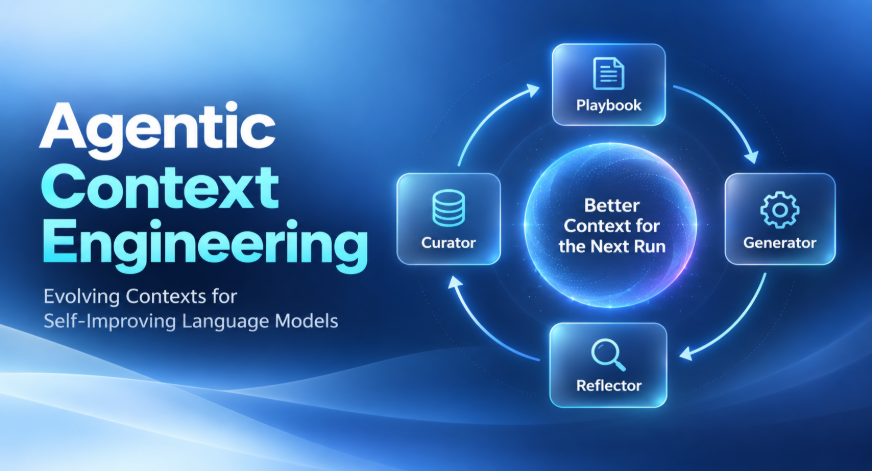
Explore how AI agents learn by editing context, not model weights
Most AI systems improve by tweaking weights, but Agentic Context Learning (ACE) takes a different path. It lets a model sharpen its performance by editing the context it reads, leaving the underlying parameters untouched. The research explains why full rewrites stumble, how a playbook update keeps things on track, and where the gains actually hold up. It's a practical, human-centered twist on self-improvement. For more on how agents are evolving, our piece on Meta's Muse promotion pairs nicely with this idea.
Balancing AI inference between server and edge for smarter cost control
Splitting inference across server and client hardware is a practical answer to AI's rising cost problem. The idea of keeping proprietary weights server-side while offloading part of the computation to user devices is worth serious attention. The real challenge is coordination: training two models to communicate through latent tensors is promising, though the complexity is substantial. If the protocol becomes standardized, the flexibility could extend beyond one-to-one setups. For deeper context on distributed systems, our guide on distributed algorithms explores similar terrain.

When AI Models Become the Target, Ransomware Takes a Darker Turn
When the same attacker breaks into the same server twice, the second visit should never bring a weapon built specifically for what you keep there. That's exactly what happened here. In July, Sysdig documented a crew it tracks as JADEPUFFER exploiting a Langflow flaw twice, but the second payload was ENCFORGE, a compiled ransomware locker with no interest in money. It carries no payment portal. It exists to destroy the AI models you cannot restore. That distinction matters.
Schema proves process can match model power in ARC reasoning
A 99% score on ARC‑AGI‑3 is the kind of number that makes you stop and ask how. Schema, a harness built around Claude Opus 4.8 and Fable 5, claims exactly that without touching model weights. It reshapes the process: turning observations into working game models, testing predictions against interaction history, and revising plans on the fly. The fallback rule is refreshingly simple, rerun below 80 with a different model and keep the higher score. That's practical engineering, not magic.