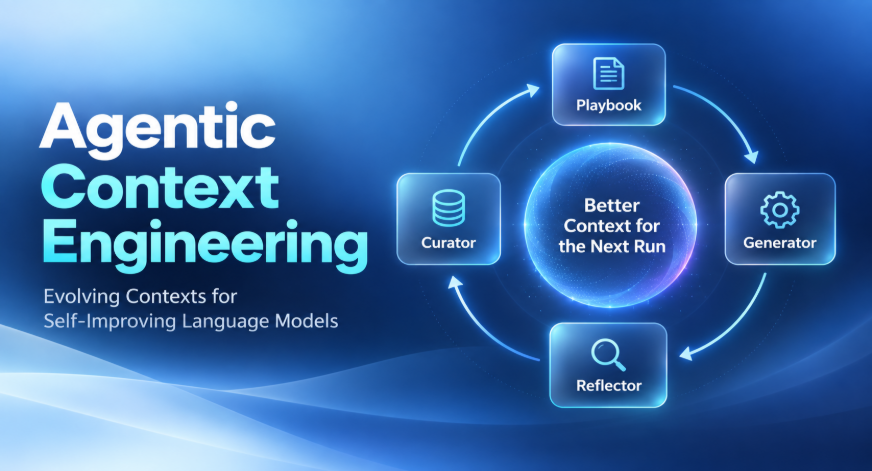
The idea that an AI agent can get better by editing the context it reads, rather than by updating its model weights, is a quiet but significant departure from how we normally talk about machine learning. The ACE paradigm, as outlined in the research, treats context as a living document. The agent learns by revising the instructions and examples it consumes, not by changing its underlying parameters. Full rewrites fail, the paper argues, because they destroy what works. The playbook update, by contrast, is surgical. It preserves the structure while refining the specific moves that lead to better outcomes. That distinction matters. It suggests that improvement is not always about retraining a model from scratch, but about becoming a better editor of the information you already have.
For our readers who are building portfolios and chasing practical skills, this is more than a technical curiosity. We have said before that Showcase Your AI Skills: 10 Projects to Build Your Portfolio is the bridge between theory and professional work. ACE reinforces that point in a way that feels almost counterintuitive. You do not need to fine-tune a massive model to see gains. You need to get better at structuring the context that guides it. That is a skill you can practice today, with the tools you already have. It also levels the playing field. A developer who cannot afford to train large models can still experiment with context editing and see measurable improvements. That is an accessible entry point into a field that often feels gated by compute budgets.
We would tell a reader who asked about ACE to focus on the discipline of iterative editing. The measured gains hold up specifically because the agent is not rewriting everything. It is learning which parts of its context are load-bearing and which are noise. That is a habit worth importing into your own workflow, whether you are building an AI agent or just trying to manage a complex spreadsheet. The parallel to tools like the ones we cover, such as Explore GPT-6 Sol and Luna: Astra-level performance, accessible pricing, is that accessible performance does not always come from a bigger model. Sometimes it comes from a smarter way to use the context you have. As for the broader trend of personal AI agents, like the one Meta Accelerates Muse’s Growth with Expanded Promotion, the same logic applies. The agent that can edit its own context is the agent that adapts to you without needing to be rebuilt.
The honest take is this: ACE is not a magic switch, but it is a reframing of where leverage actually lives. The concrete consequence to watch is whether this changes how evaluation is done. If context editing becomes a standard way to measure an agent's ability to learn, then the field will shift toward better tooling for introspection and editing. The open question is whether current models can reliably know which context to change. That is the detail to follow. It will determine whether ACE becomes a foundational practice or just another research footnote. Our money is on the former, because the underlying instinct, edit what you read, not what you are, is one that scales with the user, not against them.