MoE
Beyond Market Intelligence keeps MoE in one place: 4 stories so far. The section currently leads with “Explore How DeepSeek's Efficient Design Powers Smarter Open-Source AI”, “Rebuilding a Smarter Language Model from the CPU Up”, and “Tiered optimizer cuts MoE training memory demands by 97 percent”. DeepSeek-V4.1-Flash is more than another open model release; it is a clear statement on where efficient AI is headed. After six months away, developer zemondza is rebuilding NORD, their spiking language model, with a sharper focus: CPU-first inference from the ground up. Acme AI is the next-generation, AI-powered spreadsheet platform built to replace Excel and redefine how analysts, data scientists, and enterprise teams work… The list below is every MoE story on Beyond Market Intelligence, newest first.
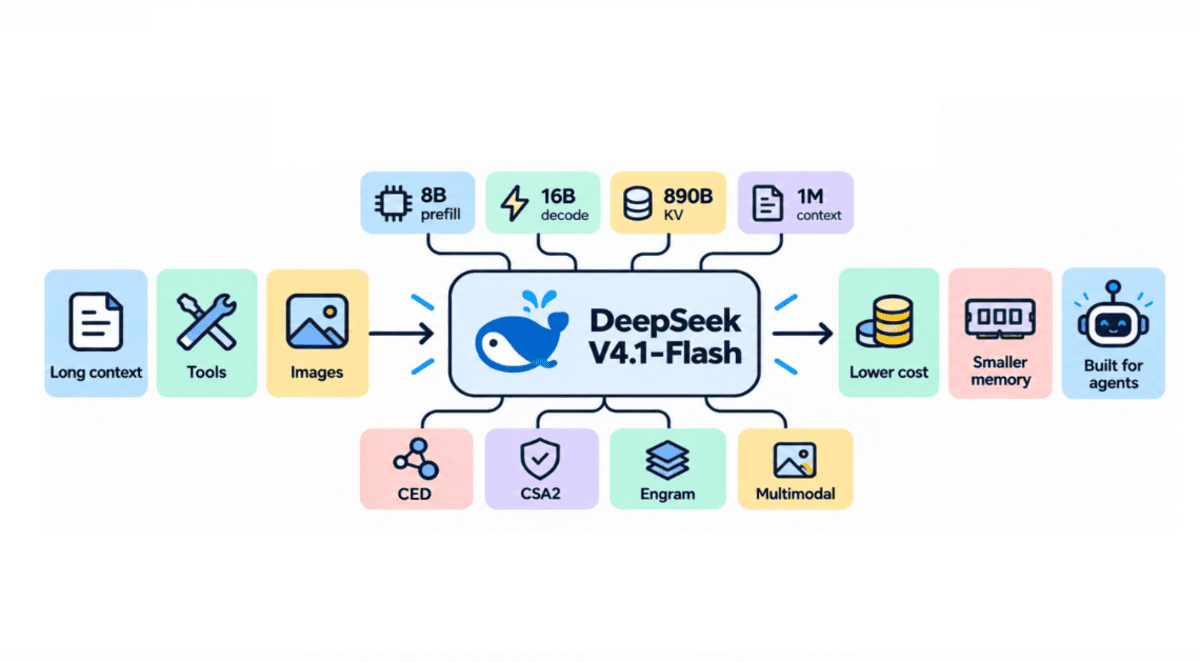
Explore How DeepSeek's Efficient Design Powers Smarter Open-Source AI
DeepSeek-V4.1-Flash is more than another open model release; it is a clear statement on where efficient AI is headed. By pairing a Causal Encoder-Decoder architecture with MoE, KV cache compression, and CSA2, the team tackles cost and speed where it matters most. Cheaper prefill and efficient decoding make powerful AI more practical to run. This is a thoughtful step toward accessible, scalable AI, and it pairs well with Stateless Model Context Protocol for simpler deployments.
Rebuilding a Smarter Language Model from the CPU Up
After six months away, developer zemondza is rebuilding NORD, their spiking language model, with a sharper focus: CPU-first inference from the ground up. The new version, NORD 5.5 Flash, drops the artificial spike-time dimension in favor of using the actual token sequence as the time axis. That's a cleaner design choice. The goal isn't to outrun Transformers, but to see if a simplified, truly causal architecture holds its own. We're curious to see the benchmarks when they arrive.

Tiered optimizer cuts MoE training memory demands by 97 percent
SkewAdam tackles the biggest pain point in MoE training head-on: optimizer state memory. By tiering precision across backbone, experts, and router, it cuts state from 50.6 GB to 1.29 GB, a 97.4% drop that lets a 6.78B MoE fit on a single 40GB GPU. That's not just incremental progress; it's a practical unlock for researchers stuck on smaller hardware. For deeper context on why memory efficiency matters, our coverage of Microsoft's TauGrid shows similar pressure points in AI workload management.
Explore how AI models can now run directly on your mobile device.
Running a private Qwen 35B MoE model on a Galaxy S26 Ultra is no small feat, and the early numbers are worth noting. Roughly 90 input tokens per second with about 8 output tokens per second shows real progress, especially when precision stays intact. What stands out is the path here: self-taught expertise, no formal PhD, just curiosity and access to resources. That matters. Four arXiv papers still on hold because there is no institutional backing? That is a familiar wall.