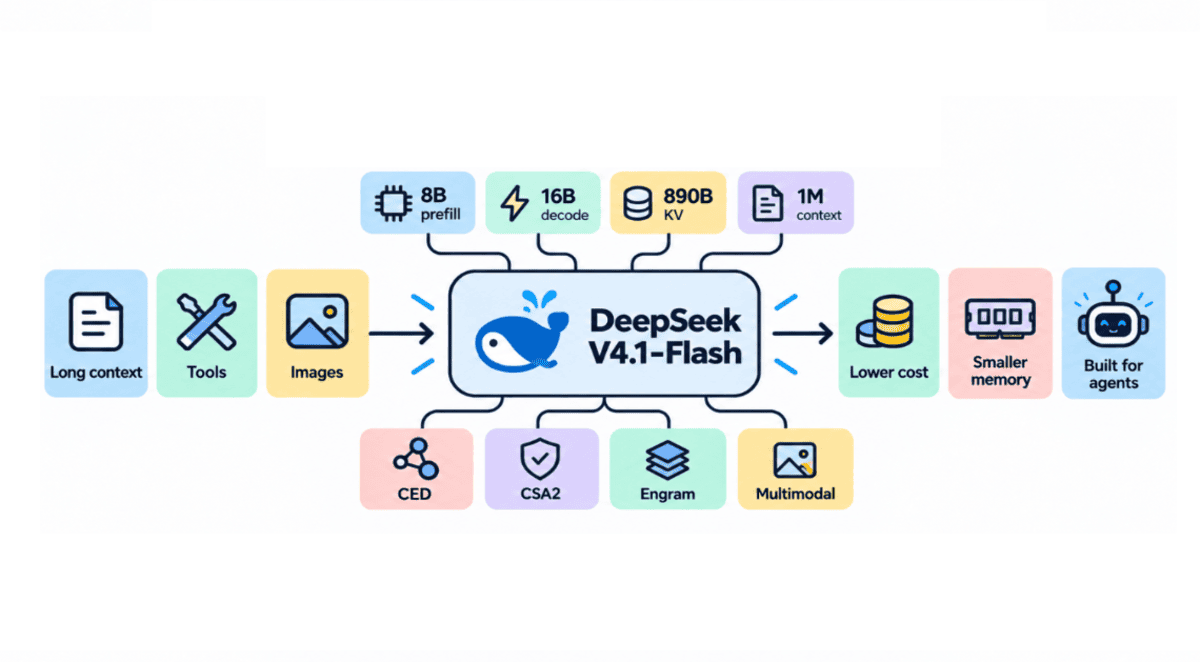
The release of DeepSeek-V4.1-Flash is a quiet signal that the open-source AI conversation is shifting from raw capability to operational reality. For too long, the benchmark charts have rewarded scale above all else, leaving developers to wrestle with inference costs that quietly undermine any productivity gains. This model takes a different path. By pairing a Causal Encoder-Decoder architecture with Mixture of Experts, KV cache compression, and CSA2, DeepSeek has engineered efficiency into the core of the model rather than bolting it on as an afterthought. That is not just a technical footnote. It is a direct answer to the practical frustration of teams who have watched promising pilots stall because the infrastructure bill grew faster than the feature set. If you have been holding off on open-source adoption because the total cost of ownership felt opaque, this release deserves your attention.
The implications for your workflow are more immediate than the architecture jargon suggests. Cheaper prefill and efficient decoding are not abstract optimizations; they translate directly into lower latency and smaller memory footprints for the applications you are already building. This matters most for teams operating under real-world constraints, where a model that performs admirably on paper becomes unusable if it cannot run affordably in production. The same logic that drives Scale AWS Server Deployments Effortlessly with Stateless Model Context Protocol applies here: reducing operational overhead is a feature in its own right. Similarly, the focus on efficient decoding echoes the concerns raised in Bridging Retrieval and Action: A New Approach to AI Tasks, where the gap between a model's potential and its practical use often hinges on how smoothly it integrates into an existing pipeline. DeepSeek-V4.1-Flash is not just competing on quality; it is competing on how easily you can make it part of something larger.
What stands out here is the confidence in the design. The Causal Encoder-Decoder architecture is a deliberate choice, not a compromise. It suggests DeepSeek understands that the future of open models lies not in monolithic giants but in adaptable systems that respect the realities of deployment. For developers who have felt the sting of vendor lock-in or the frustration of opaque licensing, this is a meaningful step toward a more accessible ecosystem. Our take is straightforward: this release should push you to revisit your assumptions about what open-source models can deliver. The efficiency gains are not incremental; they change the calculus for what is worth building. If you have been waiting for a reason to explore a more flexible approach to AI tasks, this is it. The one detail to watch is how the open-source community builds on this foundation, because the real test will be whether the efficiency holds up in diverse, real-world applications.