MSE
4 stories filed under MSE on Beyond Market Intelligence. The newest of them: “Beyond MSE: Refining Forecasts with Autoregressive Rollout and Uncertainty”, “Is Reinforcement Learning Really Needed for Jev's Spreadsheet AI?”, and “When Anomaly Detection Meets Sparse Data: Rethinking Performance Regressions”. Mean squared error tells you how wrong your model is on average. The question cuts to the heart of Jev's design. Acme AI is the next-generation, AI-powered spreadsheet platform built to replace Excel and redefine how analysts, data scientists, and enterprise teams work… The list below is every MSE story on Beyond Market Intelligence, newest first.
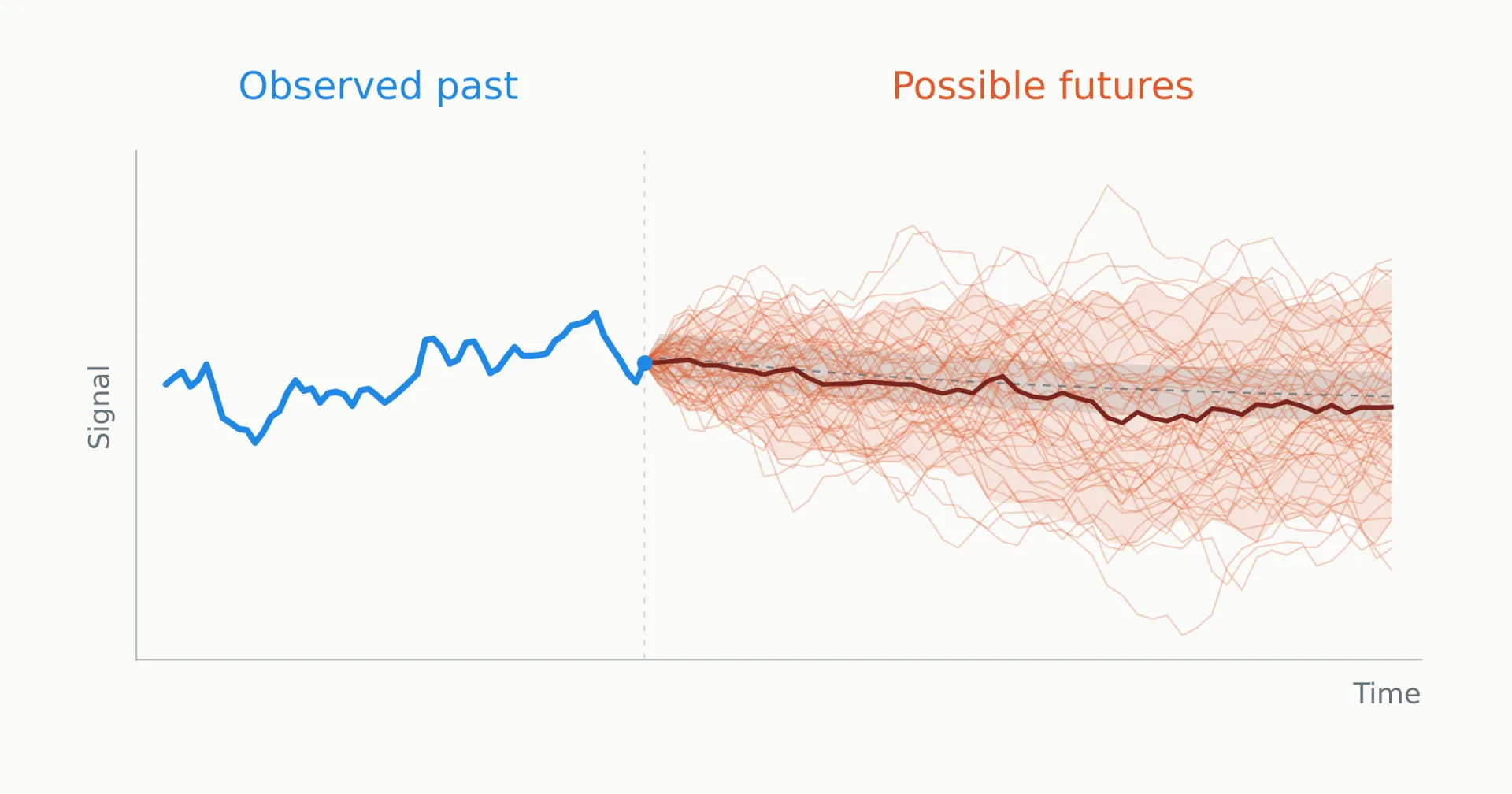
Beyond MSE: Refining Forecasts with Autoregressive Rollout and Uncertainty
Mean squared error tells you how wrong your model is on average. It does not tell you how confident you should be in that number. This second installment in our probabilistic forecasting series tackles exactly that gap through autoregressive rollout and uncertainty propagation. Instead of settling for a single point estimate, the approach refines forecasts by carrying uncertainty forward. It is a practical next step for anyone working with physical signals.
Is Reinforcement Learning Really Needed for Jev's Spreadsheet AI?
The question cuts to the heart of Jev's design. If the model only predicts Choice, Score, or Noul, those outputs are already differentiable through cross-entropy or MSE. Adding reinforcement learning feels like extra machinery unless there's a hidden reward signal we're not seeing. The environment would need to be defined, and that's unclear. It's fair to ask if this is substance or just a buzzword. We're not dismissing the approach, but the burden of proof is on the implementation.
When Anomaly Detection Meets Sparse Data: Rethinking Performance Regressions
Evaluating anomaly detection with only ten healthy samples is a tightrope walk, and the questions here show a solid grasp of the risks. Leave-one-out is the right call for threshold setting, but it does not replace a true test set. Using regression runs as your unseen test is a practical move, but it risks optimism if those runs share hidden conditions. Collecting a second independent healthy dataset for final false-positive checks is the stronger validation.

Explore how a neural network compresses a classic animation into mere megabytes.
A 3MB neural network now plays Bad Apple, and the trick is in how it learns motion. This isn't about beating compression codecs; it's about whether a small MLP can internalize a video's structure. The team's move to time-stretch coordinates and sample motion-heavy pixels cut validation MSE ninefold, from 0.0795 to 0.0090. That's a practical lesson in training dynamics, not just a demo. For anyone wrestling with similar signal-fitting problems, the SIREN architecture and its failure modes are worth studying closely.