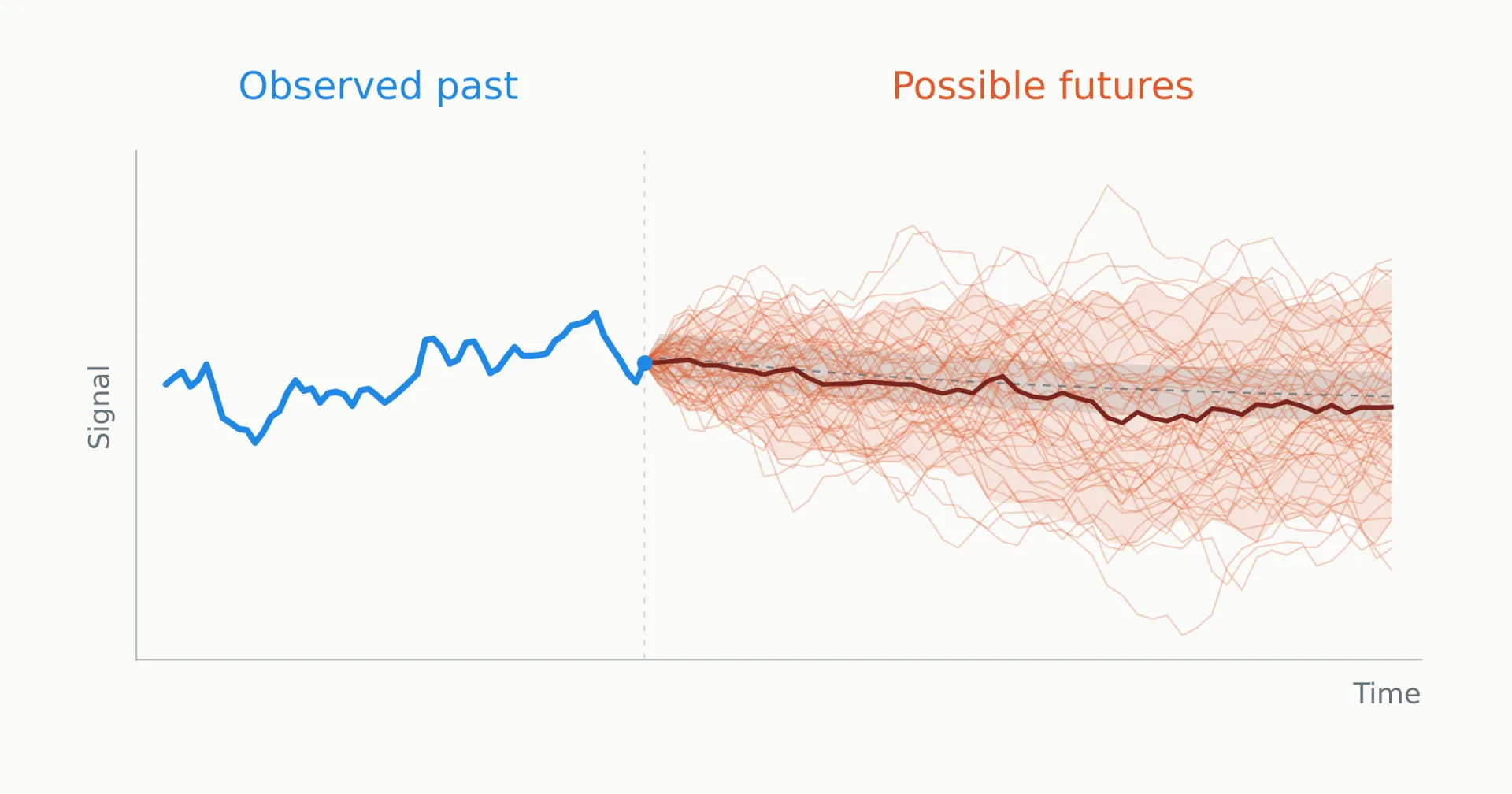
The relentless pursuit of improved forecasting accuracy is a cornerstone of data-driven decision-making, and the recent piece "Your Model's MSE Is Lying to You: Part II" highlights a crucial, often overlooked, nuance within that pursuit. While Mean Squared Error (MSE) remains a ubiquitous metric, the article rightly points out its limitations when dealing with physical signals and probabilistic forecasting. Focusing solely on MSE can mask significant uncertainty in predictions, leading to overconfident and potentially flawed conclusions. This builds on the broader conversation around understanding the technologies shaping our future, as explored in [Expanding Your Tech Fluency: Key Insights Beyond Artificial Intelligence], where we emphasized the need to move beyond surface-level understanding and grapple with the underlying complexities of modern data science. The article’s exploration of autoregressive rollout and uncertainty propagation provides a practical framework for addressing these limitations, offering a more robust approach to evaluating and refining forecasting models.
The shift toward probabilistic forecasting, as detailed in this article, represents a progressive evolution in how we approach prediction. It acknowledges that the future is inherently uncertain and strives to quantify that uncertainty, rather than presenting a single, potentially misleading point estimate. This is particularly relevant in domains like climate modeling, financial forecasting, and supply chain management, where understanding the range of possible outcomes is as important as predicting the most likely one. Furthermore, the optimization strategies discussed resonate with recent findings on optimizing System Learning Models, specifically the insights shared in [Optimize SLM: Batch Data Length, Not Individual Items], which underscore the importance of considering the broader system dynamics rather than focusing solely on individual components. This interconnectedness—understanding the limitations of a single metric like MSE and applying broader optimization principles—is becoming increasingly vital for building truly effective data-driven solutions. The sheer volume of submissions to events like NeurIPS, as evidenced by [NeurIPS Main Track: 7900 Submissions Accepted, 112 Oral Presentations], demonstrates the vibrancy and continued evolution of the field, highlighting the ongoing search for better methods and a deeper understanding of underlying principles.
The core argument—that relying solely on MSE can provide a false sense of security—is particularly compelling in today's data landscape. Businesses are increasingly making high-stakes decisions based on predictive models, and the potential consequences of inaccurate forecasts can be significant. Autoregressive rollout and uncertainty propagation offer a way to mitigate this risk by providing a more realistic assessment of model performance and enabling users to make more informed decisions. This isn’t about dismissing MSE entirely; rather, it’s about recognizing its limitations and supplementing it with more sophisticated techniques that capture the full picture of predictive uncertainty. The method itself, while technically demanding, is ultimately aimed at making the forecasting process more accessible and empowering users to build more resilient and reliable systems. The adoption of these techniques marks a move towards a future-focused approach to data management, one that prioritizes accuracy, transparency, and a deeper understanding of the underlying data.
Looking ahead, the increasing sophistication of AI-native spreadsheet technology will likely further accelerate the adoption of probabilistic forecasting methods. As users demand more granular insights and a clearer understanding of risk, tools that can quantify and communicate uncertainty will become increasingly essential. A key question to watch is how these techniques can be seamlessly integrated into existing workflows, making them accessible to a broader range of users beyond specialized data scientists. Will we see the emergence of user-friendly interfaces that automatically propagate uncertainty and provide intuitive visualizations of potential outcomes? The ability to democratize access to these powerful forecasting methods will be crucial in unlocking their full potential and driving widespread adoption across diverse industries.